[0:00]
Interviewer: All right. Well, Rachel, thank you so much for joining me here today. We'll start off nice and easy. Can you just introduce yourself with your name and what you do?
Rachel: My name is Rachel Kroese, and I've been the General Manager for mySalesman since 2017.
Interviewer: Awesome. So tell me about your background a little bit. How did you join mySalesman, and how did you actually first get into the industry?
Rachel: So back in 2014, got a call from Matt Warner, who's been a lifelong friend ever since our school ages, and said, "Hey, we're going to take the mySalesman tool to FenceTech. Would love for you to come help out with that and show the fence industry what that would look like." And it was kind of nerve-wracking a little bit, just because that's not the industry we worked in. I came from the education side of things.
[1:30]
Rachel (cont.): And so when FenceTech did roll around, we kind of were prepared to go down to Florida and meet with fence contractors at our booth and just show them what mySalesman was all about — which, educating contractors about software. Back at my first FenceTech in 2015, it looked very different than it does now.
Interviewer: Exactly. I know that conversation has changed so much from back in 2012, 2014. Now today everybody has some sort of tool that they go to when they're thinking about starting their own company, or they've at least got the lay of the land a little bit. So I guess, walk me back to those earlier days. Like you said, Empire Fence and Netting was the fence company that originally was there. And I know that mySalesman kind of came off the back of a need — just the audience in that market not knowing how much a fence would cost, and it would be completely surprising to potential customers how much that would be. And that's sort of where the tool came from.
Rachel: We were already in the space of visiting with contractors on site, and so that started in 2009. Matt is a visionary and a serial entrepreneur, so he's always on the constant look for what can we do to improve our efficiencies, get our workflows and get better at what we do. There's got to be a better way to handle a customer needing a fence than them calling up the office. We go out to see her, only to hold the baby, pet the dog, walk the fence line and talk about dollar amounts for a quote —
[3:00]
Rachel (cont.): — and that customer, well, number one, they didn't realize fence costs this much, and we didn't realize it. But this customer was not ready for a fence. They just needed some budgetary information. And then you look down the road and three years later, there's not a fence there. So that customer that initially had you out — they still have no fence. So essentially there's a lot of lost time. And we know that time is revenue, and time is one thing that you can never get back. We always say around here, we can always make more money, but you can never get back more time.
So at that point, Matt's vision of mySalesman came to being. In fact, he went to FenceTech looking for something that would serve that vision he had. But there was nothing. There was one software company that had been in this space for a very long time, but there was nothing that was cloud-based and intuitive for a user experience on the customer side. Nothing at all. And Matt brought that to not just the fence industry, but I really think he pioneered that for a lot of home service industries. But because this is where we live, this is our space, and the fence — that's where we first launched. mySalesman is for fence.
Interviewer: Amazing. So I guess, talk to me a little bit more about the integration. Like when we first started working together, what was that conversation like in terms of making your tool work with ArcSite?
Rachel: So I think the most important thing is being able to provide a qualified lead, right? And that is really just the concept of mySalesman and ArcSite —
[4:30]
Rachel (cont.): — that we're able to do this in such a quick motion: be able to pull in that customer, understand if it's ours, and then push it into ArcSite and get on site and literally sell that job right then and there. It's so simplistic. And what we've noticed in the fence industry — you know, people in our market — even as an example, if a homeowner has three companies come in and give them an estimate, they're all going to be about the same, because we're all paying about the same amount in labor and material. So where we win is on efficiencies. If you're not being efficient, you're just going to get passed by somebody else, because they are, right?
Interviewer: Exactly. It's just such a game of small margins, you know. And what I mean by that is, if somebody is just 2% better than you — 2% faster, a little bit more efficient — that's a job gone that could have gone to your business. And every dollar lost is that opportunity cost of not being able to win that job, build your business, have more capital —
[6:00]
Interviewer (cont.): — to be able to invest back into your business, to grow. It's such a snowball effect that comes from such a small instance of something happening. Sanica, can I just air-quote your "opportunity loss" like that?
Rachel: That's a big deal. That is something that we really need to educate contractors on. You have a lot of contractors who are really good at building fence and need a little bit of help on the business side of things, so they understand what you need in your tool belt to help you scale. And opportunity lost is measurable revenue.
Interviewer: So again, you said it completely correctly — when you're not in front of the right people, you have opportunity loss, which is calculated revenue. I want to shift gears a little bit now and talk about the partnership with ArcSite, because I know that our history goes back many, many years. It even predates me. So tell me about how the two companies first started working together.
Rachel: So I remember hearing ArcSite come about — seeing it on some social feeds and understanding who they are and what they did. So we did have a meeting —
[7:30]
Rachel (cont.): — with ArcSite, just to kind of jump in and introduce ourselves, figure out what our goals were and how we could partner and help each other, and what that integration would look like between the two systems. So mySalesman is very important as far as scalability, right? It's a great concept that we need to have a front-end tool. Let me just jump back — like I said, in 2015, that first FenceTech that I was at, there was nothing, and there was nothing at least that was cloud-based. We were the very first software out there as cloud-based for the fence industry, and definitely a forward-facing tool for Mr. and Mrs. Jones. I mean, this Matt was very innovative when he created the software, right? Nobody else was doing it.
So we needed to have that funnel as your first pipe into your pipeline. You need that first funnel. You need to make sure that this number-one opportunity is a good fit for your customer. So all good businesses know that not everybody is a good fit, right? You have to know who your customer is. And so not only are we providing information for that customer, we're also able to vet them to see if this is even somebody that we want to do business with. But of course, that is —
[9:00]
Rachel (cont.): — we have a lot of really cool lead management tools on the back end. But then we saw that with ArcSite, a contractor could take that one step further: being able to take all the information that mySalesman provides — and that is a ready-to-go lead. It's a hot lead. They're ready to buy. So that's going to be pushed into ArcSite. So when that contractor goes out on site with their iPad and presents an estimate — a proposal — for that customer, where they can literally sign it right there and close it. So when you're talking speed to lead, I don't think you can get any quicker than that, right? You're qualifying a customer within a matter of literally minutes. And then, once that appointment is set, that contractor goes out with their ArcSite pad and literally can get a signature while they're out there. I don't think there's anything quicker than that.
(End — approx. 10:16)
A conversation with Rachel Kroese, General Manager, mySalesman
Rachel Kroese is the General Manager of mySalesman, a cloud-based (with data stored over the internet vs. locally) estimating and lead management platform built specifically for fence contractors. She also serves as co-chair of the Women in Fence Division for the American Fence Association.
Everybody says they have a good culture. Almost nobody can explain what that actually means on a Tuesday morning at 6:45 a.m.
Rachel Kroese can. She's been inside one of the most vertically integrated operations in the fence industry since 2014. Starting as a volunteer for an old friend and eventually becoming the general manager of mySalesman, she’s spent the last decade observing what separates fence businesses that scale from the ones that plateau. Her answer almost always comes back to the same thing: people.
"We genuinely have a love and passion for everybody around us," she says. "We're not coin-operated."
That's easy to say. But Kroese's organization has grown from roughly ten employees to 190 — across a fence company, a software company, a sports construction operation, a fabrication shop, a powder coating facility, and a retail arm. That kind of growth doesn't happen by accident.

A lot of fence businesses start as family operations, where values are assumed and shared. Hiring one nephew is easy. Hiring a hundred strangers is a different problem entirely.
Kroese's company codified their culture around a set of core values early — including one that surprises people every time: don't litter.
"Litter is something you do when nobody's watching," she explains. "It shows your care value."
It's a small thing, and that's exactly the point. The companies that struggle to scale are usually the ones waiting for a culture crisis before they start thinking about culture. By then, they're playing defense.

Most managers know they're supposed to check in with their people. Few have actually built a system around it.
Kroese's team runs what they call "one with ones" company-wide — a small but intentional shift in framing. It's not a manager reviewing an employee. It's two people showing up for each other.
They ask, "hey, how's your cup today? What percentage are you at?"
The idea is what they call the braided rope: when you consistently invest in one-on-one relationships across a team, you create something stronger than a chain of command. You create a group of people who will actually pull for each other when things get hard.
"When you're being pulled with your team and the people around you, you're only going to be stronger for it."
At a time when workforce retention is one of the biggest challenges in the trades, this kind of intentional connection is a competitive advantage.

In a market where three fence companies can walk into the same job and quote within a few hundred dollars of each other, the win often goes to whoever gets there fastest — and closes cleanest.
That's the logic behind mySalesman's integration with ArcSite. A qualified lead comes in through the mySalesman funnel, gets pushed directly into ArcSite, and a contractor can show up on site with an iPad and walk away with a signed proposal.
"You're qualifying a customer within a matter of literally minutes," Kroese says. "I don't think you can get any quicker than that."
In a one-man operation, the hours spent driving to unqualified leads aren't just lost time — they're lost revenue, lost jobs, and lost capital that could've gone back into the business. Efficiency isn't just about working faster. It's about protecting the margins that allow you to grow.
The fence contractors still standing after multiple macroeconomic cycles have something in common beyond their estimating tools or their pricing strategy. They treat their team the way they want their team to treat their customers.
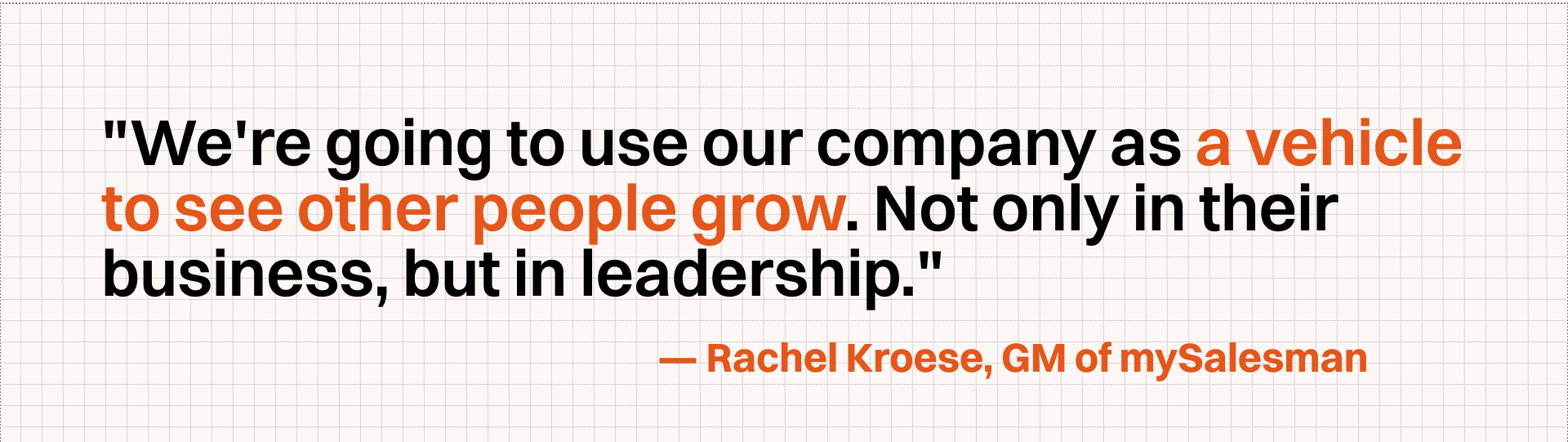
"We're going to use our company as a vehicle to see other people grow," says Kroese. "Not only in their business, but in leadership."
That's the long game. And it's one that Kroese believes more contractors in the trades are ready to play — especially the next generation coming in, who grew up expecting transparency, technology, and something worth working toward.
The businesses that have built real systems around their people, their processes, and their pipeline are the ones that will be standing when the field thins out.
Curious how ArcSite can help you run your fence business more efficiently? Click here to chat with our team.