How Straight Line Construction Increased Close Rates by 15% with ArcSite

Patrick Harmsen - Director of Sales Operations at Straight Line Construction Co
[0:00] [Cold open quote]"Being able to show a really clean, professional report back to that customer — we've seen as much as a 15% increase in our close rate on those jobs."
[0:23]Interviewer: All right, so Patrick, we'll start off nice and easy. Can you just introduce yourself with your name and your title?
Patrick: My name is Patrick. I'm the Director of Sales Operations for Straight Line Construction and RAM Jack companies.
Interviewer: Awesome. So tell me a little bit about your role. What do you do over at Straight Line?
Patrick: I have several roles. Director of Sales Operations — my main thing is I oversee all of our computer systems. Whether it is our full ERP system, anything where our CRM is set up in the system, where our sales reps are going to use that data to go out, run their appointments, come back, and then building any orders, tracking that, putting everything into the system. Our entire sales process, from start to finish. I manage all those systems, as well as working with our call center representatives. And I support — we're in three different states, so I support most of the technical training and sales training and systems training for all of our locations.
[1:27]Interviewer: Give me a quick overview about Straight Line Construction. I was looking at your website before this — saw you guys, like you said, are in a couple of different states. So give me a rundown for folks that might not know much about you.
Patrick: The elevator speech is we are family owned and operated. We started back in 1982 in southern Colorado. The current owner's father started with a couple of individuals, and then he took it on by himself and built it into the company that it is today. About 10 years ago, Tim took over for his dad, and with his wife Lauren, they run the current company that we have today. So we're, like I mentioned, in three different states. We've got five locations, but we specialize in foundation repair. Our reps are going to go out, they're going to meet with homeowners, they're going to review whatever damage or anything that they're seeing in their house. At the time, we'll put together proposals and offer them some solutions, and then our crews are going to go out and do that work if the customer decides to go with us.
We do quite a bit of commercial work as well. We've been on some really high-profile projects — from completely underpinning the Wyoming State Capitol, to putting in micro piles on top of Pikes Peak, where they have a large observation center and they've got these big decks that stretch out over the side of the mountain. We were up there for about two, three years putting micro piles in so that they could build those decks in a massive renovation that they did. And those are just some of the big projects that we've done.
[3:13]Interviewer: I want to talk about your background a little bit. I was doing a little bit of research on you before we spoke here today, and saw that you've kind of had an interesting journey into your role. Can you just tell me about your background a bit?
Patrick: Yes — born and raised in Colorado, went to school down in southern Colorado at Western State. I got into sports nutrition for a time, left that, went into mortgages, did that for eight years. Met some really great people and learned quite a bit in the mortgage industry. And as we all know, the industry changes — it goes up and down. A friend of mine was working for one of the telecommunications companies here in Colorado and said he knew of an open position. So I decided to change careers and worked for Qwest for quite some time. They were bought out by CenturyLink. I ran a large channel there, worked with systems and everything, and worked with all those master agents. Then I jumped to a company — it was kind of a partner we worked with at Qwest — that was an online aggregator. They sold TV, phone, and internet services through their platform.
I left and did some home sales for just a little bit. That's where I kind of started getting back into construction — learned quite a bit being on site for home sales. I was fortunate enough to see the house from the contract phase all the way to where we broke ground, built the foundation, framed up the house, all the way to where we walked the customers through and handed them their key when we closed that sale. While I was doing that, I ran into a friend from the mortgage industry who introduced me to Tim and Lauren. They needed some sales reps here in the Denver area. In home sales I had to work weekends, and getting into foundation repair work, I got my weekends back — so that was one of the reasons why I jumped in there.
So I was out in the field, running appointments for the first few years. I started taking on some leadership roles, and it was just a natural transition to where I moved in as sales manager. And then we made a decision to build out our own ERP system, so I was kind of the likely candidate to lead that particular initiative. Over the last five, six years we've built out our own system. We brought in another gentleman to be the sales manager, and that's actually the person who worked with the initial ArcSite representatives when we first took that on. For the last six, seven years, I've been doing primarily all of our systems — got our call center built out and launched, built all of our systems, the entire CRM process, all the way through.
[6:29]Interviewer: You mentioned you've been kind of overseeing the ArcSite implementation throughout Straight Line. So I want to rewind a little bit and talk about what was your workflow system like before you found ArcSite?
Patrick: So it was very archaic. We would go out to the customer's home with some graph paper and a pencil and tape measure. We needed pretty — not exact measurements — we needed within a few inches. We need to know the dimensions of the house, so that we know where to put the piers or any other type of elements that we're going to install in the house to repair that foundation. We need to know the exact dimensions of that particular house. Without having a system at that time, we were basically just using sketch pads and paper. We even had one guy who would just take a blank white sheet, draw a nice little square, and then just write the dimensions on there — so it wasn't to scale or anything. We had some guys that would take it to another level and had colored pencils, and they would do shading. Something we were spending, at times, you know, an extra half an hour to an hour just getting a drawing together, before we even started putting any numbers or anything into our systems to build out a quote.
We had looked at a couple of other systems to do some two-dimensional drawings to sketch out a house, but they were only used on a computer — desktop or laptop. It wasn't something that you could use in the field. And they were very, very rigid. Just trying to draw a straight line and get the corners to match up properly was a challenge in itself. And then if you wanted to put where the power comes into the house, put any bushes that could be in the way, where the driveway was set up — getting everything to scale was a great challenge. So for years, we were looking for alternatives and had tried a couple of different things.
[8:57]Interviewer: Tell me about how you actually found and discovered ArcSite. What interested you when you first found the tool?
Patrick: I don't recall exactly what the initial interaction was. I think it had to do with seeing something on LinkedIn, and it piqued my interest, so I started — I went onto the website, started looking at the different things that ArcSite would offer, to see whether or not it was going to be a good fit. And when I found that you could draw a straight line in the field with a tablet or something like that — I was all in. But from that point, we had to build a business case and present to the owner. So I got together with our sales manager, and the two of us started doing our own research. I think it was 2020 when we first jumped in with ArcSite — we were kind of early adopters. It was a match made in heaven for us.
We had gone as far as to print graph paper with 10-to-1 scale and putting our logos and stuff on it, just to try to be a little bit more professional. And the very first ArcSite drawing that we put out was 10 times better than anything that we had ever hand drawn. So it was a big win for us. The initial conversations we were having was just to give our guys a way to draw a digital diagram in the field and be able to present something back to the customer that was legible and professional. The cost wasn't extravagant or anything like that — it definitely fit well with our scale and size. Our initial purchase was for roughly five to six user seats on top of the admins to get our residential field staff armed with ArcSite. We had another initial small investment to get some iPads to outfit the guys so that they had something to go out to the customer with.
[11:13]Interviewer: Talk to me about the implementation process as well as the business case that you built.
Patrick: We're just large enough that we have some mid-level managers that could put something together and present it to Tim and Lauren, the owners of our company, to see if it was something that they would welcome — and if, financially, it fit into our model. Once we got a small quote from the onset and were able to show what we could actually do with it — I think both Ryan and myself got a test account. So I was able to load it onto my personal iPad and do a couple of drawings and sketches, just to kind of show Tim and Lauren, first off, what it could do. And just being a novice, it was pretty user friendly — I was able to draw my personal townhome and get everything put together. From there, we looked at how many sales reps we had, what the subscription costs were going to be, if there was any additional cost to having administrators be able to access that. It was a really easy business case to write, and Tim and Lauren were on board.
Once we made that commitment and signed the initial agreement, it was a pretty quick and fast process to get us on board. Initially we were just doing simple sketches, but then we soon realized there were so many more capabilities. Our sales manager Ryan took it to a whole another level over the course of the next six months, and completely changed our sales process at that point.
[13:20]Interviewer: Are you able to speak to that a little bit? Just tell me about how you kind of wove it through your sales process.
Patrick: So initially, what we would do is our sales reps would knock on the door, introduce themselves to the customer, and they would walk around the house — and that part still kind of holds true today. But from there, they would go out and start sketching the house and start photographing the property. It was all done with pencil and graph paper at that time. And then once you came back into the house, we pretty much ended the sales process there. We would talk next steps. Say, "Hey, I got to put all this information back into my system, and I will be in contact within a couple of days with a quote or next steps."
Once we found that ArcSite actually gave us the ability to do some one-call closes and do some quoting in the house, it was something that Ryan jumped on. So he started building out all the different shapes in the system — our services turning into shapes so you could quickly drag and drop them onto the ArcSite drawing. We do, on top of doing the foundation repair, some concrete lifting. Whether it's driveways, garages, sidewalks — that type of thing. It was easy to actually drop in the service and put in the square footage. Some of the stem wall repair we do is just a linear foot. So there were a lot of different options in ArcSite that allowed us to kind of build out our products into the system.
Some of our sales process requires involvement from a third-party engineer, so we're not able to quote everything in the house. But for the simple stuff — concrete lifting, stem wall repair, drainage and grading improvements — we were able to build a quote in the house and present that to the customer before we left. So it took away that extra step of always having to go back and present something. For customers who are eager to sign a quote, and to help compete against competitors that might come right in the door after us — it gave us the ability to present pricing and potentially get that job closed right then and there.
[15:54]Interviewer: Have you guys noticed any change in those close ratio metrics, or any of your business metrics, because you're able to do that close on site?
Patrick: The initial close percentage went up a few points. But what ArcSite allowed us to do — we took it to a whole another level. So when it came to the simple stuff and being able to close in the house, we probably got a 3 to 4%, maybe even as much as 5% increase, because we were closing there in the house. Especially one of our guys in southern Colorado — he does a ton of mud jacking. He's seen as many as 400 to 500 customers in a year. He can get those quotes out before he even leaves the house and see if he can close those. He closes several hundred throughout the year, and those quotes can average from $1,000 to $5,000 on a simple mud jacking job. So it definitely helped him to be more successful.
[16:49]Interviewer: I want to shift gears a tiny bit and also go back to talking about implementation and onboarding. You mentioned that initial onboarding process when you built the business case, but now when you bring on new reps, what is that training and onboarding process like now that you have ArcSite in your workflow?
Patrick: The individual reps — we put them through some internal training. We've got our standard introductory training that we're going to walk those guys through — history of the company, what foundation repair is, starting to introduce them to the terminology that comes with our industry. Helical piers, micropiles, all those jargon-type terms. Then we're going to get them into systems training, and that's where I do a good portion of it — teaching them our internal ERP system and walking them through how to manage their contacts in the CRM portion, how to build a quote out, how to produce that service quote and send it out to the customer.
We kind of use a team effort with the sales people out in the field. We do some on-the-job training, where we'll send that new sales rep out with the existing salesman, and they'll actually get a chance to share their tips and tricks on how they use ArcSite. Part of the initial training is to have those new sales reps go out several times with our current reps, and they take on that data gathering phase. So they'll start using ArcSite, they'll do the drawings, and then they've got somebody there who can give them real-time feedback. They can use the product before they're actually having to think about all the other sales activities. They also go out with our technicians, who are probably the best users of ArcSite, because that's all they do.
[19:33]Interviewer: I want to shift gears now a tiny bit and talk about some of those business impact type questions. Walk me through a top-line overview — about how much revenue do you all do per year, and have you noticed any shifts in P&L or revenue since you've brought ArcSite on board?
Patrick: Well, because some of our competitors might see this, I will keep it kind of vague. Since we've started using ArcSite, coming off of the COVID years, we were building on our business. We've seen 100% increase, 200% increase in our Arizona markets. In Denver, we've increased by over 100% coming off of COVID. We saw a huge jump, and we did a lot in marketing that really helped to drive some of those new leads coming in. But the benefit with our systems — getting our ERP system and everything in one place, and then using a tool like ArcSite — has enabled us to scale for that increase in customers. The number of appointments that we're seeing — we built our sales team from roughly four people when I first started, to as many as 10 sales reps. We've got nine currently out in the field. We've been able to scale up without hiring a whole bunch of management staff or support staff, because the tools that we have in place today — with ArcSite and with our ERP system — have been able to really take on the additional customer base.
[21:34]Interviewer: I know you guys do both residential and commercial work. For the commercial side of things, how has ArcSite factored in to getting in the door with those bigger players and closing those deals?
Patrick: The commercial side of our business currently doesn't use ArcSite a lot, and it's not that the tool doesn't work for us — it's the nature of that type of business. In a residential setting, a customer sees cracks in their house or notices some damage, they call us, and we start the process from scratch. That's where ArcSite really comes into play, because we're documenting the house from scratch. In the commercial world, usually somebody has already gone out and done all that work, and they're coming in and saying, "Here's the repair that we need — can you guys do it?" We've already got drawings, we've already got engineering plans.
For some of the simpler commercial jobs — poly foam work, concrete lifting, stem wall repair, drainage repair — we actually do have some of our commercial guys use ArcSite to do those drawings. We've done several apartment complexes that needed concrete work done, and we draw those in ArcSite. We'll have a strip mall where the sidewalks out front are down and need some work. It gives us a nice, professional drawing that we can go back to either an HOA, a property management company — we can put together really clean report stuff in those cases.
[23:44]Interviewer: In terms of those P&L type questions — have you noticed any change to your average contract value or average contract size in dollar value?
Patrick: Absolutely. We've seen probably a 25% increase in the average sale. And it's also not only giving us more money on those jobs — like I mentioned, getting out to see more customers. Guys are more efficient. Instead of one of our sales reps running himself ragged to try to get out to all these different houses and then come back and spend two, three days in the office trying to get his bids together and his bids out — he can actually spend more time seeing more customers because he's not spending as much time in his home office. Our guys are more efficient. They're not having to work as many overtime hours. They're still making good revenue because they're seeing just as many, if not maybe a 10% increase in customers, without having to spend a whole bunch more time.
[25:24]Interviewer: That's huge, because you're out there in the field, you've done a bunch of visits all day long, and then you come back to your home office and it's almost like another day's shift on top of the work you've already done. That actually brings up something — you talked about onboarding and stuff. Tell me about what that looked like with some of the more hesitant reps.
Patrick: So when we first rolled ArcSite out and gave it to some of our reps, we've got some guys that are really savvy and they're willing to try anything and everything — any new toy or tech gadget or something, they're all over it. We've got guys on the other side of the spectrum where, aside from using their cell phone and a basic laptop, they're not really getting into much of that kind of stuff. So they were very hesitant when we first rolled ArcSite out. Those first couple of drawings — I got the pushback. "Oh my gosh, this takes me forever. I'm gonna spend all this time and I'm not selling." But those same guys now are our top salesmen. The guys who are actually less tech-savvy are the best salesmen that you have. And those guys will call me and they'll have a small little question, a tweak here or there — but they're the ones that are doing ArcSite drawings, and they're the ones that are quoting in ArcSite and doing those closes inside the house.
They found that with just a small ramp-up in learning the navigation through ArcSite and the different menus, it's actually really user friendly. It makes a lot of sense. They're able to actually do drawings faster than they could on their paper drawings and then go back and try to put everything in the system. They can get more bids out now, even though they're not as tech savvy. And they let me know every time something changes, because it changes up their process. But that's another good thing about ArcSite — they don't make a lot of changes that really hamper the ability to do the drawings. Anything that's been put in has been an enhancement — nothing's been taken away.
[27:39]Interviewer: If I had to ask you what dollar value impact ArcSite has had on your business, what would you say?
Patrick: I can't give you an exact dollar amount, but I can tell you — our business has seen sales guys who used to be in that million-dollar range in sales, and some of those guys have as much as doubled that. They've been able to accomplish a significant amount more. And the tools and stuff that we have today — we've even got some additional enhancements that we're looking at that could potentially help kick that up another percent or two. Because if anything, the market is getting more competitive. We've seen some major players from across the country come into our markets and snatch up some of the small mom-and-pop foundation repair companies. So we've got these big behemoths spending all these different marketing dollars and getting celebrity endorsements. It's only getting tougher when it comes to the marketing aspect of it. So anything we can do to make it easier for the guys to sell is definitely going to help us combat that.
[29:11]Interviewer: Looking forward over the next five or ten years, what are you looking to do to remain competitive and maintain your competitive advantage?
Patrick: We've got a couple of things internally. Our ERP system was built out on more of a static, on-server type program, and Microsoft has moved those to the cloud. So we're putting in the work right now to upgrade and automate our system — it's going to give us some additional capabilities. There's some integration stuff where we can pass information back, potentially through Zapier and different programs like that, to where instead of having to key everything into ArcSite with customer name and address, we may actually be able to build out some integration. I'm looking forward to that.
You know, marketing is going to be a big part of it. AI is definitely impacting our industry — not from the actual repair itself; piers, how you install them, that's pretty straightforward. But systems-wise, we're looking forward to some of the future enhancements with ArcSite.
[31:02]Interviewer: On a more personal note — if you were to give advice to somebody that's up and coming in the foundation repair industry, or somebody who's looking to get into a role like your own, what advice would you give them?
Patrick: If you're planning on starting a company, I would probably try to coach you against it — just as competitive as the market has gotten. It's a fascinating industry. One thing that I really love about this is you're not trying to sell, you know, puppies or flowers or anything like that. This is stuff that people truly need. And oftentimes, if we're working on their house, it's most of the time their biggest asset. Being able to go in and either recover a foundation that's settled, or be able to stabilize a house in place to stave off any future damage — even help them put their house in a position where they can do additions or enhancements — that's really rewarding.
Somebody that's going to get into sales: make sure you understand as much about the customer and about their homes as you possibly can. The more you can understand about that house, the better off you're going to be. Putting together those presentations, being able to understand how the house is constructed — I had a lot of advantages being with the home builder for a while and actually getting to see where they dug the hole and started with the footings and put in the foundation walls and started framing. Being able to see the entire process really helps you to understand how to repair those homes. Do your research. Make sure you understand as much about the home. It's not just about selling — there's a lot to this industry. Even today, coming up on my 11-year anniversary, I still learn new things almost every day. I go out to houses and see stuff I've never seen before.
[35:00]Interviewer: (Discussion continues on commercial work — the film studio / boat manufacturing plant conversion project)
Patrick: The project was an old boat manufacturing plant that was repurposed into a new film studio. They needed to take out some of the middle supports, raise the roof, and added additional loads onto a lot of the existing structure. We went in and put in miles and miles of piers underneath this place, and installed helical piers — one of the first times it was approved because of the nature of the system and how well they do in a deep foundation repair or new construction project like that.
Straight Line started with doing simple mud jacking and foundation repair work, and they started using piers by another company, but then partnered — I want to say it was the late 80s — with RAM Jack and became the distributor for southern Colorado. Then took over northern Colorado. Around 2014, there was another RAM Jack dealer up here, but Tim and Lauren took over that particular part of the country. They also took over Arizona when one of the other Arizona reps moved on, and then they started from scratch: RAM Jack New Mexico. So we've got those three different states. For residential, we pretty much have those territories where we're the only one who can install RAM Jack piers in those places.
[39:12]Interviewer: Well, Patrick, I think that wraps up all my questions for you. Is there anything else that we didn't talk about that you'd like to add?
Patrick: No — I couldn't say enough good things about ArcSite. It's exceeded our expectations. Like I said, from when we first started looking for just a drafting program, it offered so much more. We got really excited once we got it implemented — our sales manager took the time and built in all of the different products so that we could actually do some quoting in the house. And then, like I said, we continue to work with the ArcSite team to give us some additional enhancements that really help our business — giving us some new features on the maps. They're always trying to improve the product. I couldn't say enough good things about the team with ArcSite.
About Straightline Construction
Industry: Foundation Repair
ArcSite customer since 2020
Headcount: 125-150
Locations: Colorado, Arizona & New Mexico
Their Story: Founded in 1982 in southern Colorado, Straight Line Construction is a family-owned foundation repair company now run by Tim and his wife, Lauren — the second generation to lead it. Tim started working for his dad at age 12 and has never known another employer. Today, the company operates five locations across three states, handles everything from residential pier installation to high-profile commercial projects like underpinning the Wyoming State Capitol and installing micro piles atop Pikes Peak.
The Impact
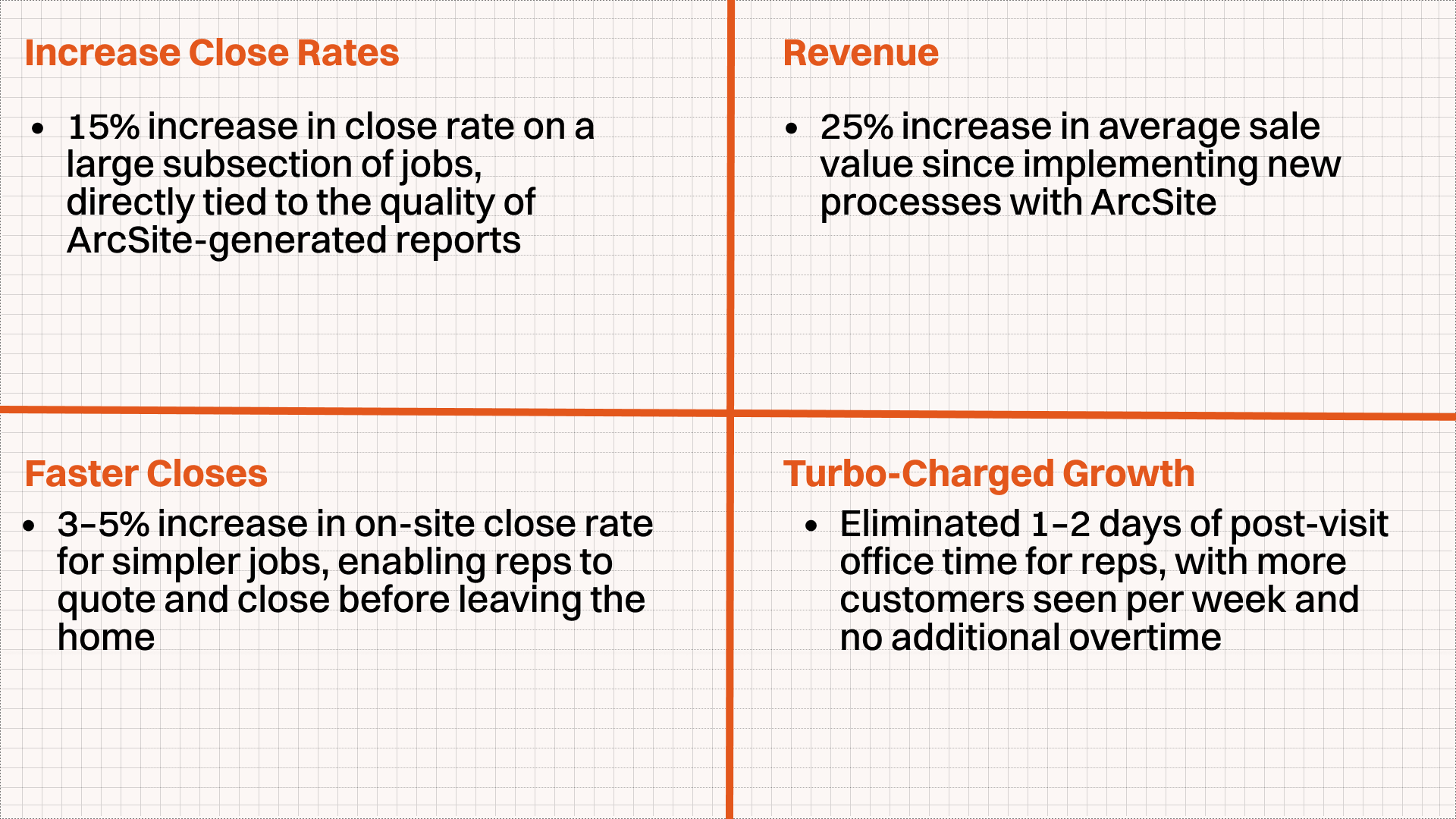
- 15% increase in the close rate of new jobs, directly tied to the quality of ArcSite-generated reports
- 25% increase in average sale value since implementing new processes in ArcSite
- 3–5% increase in on-site close rate for simpler jobs, enabling reps to quote and close before leaving the home
- Eliminated 1–2 days of post-visit office time for reps, with more customers seen per week and no additional overtime
How the Business Started
Straight Line Construction has been around since 1982, but it almost looks like a different company today. What began in southern Colorado with a small crew has grown into a multi-state operation with five locations and a reputation for handling some of the most demanding foundation and structural work in the region — including underpinning the Wyoming State Capitol and a multi-year project installing micro piles at the Pikes Peak summit observation center.
Patrick Harmsen, the Director of Sales Operations, has been with Straight Line for several years — starting as a sales rep, moving into sales management, and eventually taking on oversight of the company's full technology stack, including their custom-built ERP system, CRM, call center operations, and estimating tools across all three states. It was Patrick who found ArcSite. And it changed the way the company sells.
The Challenge
Before ArcSite, Straight Line's estimating process was, in Patrick's own words, "very archaic." Reps would show up to a homeowner's property with graph paper, a pencil, and a tape measure. Some drew a basic square with dimensions written next to it. Others went further: colored pencils, shading, half an hour of effort just to get a drawing together before even starting to build a quote. One approach was branded graph paper printed with a 10:1 scale and the Straight Line logo — an attempt to look more professional using paper tools.
None of it worked at scale. Foundation repair is a technical, high-stakes sale. Homeowners are being asked to spend significant money on work they can't see and don't fully understand. Without a clear, credible visual, closing that sale was an uphill battle.
The team had looked at other software before. But the desktop-only tools they evaluated were rigid, hard to use in the field, and couldn't handle the detail foundation repair actually requires — where the furnace sits, where the crawl space access is, which walls might block a pier installation. Getting everything to scale was a challenge in itself. They needed something built for the field.
The Solution
Patrick first came across ArcSite through LinkedIn. Further research confirmed what he suspected: this was something Straight Line could actually use.
"I found that you could draw a straight line in the field with a tablet — I was all in. It was 10 times better than anything we had ever hand-drawn."
He and the sales manager built a business case for the owner and got approval. They started with five to six user seats for the residential field team.
What unlocked real value was ArcSite's ability to build quotes in the field. The sales manager took the time to configure most of Straight Line's service catalogue into ArcSite — services turned into drag-and-drop shapes with pricing tied directly to measurements. The workflow was rebuilt so that for simpler jobs, reps could draw the site, build a quote, and present pricing before they ever left the house.
The bigger win came through the professionalism and efficiency ArcSite brought to the inspection process. Instead of spending an additional 30+ minutes back at the office recreating rough field sketches into clean customer-ready drawings, the team is able to build polished, accurate diagrams during the appointment itself. Those detailed drawings — including the home perimeter, interior walls, fixtures, and site conditions that may impact design or pricing — become the foundation for a clear, professional report the sales rep can review with the homeowner.
"We couldn't do that before ArcSite. It would have taken way too long to try to put something like that together, not to mention the scale."
The drawings also go beyond the homeowner. Straight Line shares ArcSite-generated CAD files directly with the third-party engineers who review plans and approve building permits. A tool that started as a field sketching solution became load-bearing infrastructure for the company's entire sales and project workflow.
The Results
When their processes with ArcSite became standard practice, close rates on those jobs jumped 15%. Average sale value increased 25%. And reps who previously spent one to two days a week doing post-visit office work started spending that time in front of customers instead.
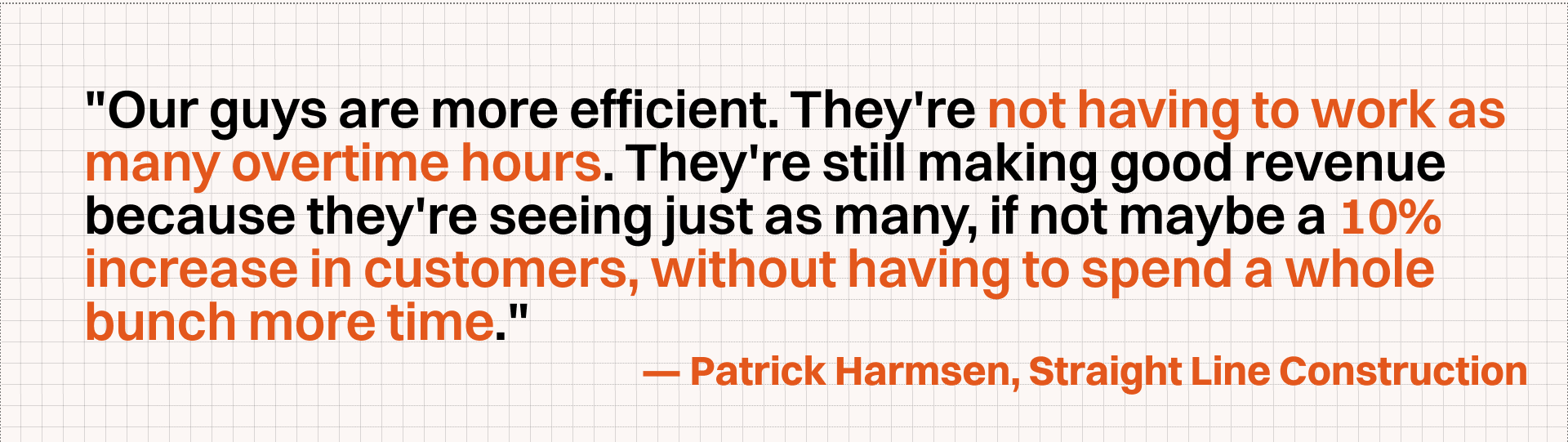
"Our guys are more efficient. They're not having to work as many overtime hours. They're still making good revenue because they're seeing just as many, if not maybe a 10% increase in customers, without having to spend a whole bunch more time."
The adoption story is one Patrick tells with some amusement now. The reps who resisted ArcSite hardest at first — the ones who complained it would take too long, that they weren't getting paid to draw — are now top performers. Once the ramp-up was behind them, they found that drawing in ArcSite was faster than doing it on paper and re-entering everything into a separate system. More bids out. Better bids. Same hours.
What's Next
Straight Line is actively working with the ArcSite team to build enhancements directly into the platform — eliminating the need to move data between multiple systems. With this new depth to our integrated partnership, it will reduce the number of people who need to touch each job, speed up report turnaround, and put polished survey reports in the sales rep's hands faster.
For Patrick, the lesson is straightforward: if your field team is still working off paper, you're leaving money on the table every single day.
See other stories