[00:00]
But we increased our contract value from $10,000 to literally $18,500 that year. Right. So it almost doubled our contract value just being able to, you know, include those other, products at scale because of ArcSite. All right, well, we'll start off nice and easy. Can you just introduce yourself with your name and title? Yeah. My name is Alex Jolley, and I am, co-founder and CRO of FRDM Turf. Awesome. So tell me about FRDM Turf. How did you guys get started? And, what does the business do? My business partner and I have been actually friends since about the sixth grade. We've been playing on our, you know, basketball team together. We went separate ways. He went off to, you know, play at the University of Hawaii. I got into actually, direct sales, you know, building up sales teams. And in our later years, about 2021, 2022, we came back together, became, pretty close again. And I was actually at a family party, and at this time I was in the solar industry, but I was at a family party, and my aunt and uncle told me they were getting artificial grass. Right. There was a bill passed in Salt Lake House Bill 242 that they were going to be increasing everybody's water rates and measuring the external water. Right, because of
[01:30]
all the water crisis. So I was I was like, well, what turf?! I thought that was football fields. So I told Max about it. He went crazy as well on it. He was like, dude, we got to do this. Like, I was already kind of looking into this for maybe my backyard because my pet. So we looked into the technology. It was amazing. So we we started off as artificial turf, right? Through that, we actually scaled out where we do a lot more hardscape and just more, you know, outdoor living. And that was a huge, huge reason that we love ArcSite is, because it opens up our product offering. Right. But, yeah, that's how we started. It was literally just, you know, my aunt and uncle saying something, and, it was just something that Max and I fell absolutely in love with, with, artificial turf and sustainable landscaping. So that's awesome. It's always those like, serendipitous moments, and then, boom, you've got this business. Now that, like, is a huge part of your life, I love it. I guess just walk me through the size of the company. Obviously it started off started off small with this like seed of an idea. So tell me about how you guys have grown over the years. Yeah. So it started as a side hustle. Max was in the tech industry. I was in solar. Right. And, we just do it on the weekends on the side towards the end of 2022. We won our first big project in the early 2023, and we decided to burn the bridges. That year, we did 2.1. Million
[03:00]
in revenue. We just went as as hard as humanly possible. My my hairline shows it right. $2.1M and then we went $6.7M and opened up, Saint George, which is southern Utah. And, this last year for $14.2 million, and we opened up Denver and then just recently opened up Phoenix. So it's just it's it's it's taken off. It's it's done really good. It's grown pretty quick. That's awesome. How many employees do you guys have overall? So we have a different, model where we actually use 1099 sales reps, where we pay a piece rate as well as we, you know, we have some W2 crews, but majority is actually subcontract labor. Subcontract crews that get paid on a piece rate. Right. So we we see ourselves as almost a platform where we control the materials that are going there and the design and a lot of the project management. And then we help both the the entrepreneurs, the sales reps and the, the installers, in a platform-like model. So, we have probably 40 plus sales representatives, and, you know, anywhere from 45 to 50, you know, even more, you know, some labor subcontractors and internally, W2, I think we have 15 or 16. We just have a couple more, just starting. So, yeah. That's great. I mean, honestly, that kind of like model is great for small
[04:30]
businesses because you're not having to have like a fixed amount of overhead and just has a little bit less. It's already a lot of pressure running a business, it’s just a little less pressure. It's crazy. And landscaping and turf, especially in Denver and in, you know, Denver and Salt Lake being our biggest markets is, you know, there's snow right? No, no work during that that time. So it helps with the seasonality where, you know, we can we can have that type of model. Absolutely. So you just mentioned that obviously you guys have had massive growth over the last couple of years. So walk me through what a typical day looks like for you in running this business. Yeah. So typical day typically starts out about 8 or 9. Where I'm, I'm, I'm actually on the sales-marketing side. We've kind of separated where, my, my business partner is, is running a lot of the installation teams. I run the sales and marketing. And so, it starts about 8 or 9 and it's a lot of check ins. We have our, you know, our marketing huddle where we look at our lead generation. Exactly what our, what what has come in, what has been scheduled, what has been closed, by our sales representatives. You know, other than that, I, I'm in a lot of recruiting meetings where you know, sales representatives come in and meet with me, and I recruit them to come work for us. Then we have a, you know, a couple little operation huddles just
[06:00]
to make sure that we're on track on all of our projects, because sometimes we could have, you know, right now, you know, we don't have as many projects going on, maybe ten or so, at a time. But, you know, during the busy season, March, April, May, we could have 30 plus. And we want to make sure that we have all eyes, that we have those, you know, check ins with the foreman team, with the project coordinators, just to make sure all of the logistics are going good. Then all the on site management, is going good. So typically, you know, afternoons is a lot of operations in the mornings is a lot of sales and marketing. Right. That's great. How did you guys sort of decide, like as your business grew like what responsibilities were going to, you know, live on your plate versus your, your business partners plate? Because that's always tricky when you're starting off. You're kind of wanting to do everything. And then it's really important to like let go of certain things in order to be able to focus on what you're really, really good at. Yeah, it's it's actually super funny, that you bring that up. So we found four arenas in our, our business. So we have marketing, we have sales, right. And we see those as two distinct, very different, you know, sectors of our business. So marketing, sales, project management or project coordination, right. All the preliminary stuff, all the back end, you know, things that go into the logistics, you know, scheduling all that and then installation.
[07:31]
Right. And site management. Those are the four sectors of our business. So it was pretty funny at the beginning because both me and my business partner wanted to be on the fun side. We call sales and marketing the fun side of the business right. So I was over marketing and install and he was over project, coordination and, sales, and we were failing miserably at that. It was funny because we have different skill sets. I have no attention to detail whatsoever. I like to move fast. I like to, you know, move loud. I'm very much a brand guy, right? I'm a I'm a sales person. I'm just a, you know, salesperson that got lucky. I always say that. Right. So me, managing install crews? Bad idea. Bad idea. It was funny because my business partner is the exact opposite. It's perfect. Yin and yang. How we work out together. He's attention to detail, down to the key. Like he'll go to a job site and point out something that the customer didn't even notice, like, hey, we need a fix, you know? And that's that's what we needed to, to keep our quality super high. So we realized, okay, hey, I know that that's not fun, but you are operations. I am the sales and marketing. Let's go there. And that's when it just clicked, right? It finally clicked. And we realized how amazing of an operations, engine that that my business partner Max, created. Well, and is continuing to create and then, same with, you know, me on the sales and marketing side that we were just playing our right
[09:02]
roles. But it's funny that you bring that up. It reminded me of so many different funny stories of like, just just funny stories about me on the install side or just not not pretty. So that's great. Honestly, it's about it's that learning process, right? You started a business. Nobody there's no handbook on. Here's how you become an entrepreneur and run your business. It’s all about just like learning on the fly. So it's really cool that you got to figure out what works for the both of you and, you know, really getting those lanes to define success. I want to shift gears now a little bit and talk about, your workflows before you found ArcSite. Can you talk me through what that was like? Yeah. So we use this satellite imagery, software. Software that, it takes every three months and we actually still utilize it and, upload it onto ArcSite. But it, it takes satellite updated satellite imagery every three months and is about 97% accuracy or accuracy on the square footage. So you can measure out yards really easily. So, we use that and we use just different color codes, to, to, to be able to just put our, products together. It was a huge mess. Right on top of that. The reason that Arcsite...well, I'll get into the solution that ArcSite brought, but we had our sales representatives, putting in every single product, manually. And we do not have set pricing either.
[10:32]
We, we base it on, like, a gross margin percentage of what you get paid on your commissions. So they had to, you know, memorize, you know, 30 plus products that that year. I think it was it was 2024 when we first had our, our sales rep, reps go on. And they had to memorize all those base lines of like, hey, you cannot charge under this. It was just a mess. And my business model is a lot different than most landscaping companies. Whereas we like about 70% of our business is won same day. We call them one touches. Right. So we go in, we pre frame that we are going to show them a price. And we're going to get them, to the finish line that day and close our project. That's, that's one of our big differentiators is we actually you know we go quick. We go fast. We create a really cool customer experience. So it was a mess. It was an absolute mess. You know, I had so many reps, you know, mess it up where we have unprofitable jobs because it wasn't a set price, where it was just a messy, messy thing with the CAD rendering. So, you know, installers would mess up on the installation side, and there was no way, absolutely no way that we'd be able to expand our contract value, through other products without a new solution. So in 2024. This is funny. I actually found the ArcSite in early 2024 and used it myself before any of my, my,
[12:03]
any of my sales reps used it. And anybody in our entire company. And I loved it. But we were just too busy to to really go all in on it. And we looked at some other things. We actually put ArcSite to the side and decided to go with another solution. And that solution failed. Going into 2020. Wait, let's see. 2023 2024. Sorry, that failed going into 2025 into this last year. Okay. And then we decided, you know, I decided to get back on the floor with Alex, which at the time he was, I think he was the VP of sales, over at ArcSite. And he showed me some of the tool, and I said, no, we got to burn all the bridges. And right before our, our SKO our sales kick off, I literally just, you know, pulled an audible and I said, we're going all in on ArcSite. The cool part about ArcSite, on the flip side of our messy, confusing system is ArcSite--all the sales rep needs to focus on is getting the measurements, designing the backyard, which is way more, you know, capture like cultivating. And it's just a better experience for the customer because they can see the different colors, they can see their yard come to life. But the biggest thing is, is they don't have to memorize all the pricing. So I was able to add, you know, some of our, our, markets have up to 118 different products, and
[13:33]
none of my...so that we could scale actually. We could it it finally took that bottleneck out of the way so that we could scale, those different products. And we actually increased from the time that we put on ArcSite, which I know that ArcSite doesn't talk about this. They should talk about this a lot more on the landscape side. But we increased our contract value from $10,000 to literally $18,500 that year. Right. So it almost doubled our contract value just being able to, you know, include those other, products at scale because of ArcSite. So that was the big thing is we could have that price book, that product catalog that controlled our margin. We had way more profitable jobs, a lot less mistakes. But the biggest thing is we could scale more products, inside of ArcSite. That's awesome. We're taking notes. We love to hear this. We love to hear from our customers. What resonated and what, you know, allowed you guys to be successful. So we love stuff like that. How about see, like, implementation process for you? Because I know that you said you used it first by yourself. And then obviously there's the process of, like, rolling it out to the team. So what was that, process like for you? Yeah. Maybe you don't want me to tell you this, so I, like I said, going into 2025, I just pulled an audible. We didn't have any tool. I did not want to use our old solution because we had so many more sales reps coming on. We wanted to scale these different products. So I just said, hey, we're going all in on ArcSite. And, I shared
[15:04]
ArcSite with the team, some of my top sales reps. They literally came to me because nobody likes change, right? And, they came to me, they're like, oh, I hate ArcSite. This thing sucks. Whatever, you know? And I said, hey, just give it a month, just give it a month. And then I called, Patrick over at ArcSite and I said, dude, we need to get everybody sold on this. Like, I need your help. There was a couple other, employees over at ArcSite that I was just, Hey, I need you to help. Come, come just get by in. And the cool part about that is they were able to drop everything. So they were able to drop everything and really pay attention to the needs of my team and take a lot of time, you know, two plus hours sometimes on these trainings to make sure those core group of sales leaders that I had understood the value of, ArcSite. And now, you know, I actually use this all the time whenever I'm making changes in our systems and flows, I'm like, remember ArcSite? Just trust me. Okay.
[16:08]
So just I want to emphasize this point on ArcSite, is I, as a business owner, I have to evaluate so many different softwares. Right? We're in the technology age where you cannot get away from utilizing technology in home services. I've been very disappointed. Me and my business, partner had this thing. It's everything that is told to you on a demo is 30 to 40% worse. Just...and if it's good enough, then we’ll move forward. That was different with ArcSite because of the customer care. Most software companies rely on their product, but not on their customer service, and that's why they fail. Whereas ArcSite, they actually take care of their customers. They actually go above and beyond and make sure that everything's, communicated. One last story on on the implementation. We just changed our, our CRM over to Service Titan. From our, our, I think it was monday.com that we're using before. And same thing is we've now been customers for a while of ArcSite and majority of softwares would just leave you hanging in the dust right. You know, our account manager, our new account manager was, is just so on top of making sure that ArcSite is communicating, you know, exactly how we want it to be with, Service Titan, but also with some of our other, like, canvasing softwares, just just different
[17:38]
like top of funnel softwares to make sure the data just runs smoothly. So that's the cool part is like it's a, it's a company that doesn't forget about you in software companies always forget about their customers. That's just unfortunately that's like the untold story of software. So yeah. Exactly. The unsaid thing is that every software or technology business is at its core, a people business, because that is who your software or technology is serving on the other end. And it's the most important thing if you don't have the, you know, goodwill of your customers, you don't really have anything. So that's always really good to hear. You can have the most amazing product in the world, but if you do not have the catalysts of of great customer care and service to make sure that those people understand the software, you will never retain customers. And that's why we absolutely love the ArcSite is because they helped us and they really retained us, right? They retained us by teaching us and making sure that we were completely, aware of any type of change, or, you know, process for anything that we even asked. They at least going to attempt to make sure it's true for us. Right? So yeah. Absolutely. So speaking of the ArcSite usage, can you walk me through, I guess, for maybe other hardscape or turf businesses that might be listening to this. Like, what does your workflow look like inside of ArcSite? If I were to be like a fly on the wall while a rep is working through the process. Yeah, yeah. So first off
[19:08]
is, let's say a lead comes in, we have it connected to go high level or top of funnel, marketing, CRM. You know, the lead actually is auto generated inside of ArcSite, and, tags one of our sales reps, you know, and obviously they already they already have it on their, their Google calendar. It has, you know, different project notes. It has all the customer, data inside of ArcSite. Then that that rep, when they get out to the project, they either use our satellite software, to just simply take a screenshot and then calibrate it on the, on, on ArcSite just to make sure that, like, they have like, oh, no, this is your house, right? Or a lot of our reps, recently have just been going out and manually measuring the yard and creating a tag that way. Right. So anyways, to watch our or to follow our workflow. rep goes into the house, builds rapport with the customer, puts down the turf samples, yada yada yada. Those out to the yard measures that yard really quickly. Ask the customer, hey, what is your dream backyard? What what can we build out of this? Then, you know, after they have the the outline of the yard, they go back in and literally that's that's our whole sales process is inside of ArcSite is we're designing with the customer. We already have our whole product catalog, built in, ready to rock and roll. Right. So they're building out the whole entire design. And I can send you guys to some designs
[20:39]
after this. It's pretty fun to see, you know, there's some sales reps that deck out on it, some sales reps that, you know, and you're like, hey, you know, you got to get a little bit better at this. So anyways, and, and we then once we've built that, we've created so much emotion with that customer. Right. It's fun. Like we've even utilized a lot of your guys's, different custom colors or like, the grass, right? Like, we have six different types of turf, and we have different colors of the grass for each one. So it just looks realistic. It it really emotionally ties the customer to the design. Then from there we we go in and we put in the financing option. We always lead with financing, at our company. We just, we're same day, right? It's a lot easier to sell a $150 a month payment than, $10,000 down payment. Right? So I always say, hey, lead with this first, and then if they have the cash, then we can go to cash. So they, they use literally ArcSite for the whole entire proposal process. They build it in, they put in the the little finance rate. We've created a custom template that they can, kind of guide the customer through the whole sales process and kind of like a price drop based on any promotions that we're running at that time, too. So it just it's our all in one kind of bidding tool inside the house. And I don't know if that makes any sense at all, but, yeah, from
[22:09]
the design, the emotional connection to the customer to getting the numbers in front of the customer, and especially that financing number, it just it's it's a match made in heaven for my my business model. No, that was great. That made a lot of sense. I love that and I think that is definitely, like, relatable to folks that might be watching this. Right. They're kind of it's always good to visualize what a business that looks like yours might do or look like inside of ArcSite, so I appreciate that. Yeah. And what I would say with any hardscapers that are, are thinking about going with ArcSite is, you got to realize is the the time is is changing. As technology and speed to lead. And speed to estimate is going to win. Right. We cannot play on the, the, the pen and paper game anymore and the faster and that's that's why we, we win a lot of jobs. That's why we've created so much market, exposure so quickly and captured so much market share is because ArcSite gives us that ability to get the estimate there literally the same day, right within 30 to 45 minutes. They have the price and they can say yes or no, right. So that's what I'd say to any hardscaper or landscapers. You got to realize, the biggest issue in your business is actually the time that you waste. And ArcSite will quicken that, that curve, right? That, that it will shorten
[23:39]
the amount of time that you waste on estimates. Definitely. It's always, you know, about speed, right? People love instant gratification these days. I think the world we live in just, you know, makes that even more of a reality. And small businesses just have to keep up. And that's really tricky when you're a small team and you're, you know, pressed to do a lot at once. So it's always good to have tools that help you do more with less. I want to ask about the customer side of this. Like what have some of the customer reactions been when you're right there at their kitchen table, being able to show them like what their yard looks like? A couple funny stories with this is, you know. Yeah, like I said, 70% of our business is one touch. They they close right there on the site. I actually personally had a couple estimates, last year that I got some random text messages, you know, three in the morning. I just can't I can't stop thinking about that design. But we have to do it, right? It it's amazing. Like, the emotional connection to that, that design. Right. It really, I think, plays a big, big role in our success, to be able to, to close those customers. Right? People buy emotionally and back it up logically. And that emotional connection to a design is, is everything right? Yeah. And that's what I'd say is it, it creates, actual sales flow and process that people are not just listening to the sales rep talk about how great they are, but it's almost a
[25:09]
collaboration between both. Right? It's like, it gives them the creation power of their yard versus, hey, this is what I want, and then come back in two weeks with, a pen and paper, kind of design. So collaboration. And then the emotion that tie that customer in is, is, it's amazing. It's so powerful. You said this a little bit before, but if, I had to ask you to put a dollar value on the impact that ArcSite has had on your business, what would you say? Let's do this, actually. Throw this, throw this, let's just say, okay, so it's about 8500 bucks, increased contract value, right? I don't think that we could have done that. Let's just equate $6,000 of that $8,000, increase to ArcSite being able to scale these other products that I don't know how I would have at scale anywhere else and kept them profitable, kept them profitable. So let's try $6,000 and then let's. What's do one of you guys have a calculator? 6000 times 672. That's how many customers we have. Hold on, hold on. I'll whip it out right now. 6000 times 672 customers is $4 million. And change. There you go. Yeah, yeah. Amazing. Speaking of scaling, then, like, as you guys look forward into the next 3 to 5 years, like where do you hope that your business will grow
[26:39]
and how do you see ArcSite helping you to grow with it. Yeah. Our big plan is, is truly to become the first landscape company in, you know, sustainable landscape company to be able to democratize landscaping. Landscaping is such a fragmented and regional play for most of America, and it's because it's an art. You know, you go from Salt Lake City to Phoenix, Arizona. The products that are used, the the design, what people value and like is completely different because it's literally art for the art. So we are going to be the first ones to figure out how to systemize landscaping at scale, not just regionally, but nationally. Right? We've found a really good operating model and a way to to expand the markets quicker than than most people, in and ArcSite is a huge play in it, right? I can build a price book for Phoenix, Arizona with my team within, you know, a few days and have sales reps ready to rock and roll. I can literally send sales reps from Salt Lake City. Hey, do you want to go open up Phoenix? That's this is exactly what happened, actually. Hey, do you want to go open Phoenix, we have a price book ready. We've already gotten all of our pricing from all of our vendors, and, we already have our installation crews set up. You guys can go down and rip. And within seven days, we had our first estimate close.
[28:09]
Right. So the market expansion is huge for us, but then also the ability to systemize our sales flow and then move that cleanly to our vendors and to our installation teams, and, and ArcSite just plays kind of like the heartbeat in that, right? I would say ArcSite, with our CRM, attached to it for project management is just like the, the combo mill of what we want to do. So that that's our goal is to democratize and really to systemize exactly how landscaping is done on a nationwide scale. So, hey, FRDM coming soon to Kansas or Florida or something Okay. I'll be on the lookout for it. And that's my home state, Florida. And, speaking of, like, expanding nationally, like how are you identifying which market you want to go into next or what are good contenders. Like what, what does it take to get on your list to be expanded into. Oh, well, hopefully nobody takes this idea because, my this is this is it right here. I follow trends of growth of track homes, but specifically track homes without backyards. So there's states that, don't require, the home builder to put in yards whatsoever, but they get fined by the HOA if they do not have a yard within 6 to 12 months. Right. So I want to follow the D.R. Hortons, the Lenars
[29:40]
to these markets. And I am just the D.R. Horton or the Lennar of the yard. Simply right. I have a perfect systemized flow. I have $150 to $300 a month payment, plan that they can just tie into their mortgage and it just makes landscaping way easier. Right. So I just look for those markets. There there is multiple markets that I've gone to. And it's funny because I do all this market research. Then I go get boots on the ground. I literally go knock doors. I fly in with my top reps, and I just go out and just hit doors and figure it out. And, there's three markets that we literally thought we're going to be, you know, home runs. And, we just decide not to go to it because the builders were putting in backyards. Right. Now there is a play on that, obviously, with our online marketing and branding works, we're going to go to those markets. But I want to go to the low hanging fruit first, which is you're going to get fined if you don't have a yard in 12 months. And I just spent $80,000 on a down payment, right. So yeah, that's my business model. Is to follow the track homes. That's really smart. Honestly. That's that's such a, like, very clever idea. And like you said, low hanging fruit, that’s the quickest way to grow your business is just get out there and make it happen. Which is. Which is awesome. Yeah. I guess, looking forward as well. Like, if you could give advice to yourself when you were first starting out or if there was like one big learning that you wish you could teleport and tell yourself,
[31:10]
where would that be? Scale comes from the process of elimination, not the process, the process of addition. So every time that we've decided to because, I mean, I've had all these different, I'm a very I'm like more of the visionary or the idealistic person in our business. So I'm like, okay, let's go win sports fields. Okay. Let's go win. You know, let's do snow during the winter. Let's do, service program turf cleaning. Oh, let's do like, now one of those, like, dog poop clean up companies with the turf clean. I have all these different ideas. And I realize that 80 to 90% of my profit and my revenue came from one thing. And that's what I told you, is residential, making sure that we can have that low monthly payment, that we can hit that at scale. So the process of elimination leads to scale. It's not the process of additions whatsoever, right? Throw out all the stuff that you think is cool, but is just distracting you from your main goal. Very smart. You know, there's many there's plenty of high paid consultants out there that will tell you exactly that. It's smart to niche down your business into a very specific, very narrow lane that you can really excel in. So you got that down pat. Last two questions for me would be number one. What do you love about being an entrepreneur? I listened to this podcast before I started this. It was it was a, a couple guys
[32:41]
who started a solar company, actually, down in Florida, that I really looked up to. And they were talking in this, podcast that they're like, you know, if I could see what was what would have, what was going to happen, I wouldn't have started. I would have thought twice about starting this company. Right. Because it's so hard. It literally like it's gut wrenching. It's like, okay, cash, you know, payroll, like, how are we going to hit this payroll? How are we going to hit this? Oh, seasonality. Here comes winter, right? All these different things, angry customer, happy customer. Right. So many different emotions that come with it. And I remember listening to that podcast and I was like, yeah, those guys are soft. But now I understand. I totally understand what they mean. But I wouldn't change it for the world. The couple things that I like to about, be being in, being an entrepreneur, being a business owner is number one is I love to compete. I love to compete in the marketplace. I love to compete against myself, against my past self, to see how far we can move something. So I love the scorecard of like, okay, how do we do more? How do you know? How do we get to the next level? I also love the impact, right? I, I was actually just thinking about this this morning is it's so awesome to think that we set up these yards. And these yards are going to impact families for, you know, 20, 20, 30 years plus. And we got to play a small part in some of those family experiences, that, you know, are going
[34:11]
to happen. So for instance, I put in artificial grass a really cool putting green like a whole nine hole putting green in my parents backyard, last year. And I remember having dinner with all of my little nieces and nephews just playing on the on the putting green. It was like, surreal. I was like, I wonder how many families we've we've experienced. We've we've created these experiences for, and it's just that ripple effect of being able to just do a little small thing, for these homeowners at a really high quality. Right. And give them an opportunity to, to experience and, and just to create memories with their families in their backyards. It's just, it's that's that's my favorite kind of that's that's what keeps me going is knowing, hey, there's a ripple effect here for families. Absolutely. It's the heart and soul, right. Like it's where your kids are going to run around. Dogs, cats, pets, all the things. That's where memories are made. And last question for you, for me is how do you define success? If you would have asked me that a few years ago, I would have, had a different, answer. Now I define success is when you go to bed. Did, do you go to bed with peace, knowing that you gave it your all that day? And it's just a daily thing. There's no quantifiable.
[35:41]
Like everybody's all the success in your family's success in your business. No. Can you go to bed at peace that you did everything you can to impact the world that day? Alex, you got me curious. Where did the name come from? Actually, because I was a first time I read it, I was like, oh, FRDM. And then everyone, everybody's like, no, no, no, it's freedom. And I was like, I like, that's a good name. Yeah. So it was, it was actually pretty funny. So when we first me and my business partner were talking, we were throwing out different ideas, different names. I actually had a coach that I, you know, I did that. This is on a totally I don't know, the this might not be exact, but it wasn't. I had a life coach that I would do these really deep meditations with. Right. And I remember, literally seeing freedom like freedom turf and I remember feeling like, okay, we're going to create freedom for these families. Freedom from maintenance, freedom from all this stuff. We're going to create freedom for our employees, our installers and our salespeople. Financial freedom, time freedom. We're going to create freedom for the world with, with water, like with the whole wild water crisis in the southwest, just with, you know, just conserving water in general. Right. The conservation, of water and then freedom for, you know, me and my business partner. So I remember just jumping out of this and feeling that we have to call it freedom. And I sent it over my business partner. This is the funny part. I'm the kind of, like, the sham wow guy. He's the do do do guy,
[37:12]
Sent it over. I'm like, hey, we're going to do this. This is what I felt. And he's like, yeah don't care about the name as long as we take care of the customers. That's all I said that it was like, sweet, we're going with freedom then. And, so I actually brought it to my wife. And our logo comes from my wife. My, my wife is really, really good at design. And, she was like, freedom's a little too generic. So she was actually the one who come up, came up with the idea is we should do FRDM, right. So we actually. No, no, not even our, our LLC, like nothing at the company is freedom spelt out. It's all FRDM, so it's, it just it's a little bit different. It makes it a little bit more new wave, but it still has that that meaning behind it. For, for us, with the freedom for families, freedom for, you know, everybody involved. So. Yeah.
About FRDM Turf
• Industry: Landscaping
• ArcSite customer since: December 2023
• Locations: Salt Lake City, Denver, Phoenix, St. George
• Headcount: 50+
• Their story: Max and Alex started FRDM Turf to solve a big problem in Utah. When Max purchased a home, he started seeing an array of brown spots on his lawn from pet waste and sun damage. This issue was compounded by the tight water restrictions in Utah. He looked at artificial turf but found no options that were both competitive and affordable. Alex and Max decided to do something about this. FRDM Turf’s goal is to make artificial turf a feasible option for the average homeowner while also providing high-quality craftsmanship and honest business practices.
The Impact
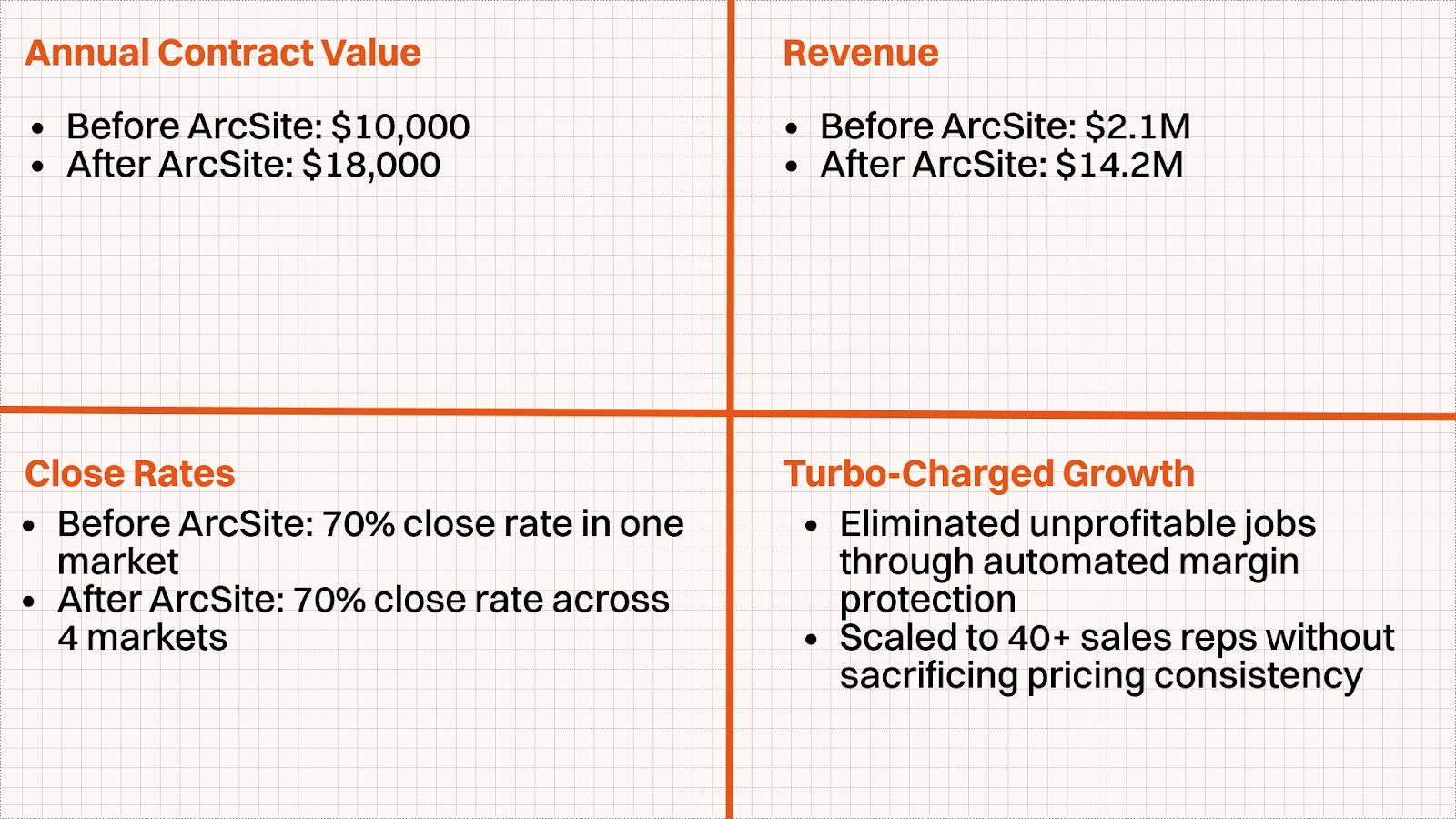
- Revenue exploded from $2.1M (2023) to $14.2M (2025) in just two years
- $4+ million in additional revenue directly attributable to increased contract value enabled by ArcSite's product catalog (672 customers × $6,000 increase)
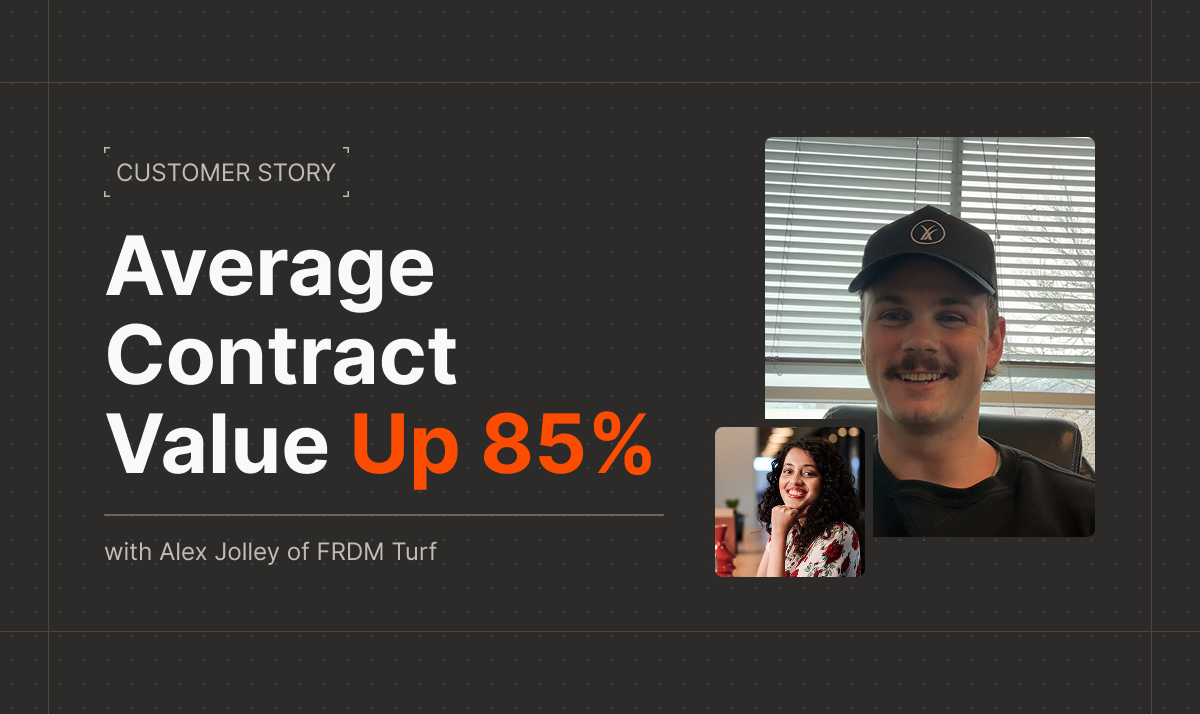
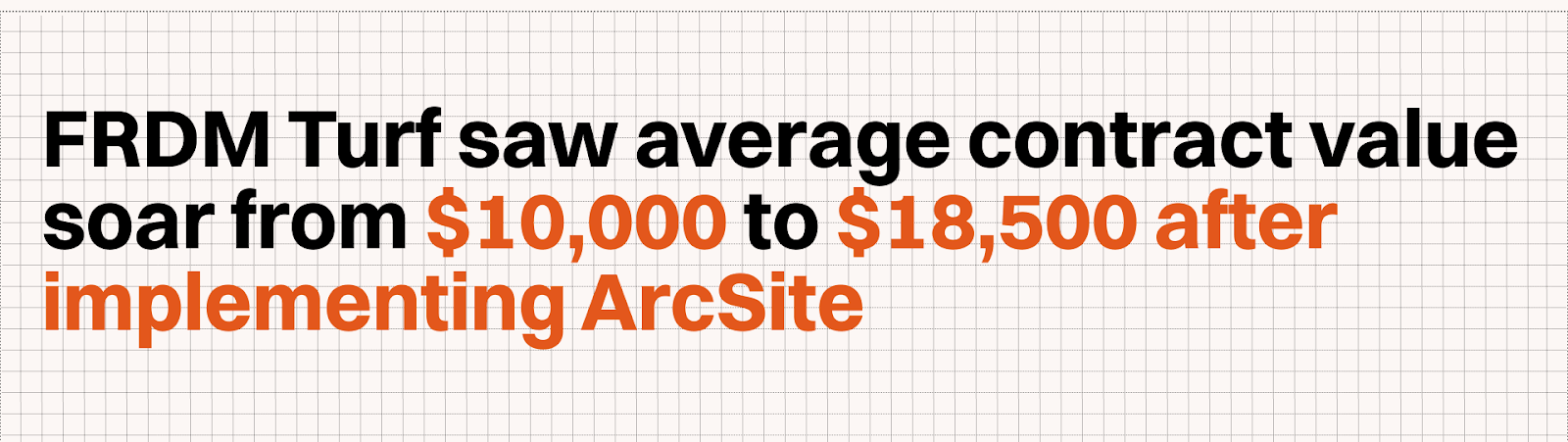
- Average contract value nearly doubled from $10,000 to $18,500 by scaling additional product offerings
- Expanded from 1 market to 4 markets (Salt Lake City, St. George, Denver, Phoenix) with new markets launched in just 7 days
- 70% same-day close rate maintained across all markets with streamlined proposal process
- Eliminated unprofitable jobs through automated margin protection
- Scaled to 40+ sales reps without sacrificing pricing accuracy or consistency
The Overview
What’s in a name? For Alex Jolley, co-founder and CRO of FRDM Turf (pronounced ‘freedom’), the name came from a bolt of inspiration. He and his business partner were hard at work building a landscaping business, but it was more than that. It isn't just about installing artificial grass; it's about creating freedom. Freedom from maintenance for families. Freedom from water waste in drought-stricken regions. And freedom for entrepreneurs and installers to build thriving careers.
Created in partnership with his best friend from 6th grade, Jolley has grown FRDM turf from a side hustle to a $14.2 million operation. Now with four markets across the Southwest, over 40 sales representatives, it’s a business that's rewriting the rules of residential landscaping.
But scaling that fast comes with a challenge: How do you maintain profitability, expand your product offerings, and close deals same-day? You can’t ask your sales team to memorize 118 different products with variable pricing. That’s when Jolley ‘pulled an audible’ and went all in on ArcSite.
The Challenge
Before ArcSite, FRDM Turf's quoting process was a mess.
"We had so many reps mess it up where we had unprofitable jobs because it wasn't a set price," Jolley recalls. "It was just a messy, messy thing."
This led to unprofitable jobs from pricing errors when reps miscalculated margins on the fly. It also limited FRDM Turf’s product expansion process. With sales reps having to manually memorize products, pricing, and margins, their process wasn’t scalable for high growth. The manual process couldn't scale across multiple markets and keep up with the pace at which they were adding new product offerings.
A company built on a "one-touch" sales model, FRDM Turf was closing 70% of deals the same day. ArcSite helped scale that close rate and propelled them to their vision of becoming the first nationwide systemized landscaping company.
"There was absolutely no way that we'd be able to expand our contract value through other products without a new solution," Jolley explains.
The Solution
Jolley discovered ArcSite in early 2024 and used it himself before rolling it out to the team. He made the call: FRDM Turf was going all-in on ArcSite. Right before their 2025 sales kickoff, Jolley committed the entire team to the platform.
ArcSite eliminated manual pricing entry entirely. The company built comprehensive product catalogs with preset margins for each market, sometimes up to 118 products in some locations, so reps never had to memorize pricing again.
"We've even utilized different custom colors for the grass. It just looks realistic. It really emotionally ties the customer to the design," Jolley says.
The proposal process became seamless. Reps could measure the yard, design the space with the customer, and present financing options, all within 30-45 minutes on-site.
FRDM integrated ArcSite with their entire tech stack, automatically generating projects in ArcSite when leads came in through their marketing CRM, and later integrating with Service Titan for project management.
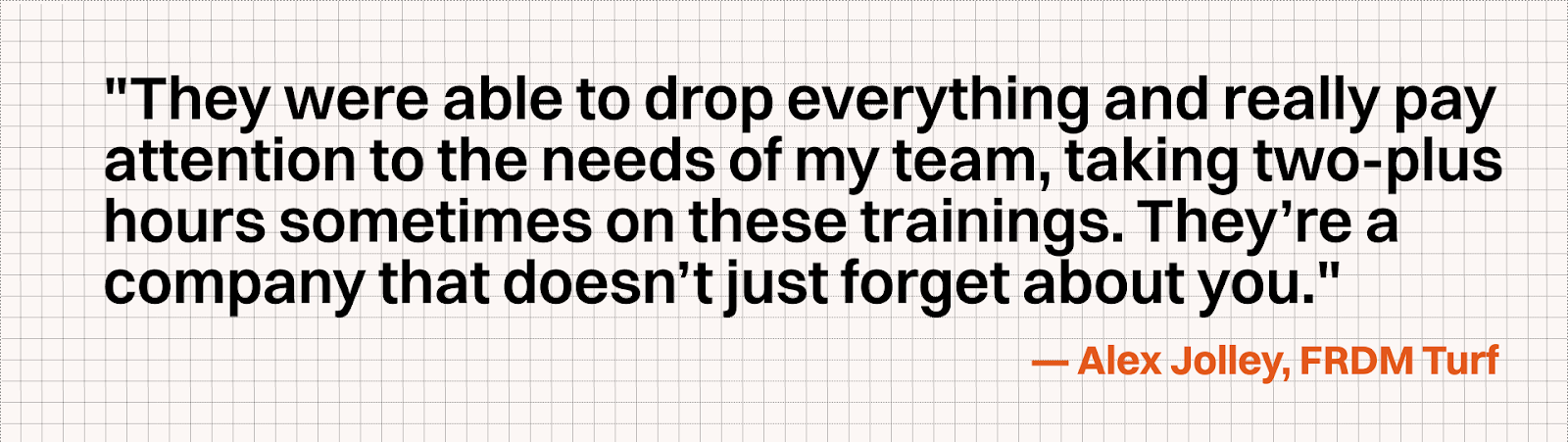
Perhaps most importantly, ArcSite's customer success team went above and beyond during implementation. "They were able to drop everything and really pay attention to the needs of my team, taking two-plus hours sometimes on these trainings," Jolley remembers. "They’re a company that doesn’t just forget about you."
The Results
By moving from a manual, error-prone quoting system to ArcSite's digital workflow, FRDM Turf transformed both its sales efficiency and its bottom line.
"We increased our contract value from $10,000 to literally $18,500 that year. It almost doubled our contract value just being able to include those other products at scale because of ArcSite."
The speed of market expansion has been equally impressive. "I can build a price book for Phoenix, Arizona, with my team within a few days and have sales reps ready to rock and roll," Jolley explains. "Within seven days, we had our first estimate close."
Looking ahead, FRDM Turf has ambitious plans to become the first landscaping company to systemize and democratize landscaping on a nationwide scale—moving beyond regional fragmentation to build a consistent, scalable model across the country.
"ArcSite, with our CRM attached to it for project management, is just the combo mill of what we want to do," Alex says. "The market expansion is huge for us, but then also the ability to systemize our sales flow and move that cleanly to our vendors and installation teams—ArcSite just plays the heartbeat in that."
See other stories