[00:00]
if I had to ask you, what dollar value impact ArcSite has had on your business, what would you say? All in all, it's probably a good million dollars to our gross revenue. And Steve we’ll start off nice and easy. Can you just introduce yourself with your name and your title? Yes. My name is, Steve Ball. I, I guess I wear many titles, own a few different, businesses and, also still work for, a fire department as well as a captain. Oh. Very cool. Many hats then. Yeah. So tell me about Michigan Gutters. How did you guys get started? Yeah. So, Michigan Gutters. I, I guess the the long story short is, like I said, I, I've been a firefighter first, so I actually, I went to school, for fire science, got my paramedic degree, when I was a very, very young, young man at 22. And, I got out of there and, kind of, went to Traverse City, Michigan, and that's, where we, we kind of set up. I, I got hired at the fire department there. And, with that schedule, we work 24 hour shifts. So I, like most, most guys in the fire service, we have a lot of days off.
[01:30]
It's long, long days when we're there, but, we have a lot of days off, so, most of us hustle and try to make some extra money, and. And that's what I did. I started a hanging gutter, with, retired firefighter from Detroit. And, we would just just kind of help them hang it, and assist him. He'd give us cash. And, we did that for a couple years, and then, kind of sometime down that, line. He was getting older at that time and, and, kept it really small, just, just kind of a local thing. And, he ended up getting sick and passing away, and, it kind of gave an opportunity with his, ex-wife, there had a an old gutter machine and some, some stock and, just kind of wanted it gone. So I, went there and we kind of worked out a deal, and she, let me just make a little payments. And I woke up a business owner, so. Didn't know anything about it. Didn't know even how to estimate. Didn't know anything about anything other than just holding a piece of gutter up and put it in screw screwing. So, I, immediately this is about 2008. So I immediately just went to Google, and, I tried to learn everything I possibly could on on this, business called, you know, gutter installation. So I, actually hooked into a, good guy. I reached out,
[03:00]
to a guy doing it the best in the area. And that was, Tony Cobb, who, actually introduced me to ArcSite as well, but, and he was out in the Grand Rapids area, and, he kind of took me under his wing. We were in that area for that market, and he really helped me out and kind of help establish the business side of it for me. And, we grew. We grew with a lot of hard work and, and, you know, I would I would work the fire department, and then I get off the fire department and I'd go install gutter and estimate till after dark and, and kind of, my wife would take the phone calls and we kind of grew the business from there. So we started from scratch pretty much. And, you know, till today, we're we're, we're around $5 million in gross revenue. So it, he grew pretty quick. So part of that was getting the right people in the right places. And, I still actually work for the fire department, so, you know, a lot of times I'm not available. So, we got really good people that can, make things happen. Amazing, what a story. And so cool. I get to talk to me then about the size of your business today. Obviously, you are wearing a completely different hat, you know, working at the fire department as well as running this business. And, being an entrepreneur by itself is already a dozen different hats to wear. So you're you're even one upping that that problem a little bit. But yeah. Who who works with you in the business. How many employees
[04:31]
do you have? What does a typical day look like for you all? Yeah. No. So today we have, So, we probably have in, in, Michigan Gutters, probably 25 employees right now. And, so that gets a little complicated, too. We also own a door company, so I end up getting a garage door company as well. So we do have some, and it's a totally separate company, but we do have some shared personnel on that, that like an HR director that I share. So, exclusively with Michigan Gutters. We have about 25, right now. And, typical day is, you know, we have, for me, I don't I don't operate, anymore in the operations of of it. I do mostly on the, the background. I'll do a lot of the finance. I, I did go get my MBA, which really made a big difference. So I help I do a lot of the strategy, how to how to grow it, how to remain consistent throughout the winter. We, you know, we have a very cold climate. Like, right now, we have about two foot of snow on the ground. So that makes it a little difficult to install gutter. So, we got into some other things. So we do heat systems. We do,
[05:52]
ice removal. So we'll actually steam ice off roofs, so they don't have ice dams. And then we, you know, do, do everything gutter. Of course. So it all kind of wraps together, but it keeps our, our guys employed and, Yeah. So right now our our our day is very busy because, they take calls in the morning and, like I said, we're steaming ice right now, which is a service. So we have a lot of, a lot of people that are calling, with water coming into their houses. And that's never a good thing. So we're scrambling. We have, real good, gal that, kind of does all the scheduling, and she, she sets, sets that up, and then we, we send out the crews. So the crews go out, we have a, a couple other staff that help with that coordinate it. And, you know, they come back, they they usually work right now from eight to, five ish, but, we do, pay on performance as well. So that's kind of, a neat little thing. So basically they're getting a percentage of, of that ticket. So their days can kind of vary somewhere along. Some are less. But ultimately it's kind of up to them and how much work they want to do. So. That's awesome. Yeah. Whenever I speak to folks that are in like the northern part of the country this time of year, I'm like, don't, don't look at my window. I’m almost feel embarrassed. I’m like it's 70 degrees here in California. Yeah. You don't want to see my window.
[07:22]
And it's beautiful with the snow and stuff. But yeah, you have to be made a tough stuff to be living up there. And I'm sure your customers are happy that they have you guys to rely on to help them with all the things that winter weather brings. Yes. Yeah. I want to talk a little bit about sort of your journey into entrepreneurship, because obviously you have a career as a fire captain and you've, you know pursued that as like your main, you know, line of work. What was sort of stirring up in you when you decided to sort of like, do this thing on the side, like, I actually want to maybe do something else outside of this. I want to start up my own business as well. Yeah. Kind of neat. Like I said, I, I got into the fire service when I was like 22 right out of college. So I was, you know, not knowing much of anything other than the college lifestyle. Right. So I, I learned real quick, you know, the value of customer service, and, and I was we were making, you know, life and death decisions, every day. And, you know, at I, at age 22 for me. So that kind of set the tone for me. You know, I, I just, I thrived in that environment. I, I enjoy stress, which sounds kind of crazy, but, if I'm. Yeah, I mean, know, if I'm not stressed, I'm not, you know, I'm not not doing things, so, Fair. So that kind of, you know, that set the tone for that environment. Now, the thing with that working for a government, it was
[08:52]
nice. You know, I had a fallback, right? So I had a career. I had a job. I could support my family that I had a young family is what we started having children and and so we were able to kind of support ourselves off of that. And I deferred a lot of that, that income or I didn't take income for, for a decade in fact, while we were a growing company. So, so that helped a lot. And then I guess ultimately, I said, you know, dealing with gutters, you're dealing with, already, any service industry, you're dealing with people that could be upset at a time. Right? But it was never I was real familiar with have with dealing with people upset, right. Or seeing people upset. So I, you know, it never, I always made it right with them. Customer service is always very important. And, you know, at the end of the day, no one was dying, right? So we would make it right with them and and grow a really good reputation, off that and, and just grew from there, you know, nothing kept us off track. We were pretty, pretty focused and, you know, I think to to this day, we still have that perspective. We're going to do the best we can. We're very customer service focused. If we messed something up, we're going to fix it. And our cost. So, you know, you do that a few times, word gets around, you know, we install now for a lot of the new builds, a lot of builders, a lot of contractors. And that's that's purely from our reputation
[10:23]
of of taking care of things when, when things aren't always right. So. Absolutely, you know, I was reading about you guys before we hopped this call and everything that you Google and see online is just like stellar work, really, like hard working, like, really cares about their craft and everything you just said, you know, lines up with that. Like, I've worked in corporate for a long time. And one thing, one of my first jobs was in PR, and the one thing that we are not are nobody's dying knees. There's no crisis happening because XYZ thing went wrong. And I think with the experience that you have, you're bringing a really like good perspective, right? Because in your role as a prior -- go ahead. Oh yeah. No, that's and it's funny because my wife is totally opposite, right. Like she, she's the the organizational piece to this mess, right? I mean, I'm, I'm the visionary. I do a lot of that. Like I said, handle that kind of stuff. Like she's the organizational piece to that. And, and, you know, any time we have a major, if you will, somebody unhappy, it's that's usually my first question. Is anyone dying? No? Okay. Well let's deal with it. And you know, and just like you said, that's that's so important because it's I see a lot of, business owners. Not they don't take that same approach. And, ultimately, it can, you know, it can, harm your business because you don't grow with that. Right? If you. What's the ratio of one bad review like leads to seven lost customers? Something like that. You know, so we
[11:53]
take a lot of, pride in that and ownership in that, for sure. Absolutely. I want to pivot now a tiny bit and talk about how you guys found ArcSite. So I know you mentioned that your previous business partner, introduced you to the tool. So talk to me what your workflow was like before our and then how you found the tool. Yeah, actually, it was, again, Tony Cobb with, All Gutter Systems down, down in Grand Rapids. We weren't partners, but he just kind of help me out and, you know, so we became friends from that point. We've, we've bought product back and forth and, and stuff throughout the years. But, he, he ultimately introduced me to this new tool. That was kind of neat. And we were drawing with, you know. Drawing on, on, tablets and, and I just love that. We for years, I personally, I've been trying to come up with something better than just a pad of paper and a pen, you know, especially as you're scaling, right? We have we have five estimators now and trying to get their vision onto a piece of paper so the ops folks can do the, can determine that order material off that, and then ultimately have the installers install on that piece of paper is very difficult. And that's one reason why, gutter installation is hard to scale. It's just it's it's a very complicated process. So, ArcSite did help with that. They, he introduced that to me and I
[13:23]
said, wow, this is amazing. We could we could work with this. And, at the time, there's a couple a young, young guy was was working there with him, and I believe he ultimately went to ArcSite and, kind of helped design that. And then I internally, like I said, we own and have a couple other different businesses now, but we have an IT lady, that is phenomenal. So she came from the computer world and, and, you know, writing code and whatnot. So she's very, very, very fluent in that type of work. And that kind of the light bulb went off. Right? So we took what ArcSite, what we were given at the time or shown. And actually, we a lot of the symbols that ArcSite uses now and, and even some of the thing came, came from our office, which is kind of cool. So, she helped design that to fit our model. And at the time, besides Tony, we were the we were the first gutter company to use it. So, we took it and made it work for how we do things. I really, really enjoy the, how it would, cost in the background, you know, so as we would draw, the estimators draw, it would kind of cost in the background and give a, you know, give a price that was consistent. So there was it was very consistent that way. It was, clean. You didn't have somebody’s scribble trying to decipher what that meant.
[14:54]
You know, we had symbols for things so they knew what to put where. And, we worked with, ArcSite quite a bit. And they were, you know, in those beginning days, it was, it would be great. It kind of kind of adjusting to fit our need. And then ultimately, I think it made something that was, pretty unique and sellable for ArcSite. That’s awesome. One of the things I, I, I'm a fairly new joiner to ArcSite. I joined about three months ago here. And one of the things I really enjoy about the culture here is that we're very much in partnership with our customers. Like if someone raises a hand and said, I want X, Y, and Z, there's a lot of, you know, care to be like, can we do that? And how fast can we do that? So sounding like you were one of those kind of like foundation companies that helped spin up the capabilities for gutters. So what was that early days like when you first implemented the tool and got your team to start using it? Basically it was kind of fun. And in my, you know, I'm a I'm a tactical operational kind of guy. Right. So like they we'd have a question like I wanted to do that. I don't know how to do that. I don't have a, you know, but these really smart guys did. And so, you know, we would I would work through Heather, on my side and say, hey, I want it to do this and that look like that. And, she would kind of relay the message and, and, you know, speak computer nerd. And, you know, they would spit out a product that was that was really cool. So, it was a game changer for us, I guess would be the big thing.
[16:24]
I mean, that, yeah, it was a hard sell. Our guys were like we’re not interested in, you know, going away from paper. Right. Because that was how we did business and, and, it was going to take more time in their mind. Well, probably year after the first year, once we implemented, they found it actually saves time, saves a lot of money for us. In a lot of callbacks and just just operational error. So, and that took, you know, the first year, every we that first few years, we spent kind of critiquing it. They also, ArcSite, was really good about, giving us a, a back end platform to kind of work with. So I know, my Heather on the, you know, on the back end, she was kind of adjusting things, adding symbols, making it work, real specific for us. So, yeah, it's fun. It was it was a good time. And like I said, it, it really, really upped our game when we would when we would, send an estimate or show an estimate versus the competitor showing an estimate, it was hands down, you would even pay a little more to have that professionalism. You know, you'd see it and say, wow, these these guys know what they're doing. At least it looked like it. Absolutely. So yeah. I guess tell me a little bit more about that. Like when you first started, you know, rolling this out and like, showing customers their digitized proposals and it all connected, the drawing, you know, reflects the price really accurately. What were some of the reactions that you got? They loved it, but it was the way we utilize it.
[17:54]
It was hard to decipher at that time. Like what was what? So, since then we created, like, keys and we've we've made it, a more simple process. And it's more, more that the average, homeowner now can look at it and say, oh, that's the front of the house, and that's what you mean. So we use, the pictures. You know, that was a big part of that, where you can take pictures through the app now, and we attach pictures to it. We can even draw on the pictures. And, that all helps, for that customer then maybe just doesn't understand it or see it. To be honest, I use it a lot to, for, if there is a disagreement, if there is a. Well, I thought I should have had this part done. Or maybe you weren't supposed to do that part. Well, you know, once we send that out, it it shows it fairly clear and where we're supposed to do and what we're supposed to do. So, it really did clear up a lot of that, that what if or, you know, some of those, some of those issues between the installation and, and, sometimes even the estimators. For sure. You mentioned earlier that it's, helped you with cost savings just operationally. Can you tell me a little bit more about what it's done in that regard? Couple things with cost. It one thing I, I, I always want to be consistent. Right? I mean, that's at least that's our companies. We everything we do is I always say it's it's, you know, it's on a per foot per item basis. So we don't, you know, whether you're living in a mega mansion here, you know, on the water or you're
[19:24]
living in a, you know, a smaller home somewhere in the woods, it doesn't matter. The price is going to be the price. So, now we have tiers and different things for that, but it's, it's it's just the system is built that way. And ArcSite helped us organize that. So it wasn't one estimator or doing one thing one way, another one doing another way. And you know, us not even knowing that. So when we put that system in play, we know that every time we draw that, you know, six inch gutter, the price is going to be the same no matter where you're at, what you're at. As long as it's, you know, the same price or the same same type of item that we're using. So that that saved us money or I should say made us more money because there was less mistakes. Right? So you're not forgetting certain things and you're not trying to use math, you know, in the back they used to have to try to figure, you know, they were adding this stuff in their head or you know, on their toes, whatever they were doing. And, you know, it was sometimes they’d mess it up or it'd be less or more. And it just it wasn't real consistent. And this, this added that consistency. And now, the price book I like because we do adjust that. Like, right now we just got a, price increase. Aluminum. Aluminum has been kind of all over. Now it's going up. So we can go on the system. We can simply, you know, Heather can just simply change the the costing,
[20:55]
and then it just happens, right? So they don't even know it needs to have it just as they draw it. They don't even necessarily know what the the price is at that time until after. Right. It just kind of it kind of happens in the background. So it's really, really been good that way. So it also helps. Yeah. It helps us detail out like if somebody wants hey what would it what would it be if I add this piece. Or maybe I have a barn and I'd like to add that, but I don't know if I want to pay for that. We can. Yeah, we can draw that up and it will, you know, tell you the the cost right then and there. Exactly. Just giving your customers more clarity into it. I think, like every homeowner, obviously, it's everybody's hard earned money. People are, you know, trying to do the best that they can with their dollar these days. And I think just clarity in terms of like, what you're getting for a service and just being, you know, very transparent with that just builds so much trust. And it's evident. And yeah, and it is trust because that's that's another important thing. You know, we don't we're not price gouging. You know, we're you're literally it's I we always would say that, you know, it's it is the price is the price. So you know, other discounts that we may run here and there. I mean, we, we know exactly what it would be. And, and actually another thing that, really did was it pulled in our office staff together now, so when they would call or a customer would call in, our office staff would get that call, they could actually handle some of that workflow, because they could pull up the estimate and actually, you know, take a piece off or add a piece based on that. So it did it did make the workflow easier
[22:25]
as well and communication better. Ultimately. That's wonderful. If I had to ask you, what dollar value impact ArcSite has had on your business, what would you say? Hmm, all in all? It's probably a good million dollars to our gross revenue. Now, that may be a little audacious, but it's, there was a couple things that that happened right at that time. Like I said, it just made us more efficient, made us follow through with pricing. Inventory on the back end got got better inventory control. So, you know, we went up from there to there well over $1 million, but I'd say $1 million of that impact had to do with just, the process that we put in place. Let's say there's another, you know, young gutters company coming up watching this. And they're curious, like, what does your workflow look like inside of ArcSite? Could you kind of walk me through that? So, what we do is, we have a, another lady that, like, she's kind of a coordinator or sales coordinator. So when she gets the call, or the calls go to her, she goes automatically in there, she creates a file, through ArcSite. So it's got the name. All the information takes, all, all the information needed. Right. And then she'll go and she puts that into the ArcSite.
[23:46]
The the database, I guess you would call it. So it's already in there. And then she'll schedule up the estimator. Right. So the estimator goes out, he goes to the site and he really searches for that, that address name, pulls it up and there's their file if you will. Okay. So from that file, he starts all that pertinent information that was given to him will be him or her on there. So, you know, there may be a couple notes. We may have some things that they need to know, or maybe they're not there when they're estimating. So she may, have some other notes in there that, that, that we put in there in ArcSite. And then, from there, he, he goes through and draws, takes his pictures. It all goes into the program. He he either closes it out, most of our estimates now, the sent later versus right on site. I like have them on site and sometimes we still do that. But a little more complication now with pictures and and in the job the we're doing all kinds of different types of gutter too. We're not just doing five inch, gutter anymore. So we get half round, eight inch, all kinds of stuff. So, he'll put it all the pertinent information. Take the pictures, go in his tablet, go back to the office at some point, and then they'll pull that back up, and then they'll they'll fine tune the estimate, you know, any additions that they need to do. Our ArcSite is set up to where it's like,
[25:16]
you know, every little line item is a different piece. So it's not just one number. They're going to know every little piece that we're we're putting into that estimate. And and then ultimately it's going to have the, the, the price at the end of it. And then she'll put that in that platform and send it. There's, you know, there's a thousand different ways to slice it that's always useful to hear, just like how you're doing it. Obviously you’ve had a ton of success, which is why we're here today chatting to you. So always good to know exactly what the nitty gritty of it looks like. I want to, pivot now a little bit and just talk about, you know, your business growth in the future. Where do you see yourself in the business in five, ten years time? I will be retiring from the fire department at some point soon. So I've been there 24 years. So, yeah. So that's happening soon. So, what's that mean for us and myself? You know, we've we've scaled, Michigan Gutters. Quite a bit. And I, I think there's a little bit more that we can scale, to in that area, but, our next step would be maybe going outside our area. And that may be, you know, opening up a couple other shops. I'm not 100% sure how that's going to look. I just my main focus right now is to lean out and and get prepared for, you know, I guess what the future looks like. Technology helps, you know, ArcSite is one of those, like I said, platforms
[26:46]
that we utilize. And so the better we can get, the more efficient we can be helps. I kind of I said earlier, I'm a little bit of a serial entrepreneur. We get into a lot of properties, so we do a property management, company and also a garage door company, as well. So, we actually get into some gutter supply as well. So, lots of different things. We're kind of dabbling in now there, you know. But, as far as for Michigan Gutters, it's it's, it kind of stands on its own two feet. I kind of work myself out of a job to be honest with you. So. Honestly, that's the marker of a successful business, it runs itself, right? You get the time to do what you want to do. Yeah. Exactly. Amazing. You know, like you just said, you're a serial entrepreneur. So my other question to you is, what's your favorite thing about being an entrepreneur? Man. So I love I love, like I said, the stress of building something. And I love the, the, the seeing the fruits of your labor as well, you know, so when we're putting I love watching our folks be successful, raise families off it and buy houses and all the other stuff that's, you know, great about living in this country and, that you can do this, right. And it just takes a lot of hard work.
[28:17]
So I, I really enjoy that. And that's, that's kind of what keeps me going is, I like the stress of, knowing that I need to you know, we have to put food on the table for, for folks and and, like, in northern Michigan right now, you know, we have to. Most gutter companies, in cold climates, they, they close up, and, you know, their folks will either go on unemployment or have to find something else. And I just never like that. So we, we keep them fully employed and with benefits and, and everything else so that that puts a lot of pressure on making sure that we find work and good work. So, yeah, I guess that's what that's the big thing that drives me. Absolutely. It's all about looking after your people, right? Like, because, you know, a job, a company, a career, it's all just community. It's all just people that you care about and you work with, you know, the same people day in and day out. Sometimes you spend more time with the folks you work with than you do with your own family. If you can travel back in time to when you first started and give yourself advice, what would your biggest piece of advice be? Man. I would say don't quit, you know, and that's and and I don't think we did. So it's not like advice said we weren't I I'm glad I didn't. Right. I mean it's but I, I see a lot of young entrepreneurs that they, they get they get attracted to their golden ticket or, you know, the new car or the fancy
[29:47]
this or or that. And they want that now. Right? So I always say, you know, I had these conversations now and it's it's really duration. It's persistence, duration of doing the right thing. And, and if I had to give anyone advice, that's what I would say myself. I did do that. You know, and a little bit by necessity at that time, we put ourself in kind of a rocky position, you know, because we were growing so quick and trying to make payroll with credit cards and, and, so I guess if I had advice for myself, I would say, hey, let's let's be a little smarter about this. And, you know, not not, try to grow so. I was real focused on growth, which was good, but I didn't really have the pieces in place at that time. So I didn't have, you know, I didn't have relationships with banks. I didn't have any of the stuff that eventually you have to have. Lines of credit, you know, those type of things that that are important for a business, especially a service type business like ours. So, I would look back and tell myself to slow down and and do a little more strategic. I mean, we made it, you know, but, it was, there was some trying times for sure. Absolutely. But the wisdom you got from those trying times, it’s paid off in spades. Yeah, especially these days. I think there's such a, there's a lot of culture around like, oh, just go run your own business. Don't you know, work traditional 9 to 5, whatever. But like,
[31:18]
there's always trade offs, right. Like when really all the pressure is on your back and your back alone. And you're trying to make payroll. You're trying to run a business, you know, like, you know, all of these decisions that you've probably there's no handbook on, like, here's how you become an entrepreneur. Well. Another big thing for me, I kind of mentioned I didn't know anything about business. I was just a hard worker, you know, I was just I was a firefighter. So, I mean, we just the work. Yes. What I did and, like, that's what I knew. And, looking back, I, I went and got my MBA, during which I wouldn't suggest there was a lot of work, but it really, really opened my eyes to business. Yeah. And it was kind of, I guess, good in that, that part of it. And I was sitting in class, you know, I was probably 28, 29 at the time, but I was there in class with, you know, 22 year olds. So who didn't have any kind of experience, super smart people, but didn't have the experience where I had a lot of experience, bad experience, good experience, you know, just kind of, so we used a lot of Michigan Gutter projects in class. So that was kind of neat. But, and it, it really helped me once I understood my, my financials and I guess that would be another little piece of advice I'd say is get good at financials. And if you can go through your pals, and your balance, sheet and understand what those number means and put those to, you know, the KPIs and ratios, that's what I spend a lot of my time on now. But that if I knew that, then
[32:48]
it would have been a game changer, because I would have did. You know, that's how that's what guides all your you should guide all your decisioning. And, you know, that's to this day, most businesses, small businesses don't even know what that is. Yeah. So, you know, they they give it to their accountant and say, hey, figure this out. You know, but they just kind of kind of go with the flow. But, I, I try to make, data driven decisions now. So. Absolutely. I think a lot of folks get intimidated by it. Right? Like there's some people love math, a lot of people don't. Right. And then they're like, I can't touch it with a ten foot pole. There's a sort of like fear of like learning how to do it. But if you just get the basics down, it really gives you a lot of mileage and what you’re able to do with growing your business in that regard. Yeah, I really did. And then, you know, work hard. Like I said, 20. I worked, ten or I was going, you know, for a long time. It was 100 hours a week. That's something. But, you know, I was working 24 hour shifts at the fire department, and then, you know, I'd come home and we'd work, you know, sun up to sun down. So that that was a little much. I wouldn't advise that. I mean, that gets that life. Life balance is, important, but, you know, like I said, I kind of put ourself in a, maybe not a good position because we, we had to do we had no choice. So but it worked. During those days. How do you, you know, I guess deal with burnout or tiredness or just keep yourself going because 100 hours a week is no joke for years on end. To be honest, I don't.
[34:18]
I don't think I was smart enough not to like it, just I mean, it just like I said, I just kind of it, you know, we were brought up pretty, you know, pretty humble beginnings. So, I mean, I, our family never had a whole lot. But we worked hard, right? I watched my dad work hard his whole life, and and I just knew. I knew with hard work, I could. I could make it. So, And that's what I knew, and that's what I did. And, you know, one, one thing that was kind of neat that happened that really was pivotal, for me is I used to do all the and this is common with most, small business owners, too. I had to be there to do all the work right? Because nobody does it as good as me. Nobody cares. And it's hard to scale past that. Right? Well, in my case, I, I had done that for a couple of years, and I was doing everything, and I fell off a ladder and broke my hands. So that was in that tragic event, it forced me to pull out. I had no other option other than let other people run my company or do, you know, do the work of the company. And that was that's when we really hit a whole nother level because I, I had to back out and then all of a sudden my, I had to start thinking, well, how do we make this work through someone else, right. And not me. And that's, that's
[35:49]
that was a big moment. And from there we started hiring, you know, the right people. And, come to find out, a lot of them do it way better than I could and did. So, you know, that was, That was good. Find smarter people, put them on the right seats on the bus. So, that's and that's what happened. So that that was, that was a big moment for me. Absolutely. Sometimes it's by necessity or by design, but, you know, and it's obviously awful, but the place that it got you to, to be able to step back from the business is ultimately great for, you know, your own work life balance and being able to step away and do other things and also the growth of your business. My last question for you is how do you define success? It's really not about money. It's about achieving your goals. So even what you set out to do, and I think that's, that's really what it's about is, is, for me personally, like I said earlier, success for me is watching others succeed, if that makes sense. So watching families be formed and survive off this and make it and by like I said, we had one one young guy just buy a house, build a house, you know, and he works for us, works hard. Great guy. I love that, you know, or when they're, you know, doing what they want to do and are and are happy and excited. And then I know that we we built that. Right. So for me, that's success. And that's what drives me. So, it's not about, you know,
[37:19]
the money or anything like that per se. It's actually watching it grow. And achieving those goals that we set out to do. So I mean, if I want to be the best gutter installation company in the, in the US, you know, so it's we're going to we're going to strive to be that.
About Michigan Gutters
• Industry: Gutters
• ArcSite customer since: May 2020
• Location: Michigan
• Headcount: ~25
• Their Story: Steve Ball is a fire captain turned serial entrepreneur. After helping a retired firefighter install gutters on his days off, he purchased the business outright in 2008 and built it from scratch — without knowing anything about estimating, pricing, or running a company. Today, Michigan Gutters is a ~$5M operation serving northern Michigan with gutter installation, heat systems, and ice removal services.
The Impact
- ~$1 million added to gross revenue directly attributable to ArcSite's standardized estimating and pricing workflow
- Dramatically reduced callbacks and operational errors by replacing hand-drawn sketches with clear digital proposals and photo documentation
- Proposal quality became a competitive differentiator — professional ArcSite estimates commanded higher prices than competitor hand-written quotes
- Scaled to 25 employees while the owner stepped fully out of day-to-day operations
- Real-time price book updates — when aluminum costs rise, one backend change instantly flows to all 5 estimators with zero manual intervention
- Dispute resolution time cut — Arcsite helped eliminate "he said/she said" scope conflicts between customers and install crews with easy-to-understand photos and documentation
The Overview
Steve Ball says he “likes being stressed.” Not something a lot of people say! But when you look back on his career, he’s spent 24 years as a fire captain in Traverse City, MI. He is practiced at making calm, decisive calls under pressure. That same instinct has defined his approach to business.
"I woke up a business owner," Ball recalls. "Didn't know anything about it. Didn't even know how to estimate. I knew nothing other than just holding a piece of gutter up and screwing it in."
That was 2008. Today, Michigan Gutters operates at nearly $5 million in gross revenue with 25 employees, five estimators, and a suite of winter services including heat cable systems and steam-based ice removal. Ball still works shifts at the fire department — now as a captain — and has largely stepped back from day-to-day operations of Michigan Gutters, having built a team capable of running the company without him.
Part of what made that possible was getting the right systems in place. ArcSite was one of them.
The Challenge
For years, Michigan Gutters ran its estimating process on paper. Estimators would sketch drawings by hand, do math on the fly, and present quotes that varied in quality, clarity, and accuracy depending on who wrote them.
"Getting their vision onto a piece of paper so the ops folks can determine and order material off that, and then ultimately have the installers install on that piece of paper — is very difficult," Ball explains. "That's one reason why gutter installation is hard to scale."
With five estimators each doing things their own way, consistency was nearly impossible to enforce. A customer might receive a meticulous drawing from one rep and a rough sketch from another. Pricing could vary based on how each estimator calculated material costs in their head.
And when miscommunications happened between the estimate and the install, there was no clear record to refer back to, which led to lost revenue and higher costs.
Ball had been searching for a better solution for years. Paper worked when the business was small. It wasn't going to work at scale.
The Solution
The introduction came through Tony Cobb of All Gutter Systems in Grand Rapids — the same mentor who helped Ball establish the business side of Michigan Gutters in the early days. When Cobb showed Ball ArcSite in 2020, it clicked immediately.
"He introduced me to this new tool. We were drawing on tablets, and I just loved that. For years, I personally had been trying to come up with something better than just a pad of paper and a pen."
The estimating workflow was rebuilt from the ground up. When a customer calls in, a sales coordinator creates a file in ArcSite with all pertinent information — name, address, notes — before the estimator even leaves the office. The estimator arrives on-site, pulls up the pre-populated file, takes photos through the app, draws the layout, and captures all relevant details directly in ArcSite on a tablet. Pricing updates — such as aluminum cost increases — are made centrally in the price book, so all estimators automatically quote the correct rates without any manual intervention.
The Results
The impact of ArcSite on Michigan Gutters has been broad, touching everything from sales presentation quality to operational accuracy to internal communication.
"All in all, it's probably a good million dollars to our gross revenue."
Ball attributes this figure to a combination of factors that compounded over time. The professionalism of ArcSite-generated proposals gave Michigan Gutters a visible edge over competitors still working off handwritten quotes.
"When we would send an estimate versus the competitor showing an estimate, it was hands down. You would even pay a little more to have that professionalism. You'd see it and say, 'Wow, these guys know what they're doing.'"
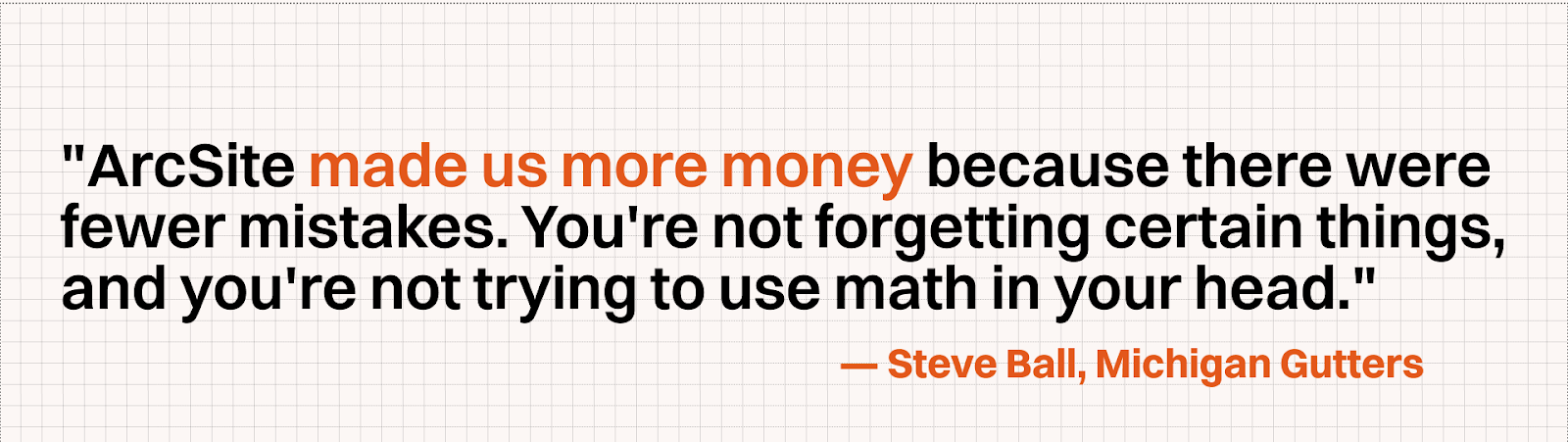
"It made us more money because there were fewer mistakes," Ball says. "You're not forgetting certain things, and you're not trying to use math in your head."
The clarity of digital proposals reduced conflicts between what customers expected and what installers delivered. When a customer questioned whether a particular section was included in the scope, the drawing and signed proposal provided an unambiguous answer.
"It really did clear up a lot of those 'what if' issues between the installation and sometimes even the estimators," Ball explains.
And practically speaking, office staff could now pull up an estimate and make minor adjustments — removing or adding a line item — without needing to reach the estimator directly. Workflows that once required hand-offs became self-service. With office staff being more involved and having access to information, it freed up estimators and field staff to do more with less. The entire team became more efficient and self-sufficient to serve Michigan Gutters’ customers.
Ball is approaching retirement from the fire department after 24 years of service. With that transition on the horizon, his focus is on stepping back from Michigan Gutters’ day-to-day operations and positioning the business for its next phase of growth — potentially expanding into additional markets or opening new locations.
Ball’s advice is straightforward, saying, "Don't quit. It's persistence. The duration of doing the right thing. And get good at your financials. If you can go through your P&Ls and your balance sheet and understand what those numbers mean, that's what should guide all your decision-making."
With ArcSite and a good understanding of your financials, you can build the business that you’ve always wanted.
See other stories