Watch instantly on-demand. Click the video to unlock the session.
The Parking Lot Playbook: Don't Foam Away Your Margin
Nicole Kelly
•
October 14, 2026
•
30 Min
Access the webinar
Thank you! Your submission has been received!
Oops! Something went wrong while submitting the form.
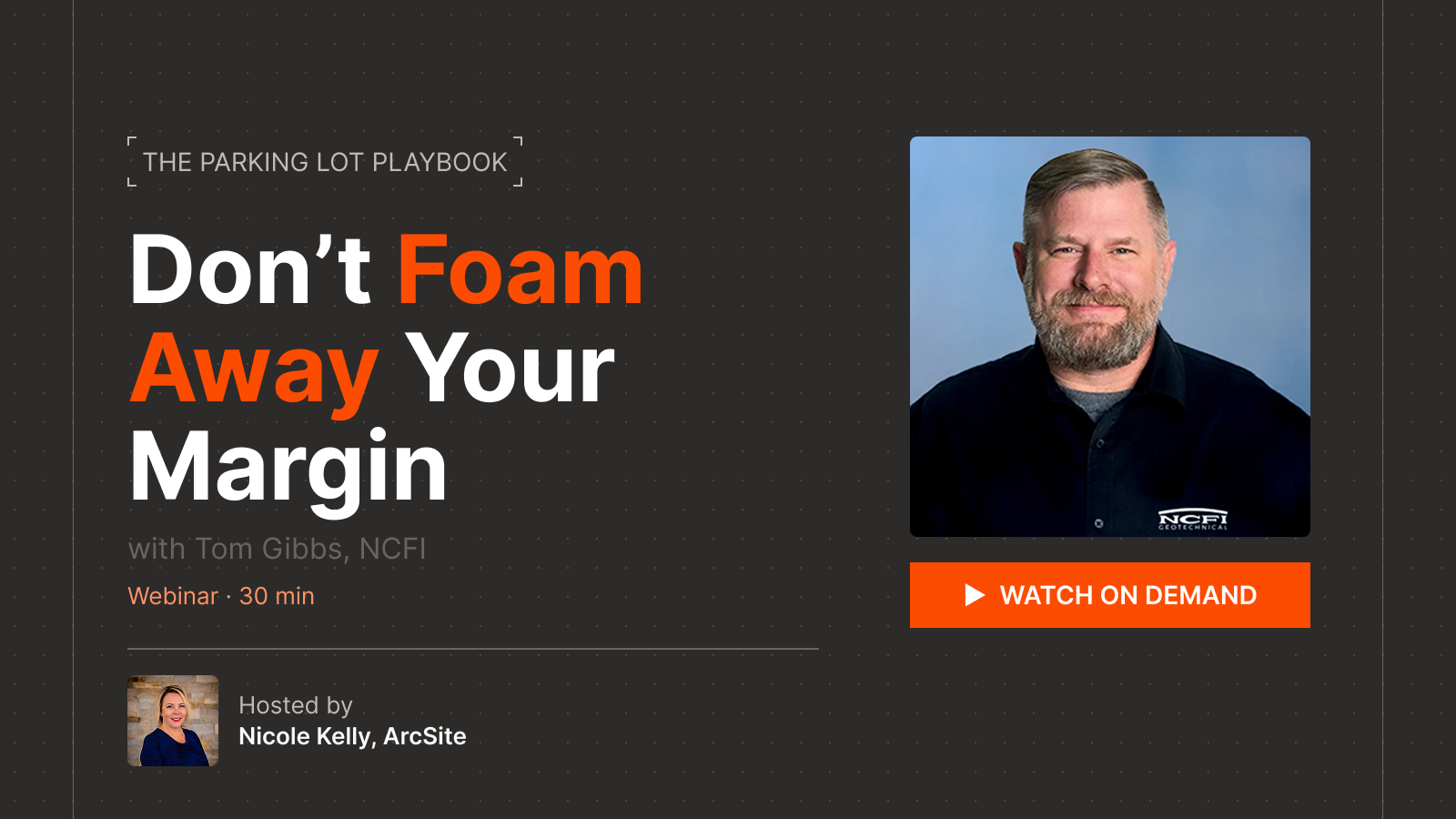
Don’t Foam Away Your Margin
Most foam jobs are won or lost before you leave the driveway. If you guess low on the void, the extra pounds come straight out of your margin. If you pad the number to be safe, the guy down the street gets the job.
In this 30-minute session, Tom Gibbs of NCFI and Alexann Watson of ArcSite show how to scope polyurethane foam jobs accurately and match the right system to the void. They also cover how to hand the homeowner a lump-sum price they’ll sign on the spot.
What you’ll learn:
- Why density drives the math, and which systems fit lifting versus void fill
- How the thickness factor accounts for packing, so you stop under-ordering
- Why lump-sum pricing closes faster than quoting by the pound
- How to draw the job, calculate your NCFI material, and get the proposal signed from the driveway
Share


The Parking Lot Playbook: Don't Foam Away Your Margin
Guest: Tom Gibbs, NCFI
Co-presenter: Alexann Watson, Partner Account Manager, ArcSite
Host: Nicole Kelly, ArcSite
Timestamps every 90 seconds
Nicole Kelly: [00:00] Hi everyone, and welcome to another episode of The Parking Lot Playbook. It's a webinar series from ArcSite, built for contractors on the go to learn how to more effectively use the tools and the products that may already be in your workflow. You can watch this from the parking lot of your favorite lunch or breakfast spot on your phone. Learn how to quickly level up your business and hit the ground running. Some quick housekeeping. We're recording this session, so if you have to jump to a job, you'll get the replay in your inbox. You can drop your questions in the Q&A panel on the right-hand side as we go. We'll get to as many as we can at the end. And if we don't get to them, we'll definitely reach out to answer your question directly. All right. Ready? Let's get into it. So here's the scenario. You're standing in a customer's driveway. The slab sunk, sunk a couple of inches, or the crawl space is a mess. And they want a number right now. So you size it up. You do the math in your head. You give them a price, then you actually start the job. And it takes way more material than you figured. Or you pad the number to be safe, and the guy down the street gets the job because his quote was lower. Most jobs. Most foam jobs are won or lost even before you leave the driveway. So let me ask you, how do you build a quote on a foam job today? Is it in my head or gut feel? [01:30] Pen and paper? A spreadsheet or software? There are no wrong answers here. But if you say gut feel or pen and paper or maybe even a spreadsheet, that's most of you. And honestly, that's most of the industry. It works until it doesn't. So, current way: tape measure, sketch on a notepad, rule-of-thumb math, quote typed up at your office or at your kitchen table that night. The crew shows up, but the actual job turns out to be different than what was sold. Now imagine a new way. Draw the job on site. The material takeoff calculates from the drawing. Create an estimate on the spot, proposal signed before you leave. You can even take a down payment from the driveway. Maybe you can even offer financing. And the crew gets an accurate drawing, material list, and delivers the job everyone expects. It all starts with knowing the product that the job actually needs. And nobody knows foam better than NCFI. I want to introduce to you our speakers today, Tom Gibbs from NCFI and Alexann Watson from ArcSite. Tom works with foam contractors every day so he knows exactly where jobs go sideways before the first pound even goes in. Tom, so excited to have you with us today. Give us a quick intro to you and NCFI.
Tom Gibbs: Thanks, Nicole. So my name is Tom Gibbs. As Nicole said, I've been with NCFI on and off for the last decade [03:00] and been working with polyurethane foam grouts for the last 19 years in some capacity or another. And, and I've been on the residential side, I've been on the manufacturing side, I've been on the commercial side. And, and I know that, you know, after this many years, I can kind of look at a job and have a ballpark idea. But the reality is, as Nicole mentioned earlier, the more precise you you are with your measurements and, and having, you know, the computer do the math for you, certainly makes makes more sense. And it looks a lot more professional as well. So, and we at NCFI, we have an entire division dedicated towards just this product line. We also make spray foam insulation, roofing foam and a bunch of other stuff. But the team that we've put together has over 160 years of experience dealing with these products, been putting in the ground for a very long time. And, and we're really proud to be, you know, the kind of the innovators in that.
Nicole Kelly: Awesome. And Tom, we're definitely going to get into it a little bit more. So excited to have your knowledge and your experience. Alexann, quick intro for the viewers. Who are you and what do you do here at ArcSite?
Alexann Watson: Yeah, my name is Alexann Watson. I'm the partner account manager over here at ArcSite. So I've had the pleasure of working with, as far as getting their products into ArcSite and working with them on the proper calculations. You know, ArcSite always wants to partner with the top manufacturers [04:30] in the industries that we serve and has been a fantastic partner in getting all of their products into ArcSite. So it's literally click, drag, you know, answer a couple of simple questions and details, and you've got an accurate calculation of exactly how much you need for your project Before, you kind of used ArcSite, and then leave it to run the calculation yourself and put together a quote or order request for foam at that point. Now it's one-stop. It's, you know, you roll in with your truck, you assess the project and you're leaving the property. Having given the client a detailed, accurate, professional-looking...
Nicole Kelly: Super cool. And I know we're going to see some more about that. But, Tom, let me come back to you. Let's start from from the beginning. What type of contractors use NCFI products?
Tom Gibbs: Quite a, quite a variety. But, that we we have a lot of partners that are in the foundation repair industry in general. They work on, you know, residential homes. Some do like commercial, some step up into heavy commercial and civil work. This product right now is primarily designed for, for the residential market, although it certainly can be used on some commercial projects as well. While we do have a lot of of different types of work that we do, this is the partnership with ArcSite is primarily for the concrete leveling product line and void fill. Not so much for, you know, the deep injection stuff, stuff like that. But we do intend to try to [06:00] maybe enhance the product down, down the road to, to work with those as well for the, for the commercial divisions. But yeah, it's, it's primarily we have a lot of people that do just, just polyurethane. That's all they do is go out and lift driveways, sidewalks, foundations, what have you. But we also have, you know, companies that that kind of do it all. And this is just one of the, one of the product lines that they, that they do. And it pairs nicely. I mean, when you're repairing a foundation, if you lift a house up, you're creating voids underneath that house. They need to be filled with something and polyurethane foam is a great product to fill them with. Fill those voids with. So there's definitely a good partnership there. That kind of sums it up. I mean, a lot of, a lot of residential contractors.
Nicole Kelly: Okay, great. And I know NCFI has has a pretty wide variety of different products, and I have to imagine that matching the right product to the job is crucial. So, you know, even if you don't have them in ArcSite and you're thinking about like the different products that you have, what are the differences between when you're lifting versus filling versus soil stabilization versus insulation? What are those differences in the products?
Tom Gibbs: And the ArcSite tool is not going to necessarily help with that. That's what we're here for. But the density is is probably the biggest difference in the different varieties or different systems that we have. And the number portion of the system description [07:30] or system number, that is the density number. So if you're dealing with the 3RH, that's a 3-pound, or 3-pound per cubic foot foam. If you're dealing with the 4RH, it's a 4-pound per cubic foot foam. So with that basic understanding, that helps with the math part of it. But the rest of it is about speed. We have faster systems for lifting, slower systems for void filling, slower systems for deep injection. So there's there's some variety there. All the system numbers that are in ArcSite can also be found and the technical data sheets can also be found. If... Are they going to... Alexann, are they going to be on the website, or...
Alexann Watson: The, the technical data sheets attached to each product, those can actually be available within the app as you draw with those products. Also available on our website under the same name.
Tom Gibbs: So, so that helps give a better description than what you're going to see, you know, just by... But most contractors end up using primarily 1 or 2 systems until they come across a special project. We put the majority of our systems into the ArcSite platform just so it would make it easy, to, you know, if you do come across a special project, it's already in there. We don't have to go add it in or try and figure it out, but, but the density number is is the key factor in the math part of the calculation.
Nicole Kelly: That makes sense. And, you know, thinking about all the different types and particularly [09:00] if those special jobs come up, where do you find that contractors go wrong? most, when they're they're scoping and pricing out these types of jobs.
Tom Gibbs: So the biggest, the biggest thing that we see happen periodically is you, you know, you can't really see below the slab, right? Unless you do some test drilling and some people do that and it's a great practice. When you don't know the size of the void, it's hard to give a really accurate estimate. For one thing, you're not going to be sure how much material you're really going to use on the project, but more importantly, larger voids, can create problems with the material. We have a line of super-low exothermic systems that are designed for filling large voids. When you come across them. Let's say you've got a front porch on the house. I think we have down here in the South. You know, they've got large front porches, built all kinds of different ways, and sometimes you may have a six-foot void that is four foot tall underneath this porch. And if you sit there and pump your, your fast-lifting foam into that void and fill it all the way up and go, why isn't it lifting? Why isn't it lifting? You could literally catch it, catch the foam on fire If you put in too much too fast of the wrong system. So when you drill the hole, you should know that. You know, you you'll find out real quick. [10:30] Inspect the hole. But that's that's where we see issues happen is the, the... If you don't have enough information to, to to properly scope the job, it can bite you both on the overage portion, portion of it, you know, using more material than you anticipated as well as, you know, potentially creating a problem with heat.
Nicole Kelly: I didn't even know that you could catch your foam on fire putting it in too fast. So definitely something to watch out for if you're thinking about like, if you could give one piece of advice to a contractor pricing their next their next job, what would it be?
Tom Gibbs: Gather as much information as possible on the front end and put it into the, into the app. The app's not going to tell you which foam to use. That, that comes from working with us and learning as much as you can about the different systems and knowing when to say, hey, I need to give, you know, and see if I call or NCFI a call, or I need to do this with this job because of these certain circumstances that comes with time. But, yeah, I mean, the variety of foams is on there. To be able to scope anything, but, most, most contractors are going to use maybe 1 or 2 of those systems that are listed.
Nicole Kelly: So we've got, make sure you pick the right foam, scope the job accurately. All right, Alexann. And now let's see what happens next. Okay. You have to turn that into a price, right, That the customer says yes to. So talk us through [12:00] how, how do you take this this job, you've got it accurately scoped. You've got the right material for it. Now what? What happens where you could take that job from, you know, the driveway, basically, from start to finish?
Alexann Watson: Yeah, absolutely. So, Nicole, we have a we have a demo video that we'll show eventually at some point in this webinar. But, you know, from start to finish, you're drawing out the driveway, you're sketching the property. You know, whether you're lifting a driveway, concrete slab or a patio, whatever it is like we have here. Perfect. Great timing. You're going to be able to not only show where your injection points are, but you're going to be able to pick each type of geotechnical polyurethane that you're going to use per area. Now we have two different kinds of products. Some are by square foot, some are by pounds. And when you're entering these into the drawing, you're going to see which type you're going to use and where. You can even produce a, a legend to show your homeowner, hey, here's what this color means, because obviously it's not labeled right here and you're going to see it right now. You can drop that legend right in the top right-hand corner. Again, so your homeowner can reference, you know, what they're looking at and understand it better because that's the big thing. And I think a lot of contractor conversations, you want to understand what you're looking at. As you can see here, once those products are entered into your drawing you're going to add some specific attribute details. Tom, I would love for you to elaborate on these details that need to be entered in, such as, you know, the void in inches, the settlement in inches, and you know, [13:30] the thickness factor and things of that nature.
Tom Gibbs: So, basically, estimating is basically a big problem, right? We're trying to calculate the amount of foam that it would take to fill the void if the slab was magically put back into place. And so if you've got a driveway pad, for instance, it's ten by ten. What does it what does the void look like underneath? If I get it back to where it's supposed to be? It's not always going to be a perfect shape. It could be triangular shape or what have you. So sometimes you kind of got to average it out. But that's what you're trying to get to. But you also need to take into consideration this is why we did the thickness factor and so on. The thickness factor we're taking what folks in the industry call packing into consideration. So we're not just going to fill that void. The ground underneath it is going to have to start to compact enough to support the lift. So and then the foam itself is going to compact as it's being put in. So that packing factor increases the amount of material that you're going to need. And so what we did was we said okay let's do a thickness factor. Can you click on the thickness factor?
Alexann Watson: It's actually a video, so I can't quite click on it.
Tom Gibbs: Yeah. Okay. Well it gives you a choice between I think light, medium and heavy. [15:00] And then it gives you a chance to just put in your own number. But basically it's a, it's a percentage that you're adding for additional material for, for the project. You know, because once you figure out what that void looks like, you can say, okay, using a 3 pound foam, it's, you've got, let's say, you know, ten cubic foot void total, add it up. Then you're going to use, let's say nine. So the math's a little bit easier. you're going to use, you know nine three times that. So so you you're doing the math and figuring out that. But you want to add some additional material in there for that for that packing factor. And so that's what the "Choose a Thickness Factor" box is for there, or dropdown menu is for. And it shows you when you, when you actually click on it, it'll, it'll show you the percentages that it's increasing it. And then it gives you an option should give you an option to be able to just put in your own number. If you're somebody that has been doing this for years and you're comfortable saying, hey, I'm always going to put 25% extra on there. Then you have that ability to do that with that tool.
Alexann Watson: Awesome. So you have your the, you know, the, the void in inches, the settlement in inches. Those two are going to be added together to essentially create that, right?
Tom Gibbs: Right. So if it's down two inches and has a two-inch void, then we're really trying to get it. When, when that's back in place you've really got four inches there. [16:30] So it's just adding those two numbers together. Some people just look at it by the drop. But if you're somebody that looks like you look at it as, as a void and settlement, then that's, that's how those two numbers add up together.
Alexann Watson: Awesome. Yeah, we've worked very closely with NCFI to create these calculations and to add in all these, details that are extremely important to calculating the exact number and amount of product that you need from NCFI. So you're not order, order, over-ordering or under-ordering, You know, for your job and you're able to not only have that accurate data on site, you're able to produce a proposal, take a signature, take payment, and you're ready to go.
Tom Gibbs: Yeah. And, and also that, that same drawing, all of that information, it's all based in the cloud. So the crew also has all of that information when they get on site as well. There's not that worry of like, oh hey, wait a minute. Somebody did different math. And that's very valuable. That's very valuable because a lot of, a lot of companies have gone to pricing things by the either by the pad, each individual pad, or by the square foot. And the crew needs to know which, which pads to work on. And so having that drawing showing, hey, because the customer may have decided to not do the full job, they just want to get rid of the worst, you know, drops and and they may not do the whole driveway or what have you. So, you know, the crew may see another spot that needs work and then they go off and do it, and they weren't [18:00] supposed to do it. And then the the boss gets mad because they, they were doing work that, you know, the customer wouldn't get charged for. And so it's, it's great to have that accurate drawing. I've seen a lot of, a lot of I've been on a lot of job sites where the crew breaks out a hand drawn, you know, thing on a piece of notebook paper, and they're just trying to figure it out. And some guys are good at that. Some guys are not. So it's nice to have a very professional looking thing like this. And, and Alexann can tell you more about it. But there's a lot of other tools here. It's not just the the estimating but the proposal that it puts together and all that stuff. You know, I used to spend hours when I was contractor doing this myself, writing these things up. And because I did not have this tool at that time and I think it's, it's great to have that.
Alexann Watson: Absolutely. I think the three main things are time, trust, and professionalism that, you know, we see are the most effective when winning a job. And not only is this saving you a ton of time with the calculations. It builds trust when you're able to get the accurate numbers on site the first time, and you know you're able to show a professional proposal, which is just it's going to build trust with the homeowner all around and say, hey, this guy knows what he's doing, they've got the right tools, and they're ready to go. Instead of having to come back later and say, "Oh, we didn't calculate this right."
Nicole Kelly: Yeah, for sure. And thinking too, you know, with ArcSite, I'm going to give a little shout out to Nate, our payments guy. But also, you know, if you're, if you partner with ArcSite and NCFI, [19:30] you have the option of being able to take like a down payment right there with a payment option from, from ArcSite, but also financing. Right. Because these, these jobs sometimes are not the cheapest. And there are jobs that the homeowner doesn't really save up for, like they may with some other home improvement projects. As somebody who also lives in the South, the ground can shift pretty quickly. And so being able to, to be professional, be able to show them like, hey, we know what we're doing. We look professional. That also builds trust and and be able to, to help you win the jobs faster. All right. So that matters for your bottom line too. Tom, Alexann, thinking about where the money actually, like, leaks, right? The, the title of this session is "Don't Foam Away Your Margin." You know, talking about like the underpriced jobs, the extra foam and the labor coming straight out of your margin. That's something, Tom, that you probably have seen quite a bit in your experience as well.
Tom Gibbs: Yeah, there's you know, there was a trend a long time ago to price these jobs by the pound and say, okay, you know, Mr. Customer, I think it's going to be, you know, probably a 200-pound job and sort of back then, pricing was maybe ten bucks a pound or so and you're like, okay, it's $2,000. You get 200 pounds of foam. Well... You get into the job. [21:00] First of all, there's a huge negative there for the, for the customer. Like, you're, you're asking me to sign a blank check by doing it that way. There are still some customers, are still some contractors that do that. We kind of like to train and push the concept of lump-sum pricing, where you just you get as much information as you can, have an accurate quote and go in. And if you go over a little bit, you go over a little bit, you lose on that one a little bit. If you're constantly losing, then you need to reevaluate your estimating technique, you know, gather more information, get more detail, be more accurate with your measurements and that kind of stuff. But you're going to have a lot where you if you're using the, the, thickness factor, that overage percentage that bump it up a little bit more. You're going to have some jobs where you said it's going to be 200 pounds, and you only use 150. So treat those pounds like, like dollars in a bank account. If you, if you're under 50 on one, on one job, and put it in the bank. And then when you end up being over by 10, you got 40 pounds left in the bank. And so lump-sum pricing is a whole lot easier to close your sales with. To be able to say this is what it's going to cost. Now the crew needs to know that if they go out there and they drill through that front porch and they find a seven-foot void that they need to call the boss and say, hey, we need to talk to the customer. This is not what we thought we were up against. And your contract language should read that you have the right, even though you've [22:30] given them a lump sum price, that you have the right to be able to back off and say, hey, unforeseen circumstances, we didn't know there was this big of a void here. We can get you a new price. We may want to actually use a different product for this, so we probably need to come back and do it a different way. If the void's too large. Because not everybody's going to have the void fill foam on their rig at all times. So it gives you that that opportunity to do that. There are still people that, that, will add an overage clause into their lump-sum pricing, but that's not really true lump sum pricing. But they'll give them an estimated number of pounds. It's still a big negative when you're trying to close the sale. Imagine.
Nicole Kelly: And so we are getting close to time. I want to make sure that we have time for Q&A. And so I'm going to switch over to see if there are any questions. Alexann, the first one's for you. Does ArcSite work offline, like in a crawl space or a basement if I'm somewhere without a signal?
Alexann Watson: I believe it can. If you were... Yeah, I believe it can download in there so you're able to work offline, but it just won't sync to the cloud while you are offline. It'll have to wait until you're...
Nicole Kelly: Drawing in ArcSite works fully offline. And then it'll sync when you're, you're back online. The product photos too are also available offline, but videos will need a connection to be able to sync. Let's see what else is on there [24:00] in terms of, "Do I have to build my own NCFI product library myself, or is it part of ArcSite?"
Alexann Watson: Excellent question. So when, if you're signed up for ArcSite and you would like the product library, you just let us know. You can let us know. I believe through whoever's sticking to it. Ask your, your sales rep, your customer success rep. And it's super easy. We just copy it on over to your account manually.
Nicole Kelly: And I guess maybe this is for both of you. Can I give the customer options when I'm quoting and I'm assuming, Alexann, it's probably close to the good, better, best pricing that we do in our estimations. But Tom, Alexann, Are those products set up in the ArcSite library for them to be able to do like this is the best option that you could do. This is like the most cost-effective one.
Alexann Watson: So I'm going to start this off. Tom, I'd like to have you elaborate on if there are options like that for projects that you've seen where you would offer a good, better, best. And then I'll elaborate on how that works in the proposal tool.
Tom Gibbs: Yeah. I mean, like I said earlier about some projects, you know, you may propose to do the entire driveway, you know, usually part of the driveway settling. It's not a bad idea to go ahead and try and stabilize the whole thing, but they may not opt for that. They just want to get rid of the, you know, the bumps that are [25:30] tearing up their tires or what have you. And so the best option would be to do the whole thing with caulking and all that good stuff. Whereas the good option may be to just get rid of that one big bump in the driveway that's driving me crazy. So yeah.
Alexann Watson: And when you go to the proposal, you are able to offer a good, better, best option. And we actually have a webinar next month on proposals, best practices that you are welcome to attend to. Learn exactly how to do that.
Nicole Kelly: Awesome. Well, I know we're getting close on time, but before you go, Tom, Alexann, do you want to talk about the special offer for NCFI and ArcSite customers?
Alexann Watson: Absolutely. So all new customers who sign up through NCFI, the promo code is NCFI10. And that is 10% off your first year of ArcSite. That applies to both annual and monthly plans and to all tiers.
Nicole Kelly: Right. And Tom, how should people get in touch if they're interested in learning more about NCFI and the products?
Tom Gibbs: We have a Contact Us form there on the website you can send in, you know, send in your contact info and we're happy to to get back in touch with you. It's sent out to myself as well as the territory manager that for that state. And so we'll make sure that you're, you're able to get ahold of somebody, or somebody gets ahold of you rather, and, and, and happy to get anybody started, whether they're currently, you know, already doing this and using one of our competitors products and want to give us a shot or if, just wanting to get into the industry and add this to the more that they're doing [27:00] or just starting from scratch, I'm happy to help with any of that. And I think this is a great tool that, that, you know, we have we've never had before. We've had our little calculators that we use and they're great, but they don't put together an entire proposal that this does. And I think it I think it's great from that aspect.
Alexann Watson: Awesome. And if you're interested in ArcSite and you're not already an ArcSite customer, you can go to www.arcsite.com. We have a Book a Demo form there, but you can also check out the website and see all of our all of our information, but you can definitely get in touch with us that way. Nicole, we have two more questions in the chat. If I can toss those to Tom real quick. Tom, the first question is do you recommend pre-drilling for void check?
Tom Gibbs: You know I do. I did it all the time. And I can honestly say that 99% of the time if I did that I got the job. About the only 1% time that I didn't would be if, if they just didn't have the money to fix it. You know, because you're going above and beyond what your competition is doing. When you do that, you're increasing the accuracy of your quote and giving the customer a fair shake. You know, you can still miss something. You know, you can only drill so many holes before they're like, okay, "I don't want my garage to be a Swiss cheese." But, you know, you can drill one spot and there might be a bigger void over in another spot that you didn't find. But if you're not going to drill, at least use like, a rubber mallet to tap around. There's all kinds of different tools for, you know, kind of identifying the voids by just tapping on the slab, [28:30] whether it's a rubber mallet or seeing guys just carry a stick that they, you know, bang on the ground and you can hear that hollowness. But when you hear that, you know, if your sales guys are not going to carry a drill and do drill tests, if you hear something sounds really bad, maybe it's a good time to say, hey, I want to have my operations manager come out and do a couple of drill tests to see, you know what we're up against. This is the larger the job, the more chance there is for that. You know, to be a big loss if you end up, you know, having a bigger void than you could by just standard, you know, looking at it and putting the hammer to it.
Alexann Watson: Awesome. Thanks, Tom. And the next question is, was this recorded? Yes, it is recorded. Nicole, could you please elaborate on where this will be, where it will live and how they can get access?
Nicole Kelly: It is definitely being recorded. And once we do the processing, for it to be able to get you a link that you can access, you will get an email from ArcSite with the link to the playback for this webinar. Probably be tomorrow. But you'll definitely get an email from, from ArcSite and it'll have the link where you can hit the playback. We have one more?
Alexann Watson: Yep, that was it. It was just a comment that someone's got a crew who is using both ArcSite and NCFI products, and they think it would be helpful for them to know that we have a product.
Nicole Kelly: Well, that's awesome. I'm glad that this webinar was helpful for, for you to, to know that that's available for you. [30:00] Looking forward to hearing your experience of what it's like. Before we go, like, here's the takeaway. Don't foam away your margin. Pick the right products. Price it right. Scope it right. You can get the contract signed before you leave the driveway. Tom, Alexann, thank you both. And thanks, everyone for spending part of your day with us. We'll see you at the next Parking Lot Playbook webinar series session. But until then, be safe. And thank you for joining us.
Share
Share








Ask AI about ArcSite: