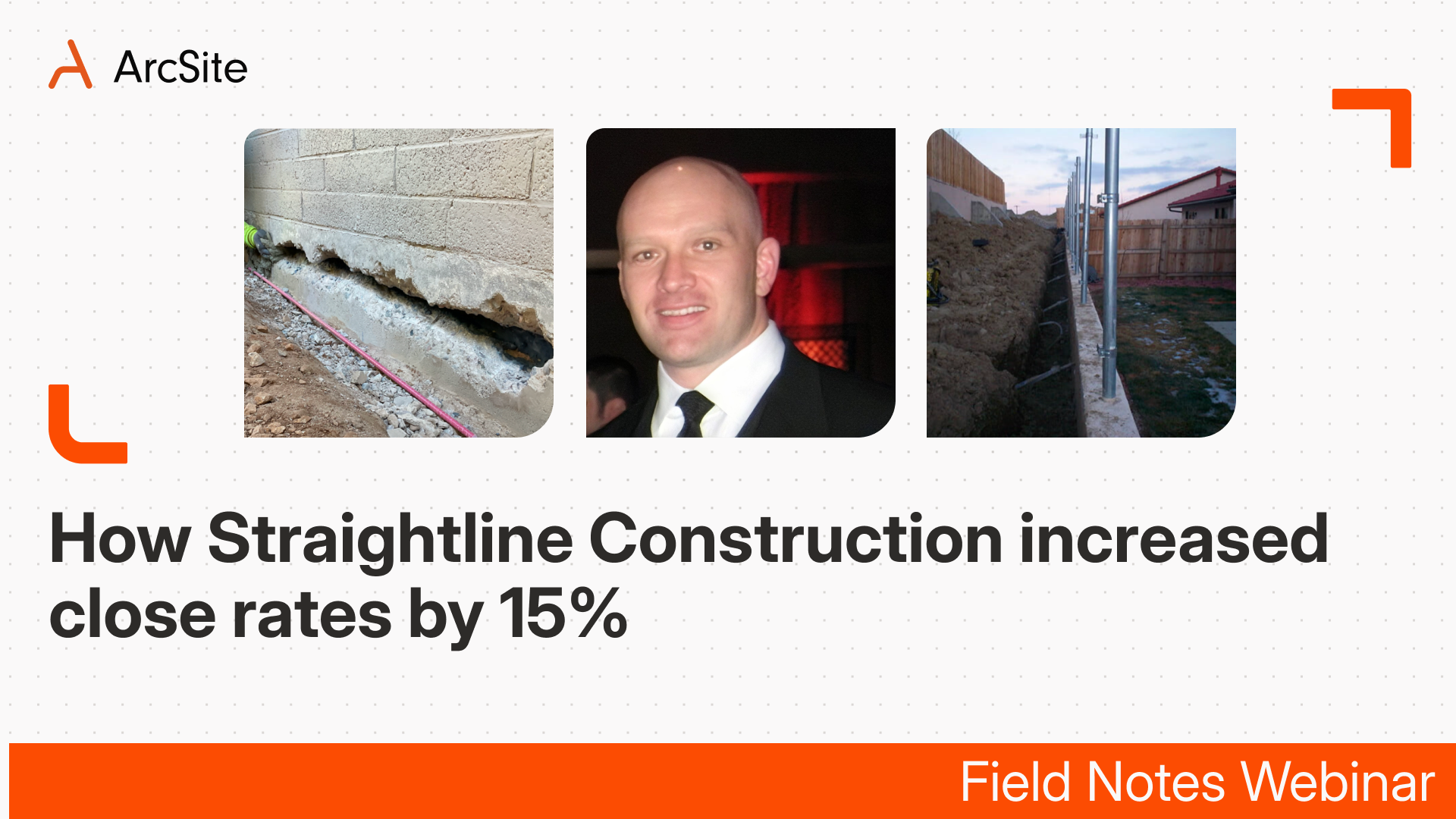
Field Notes: Finger Snap Pricing with Robert Whittaker of Magnolia Fence
Access the webinar
You finish the walkthrough and shake the homeowner's hand. They say they'll think about it.
That's the moment most contractors lose the job. It goes to whoever calls back first, or better, to whoever already had a number before leaving the driveway.
Robert Whittaker runs Magnolia Fence and Patio, a $10 million fencing and patio company outside Fort Worth. For years he watched good leads go cold in the gap between the estimate and the follow-up call. Then he changed one key thing - he started pricing jobs on site before he ever left the yard.
The results: 40% more revenue recovered from deals that used to stall out waiting on a callback. His cash conversion cycle dropped 15%, and nothing else in the business changed.
In this episode of Field Notes, ArcSite's Nicole Kelly sits down with Robert to walk through what he calls "finger-snap pricing" - a system designed so any rep on his team can quote, draw, and close before they leave the property. He gets into where he stalled out building it, and the three moves any contractor can make this week to close their own decision window.


Guest: Robert Whittaker (Magnolia Fence and Patio / Purple Coaching) Host: Nicole Kelly (ArcSite)
Nicole Kelly: Hello everyone, welcome to Field Notes, a series from ArcSite where we sit down with real pros doing real work and discuss how other home services pros have solved thorny business challenges. I'm Nicole Kelly. Today's episode is called Finger Snap Pricing. We're talking about what happens in the gap between your in-home visit and the close, because that gap is where deals go to die. A customer says, let me think about it.
And by the time they thought about it, your competitor has already booked the job. But today we have someone here who has solved this problem, and not with better salespeople, but with a better system. But before I bring out our guests, I want to ask you a question. But I also want to tell you what we're going to cover. So here's what we're covering today. First, the decision window. What is it and why it might be costing you or your team from booking the job? Next, revenue leak.
How slow pricing bleeds revenue. Finger snap pricing, what that system looks like, and how any rep can run it. And the three things you can do this week to start closing the window. We're recording this session. Drop your questions in the QA panel on the right-hand side. We'll work through as many as we can at the end. All right, but before I bring out Robert, I want to ask you a question. When was the last time you followed up on a quote?
[01:36]
Nicole Kelly: And the customer had already gone with someone else? Be honest, most contractors in this room have a story or two, or more, where you know that that deal didn't go to a cheaper competitor. It went to whoever got back to the customer first, or maybe whoever delivered a quote before they ever left the customer site. That's what today is all about. So I'm very, very excited to welcome Robert to Field Notes. Robert, I'm really glad to have you here.
For folks who don't know you yet, give us the 30-second version of who are you and what does Magnolia Fence and Patio and Purple Coaching do?
Robert Whittaker: Yeah, hey, Nicole, thanks for having me on and I'm so excited 'cause I get to
not only share my story, but go shoulder to shoulder with one of my favorite softwares, my IT stack. And I've got a heck of a story because I am far from the person to implement a software like this. So if I can do it, anybody can do it. I have never gotten paid by anybody but myself. I've written the check, signing on the front and the back. And somewhere in my early 20s, I decided I was crazy enough to own a landscape company. And the challenge there was you would install.
Plants and asked people to wait for it to get bigger. And over time, I realized I wanted to be in construction where I could leave the finished product the best it was ever gonna look. And so moved to Fort Worth, Texas. started Magnolia Fence and Patio. We are a $10 million company. We primarily operate in the residential space, now entering the commercial space and
[03:09]
Robert Whittaker: purple coaching is the man of the arena coaching and consulting service. I I've done this long enough. People call me because they want to do what I do, and I have to show them what I did. and so we get to work through challenges, tough conversations, and and help people scale their leadership team. So
I own a fence, patio construction. If it's outdoors, pretty much we execute it. And then I own the consulting business where I spend about eighty percent of my time helping businesses fall back in love with what they started.
Nicole Kelly: Yeah, and just so people have context, you mentioned it's a $10 million business. You have two locations in Dallas Fort Worth, and you have purple coaching. So you have built out enough of a business operating system that now you spend most of your time coaching other contractors as the purple coach. So your fencing and patio and outdoor business basically runs without you being a bottleneck, right?
Robert Whittaker: It is.
Yeah.
Yeah yeah, and I guess for those listening, so 10 million is revenue and and for anybody that I coach knows that we also like making profits. So we take typically sixteen to eighteen percent to the bottom line. We manage our margins, about forty percent gross margin, and our overhead runs anywhere between twenty, twenty-five percent. So we definitely drive revenue, but we also like the world needs us rich.
The world needs us profitable because we can solve problems and we're very meaningful with the means. So we do make money. Now, not every year because of different things in the market, or we choose to scale the company and it costs money. But yeah, and and I know we'll get to that. But if you ask me when I started purple coaching consulting, it was after I put in some of my IT stack. There were two companies that changed the trajectory of my sanity, for lack of better words. It was both JobNimbus and ArcSite and
[04:55]
Robert Whittaker: I remember five or six years ago I said, I want a tool that I have one login. And I can tell y'all right now that that's like saying I want one employee to do all the tasks. You need different employees, you need different logins for their expertise. and so I was
I was told I was only allowed 10 large ideas a year. And it was February and I'd used them all up. So actually, behind the backs of my employees, I launched ArcSite and JobNimbus in the same month and a half. And I realized once we implemented and executed and got everyone on board, I was like, I don't have to be here anymore. So I bought back my time. And so how I can spend 80 or 90 percent of my time doing consulting work,
I mean, I can literally even train my competitors. They'll just never catch up to me because our systems and processes are just so fast. And I think about Nick Saban, you know, Nick Saban didn't care who was on his team. He knew how to win championships with his systems and processes. And I mean, you want to talk about like people don't want to work anymore. He had 18-year-old knuckleheads that were used to being hometown heroes come into a town and had to play as a team. And somewhere after four years, he knew that they were gonna leave him.
[06:08]
Robert Whittaker: And so, anyways, between ArcSite and JobNimbus, I launched this. Now the question I want to back up, and I know that you're in charge, but I want to back up that question pissed me off equally as much. And so that question was solved because I I implemented some automation through through JobNimbus. So that bought me some time, but I realized that that that
Following up was key, but you also needed to get people pricing fast. And so when we're talking about snap finger pricing and and how that all works, now I don't have the hero story you're probably looking for because I was the person who did not implement ArcSite to the fullest capacity, got really close, and then I got distracted. But I still hung on to the software, still worked with it. And now we are where we are today, where now I can hire and fire and promote salespeople because I have a tool like ArcSite that.
allows me to not have to train pricing, train measuring, train in-home presentations. But the question right there, when was the last time you followed up on a quote and the customer had already gone with somebody else? In the world I'm in, and I want everybody to know this, the world I'm in, it's likely that they're going to need to talk to a neighbor.
So the reality that you have to follow up is extremely high. Now, if I was a roofer or I was performing landscape work, I could probably close it on site. But if you don't have a process for follow-up, and I want to I want to go ahead and just kind of put a pin on this, it is you it is your permission to be persuasive. They contacted you, they want you to be persuasive, not manipulated, but persuaded. And I I would argue that people claim that nobody wants to work anymore.
[07:49]
Robert Whittaker: So if you show up asking for the work, you're gonna stand out. And for good.
Nicole Kelly: Let's talk about that decision window because I think that comes into a really good point of what you're talking about here. You know, first of all, we should probably establish what the decision window is, but most contractors are probably losing deals in this window and they're blaming it on something else entirely. So, you know, talking with you earlier, you know, thinking about like the decision window is where the deals go to die. The longer that decision window is open.
the more opportunity somebody else has. And so I really want to talk about these numbers because this is pretty impactful. You mentioned that there was 40% revenue recovered, not from new leads, but just from pre like plugging that revenue leak in that decision window. And then that 15% drop in the cash conversion cycle from closing in home. Like both of those came from that one fundamental change, giving the customers a number before you leave the site. So Robert, walk us back to the beginning.
Before you had that pricing system in place, like what did that in home estimate actually look like? Like you'd go out, you'd measure, and then what happened?
Robert Whittaker: Yeah. So like looking back, I actually really loved my old presentation. It was old school. It was we'd printed this this pamphlet and I'd gone to Mexico and I'd sat through some 90 minute presentations and they are just phenomenal salespeople. They take a marker, they put they're you can't tell what they're drawing or writing, but like your eyes are captivated.
[09:19]
Robert Whittaker: And they're moving so fast. And I was like, that's how I want to sell. And so I I did that process and then I would jot up some quote. Well, that worked for a while, but that's like that's 2x growth, but that's not a 10x scalable growth. And so you know, it got to the point where then I was finding myself constantly apologizing because I wasn't getting to people fast enough and you had to implement softwares and things like that. And so so for the listeners, I don't think a lot of people understand their cash conversion.
Conversion cycle or their CCC. The cash conversion cycle, in my opinion, is from the day you spend a dollar to the day you collect the dollar. And so, like in my world, you spend some level of marketing and then you hope that they're gonna call. It's probably not like running a special today for pizza and you get called that same day, but let's assume from the moment they contact you to the moment that you collect that final check is 60 days.
Well, you better hope that you're borrowing money for 60 days free of charge. And we actually our cash conversion cycle currently right now is about sixty-six days. And we borrow money at about eighty-five days interest free. So our goal is to always just stay below eighty-five days and we're borrowing free money. If you guys want to hear more about this, just reach out to me, Robert Whittaker Purple Coach, because this is so critical.
[10:39]
Robert Whittaker: And when we were reaching that 85 to 90 day cash conversion cycle, we've said, where's our biggest bottlenecks? Where are we spending the most time? It was two areas. One collections, which shouldn't be, but one was collections, a little bit out of our control, and one was the the close. We would do it as some level of of on-site like
I guess estimate. I don't want to say proposal, because we were just walking it, measuring it, getting to the next one as fast as we could. And we'd go back and have an office day and we'd send them a quote and things would get spammed. And like you mentioned, we'd forget to follow up. Or here's the crazy thing about that question in the past. When was the last time you consistently followed up? Because here's what happened. You go, I'm gonna follow up. And you follow up with 40 people in one day.
And then you can't get back to all those people that responded. So you need to just follow up consistently, two to three people every single day. So that way your pipeline always stays consistent. So going back to this 40%, most people just wanted to be asked for the close. And that's if you're listening, if you aren't selling, it's likely because you're not very good at asking for the close. People need to be sold. And if you're selling an honorable product, your company has.
A mission, vision, and values that align with the world today, then you need to ask for the business. And so, anyways, this 40%, I mean, I can show you in it's two parts. And I really need to make sure that everyone here, like ArcSite was extremely helpful, but it wasn't one login. It also needed to be JobNimbus or whatever it is, contractor accelerator, whoever it is. Like,
[12:17]
Robert Whittaker: The day of having one login is such an amateur way of thinking. And if you can't manage two logins, show me that you only have Netflix and not Amazon. Like you have you have Disney and Prime and Paramount. Like, let's prioritize your priorities. And so the 40% happened because we got people pricing quicker. Just simply put.
And not only that, it was very accurate. And we we have real-time pricing in there. So it's non-negotiable. It wasn't like, let me check with my supplier. And in the fencing world, people, this is how it works. You go measure and then they go send a quote request to a supplier. The supplier somehow magically sends it back over a period of time, and then they tell you the price. Well, we we've done this so long that we don't need to one bog our suppliers down for that.
And s and two, like we know suppliers are dealing with the exact same challenges today, which is a shortened labor force, the the supply chain that's temp taking a lot more of their time, and they're just not as responsive. And so
we figured out what our cost is per product. We put it into ArcSite relatively easy. We draw the line and poof, we've got snap finger pricing. And then the client goes, That's outside of my budget. And you say, Okay, perfect. What do you want to take off? And then you just change the simple line and then they say, Okay, that's more on my budget. Say, all right, well, what would it take for you to say yes today? And likely they're gonna Well, I need to talk to neighbors, whatever else. And then that's when we didn't do our job. And that's one of my favorite questions to ask and going back to the 40%. Is now that I can provide snap finger pricing.
[13:49]
Robert Whittaker: On the phone, we go, hey, are you prepared to say yes if we get you a quote on site? So we just set, well, what do you mean? I said, Yeah, I understand. We have a professional proposal that's gonna be prepared on site as long as it's one of our chicken sandwiches, one of our normal things. And they go, Well, I hadn't talked to my neighbor. Okay, so you're at the beginning stage of this process. And they go, Well, if the price is good, I'm ready to go. But you're still gonna talk to your neighbors. We know that this is gonna be a process. And they go, Yeah.
Well, if we can get your neighbor on board, then we could actually build you a better fence. And they go, That makes sense, because you know, now we're splitting costs. And we go in with a different mindset, but now we're not giving a proposal to a homeowner. We're asking that the neighbor gets involved earlier too. And so the the numbers have to do with changing the entire strategy. We just had a tool to be able to do it.
So I measure everything on my phone, so it's super nice because you have your tablet. or in this case I was measuring on my tablet, have your tablet. So I no longer have to do a measuring wheel. I don't have to juggle paper and it's raining and everything like that. So anyways, that's that's how that forty and fifteen percent came about.
Nicole Kelly: That's awesome. And like now that we we kind of know like that decision window, that that period of time between the fact that the customer is asking you to give them a number and the time that you give them the number, that decision window is kind of defined. But now let's like talk about the revenue leak because you know, thinking about slow quotes and cooled leads, like there's there's real money that's being lost due to that delay. So, you know, why do revenue leaks happen and
[15:24]
Nicole Kelly: you know, you discovered that there are actually four ways that you're you're kind of like slowing down. So first it's that decision window. The customers are saying, you know, let me think about it or I've got to get my neighbor involved. And that's that's that decision window where the deals go to die. And then the comparison shopping, right? Because it's it's not just about price. It's about buying time. They're delaying, but every time you delay, you open a door for a competitor.
And then that 40% insight, which was, you know, your aha moment, and then the fix, like that guaranteed pricing before you leave. So the customer has a number, that decision window closes. So this is a distillation of a really common situation that most people in this room have experienced, starting with the let me think about it. So, Robert, in your opinion, what's actually happening when a customer says that? Are they shopping price or are they really buying time?
Robert Whittaker: I mean your guess is as good as mine. y you know, I think especially with the infinite amount of information there is today that nobody can trust anything, trust is an absolute premium now. And so if you're not working your Google business listing, getting Google reviews that are real and authentic, then then you're already at a disadvantage. I think
[16:41]
Nicole Kelly: Ha ha ha.
Robert Whittaker: I actually enjoy people getting additional quotes so that way that there is no buyer's remorse or I wonder if. and not everyone has the privilege to be as big as we are, but we started at one as well at one point. And so you've got to understand what your unique differentiator is and just own it and be okay if somebody else doesn't buy into that. And so, like for me, like we own the fact that we're unbelievably fast. And one of the reasons we're unbelievably fast is because we have high overhead.
And I tell people all the time, like, hey, listen, my competitors are likely going to say something like this, Well, Magnoia fence is going to be higher because they have overhead. Well, I bought my building to move faster for you because you at one point wanted me to move quicker. And so the reality is your building is equally mine as it is yours. I'm just dumb enough to buy it. And so I like my unique differentiators, I can move freaking fast.
And here's the deal: if they're not baking in overhead for future growth, they're eventually gonna die. So that warranty that they're promising is not actually a real warranty because they're not gonna be around to enforce it. And so I own some of those things. And if you're like, well, that doesn't matter. Price is the only thing that matters, that's totally fine. But it's not what matters to us. And so this just isn't gonna work. And then that having that ability to provide them a price right away and walk away and move on to the next deal, that freedom.
[18:02]
Robert Whittaker: Is what really matters because the reality is like even if you get four customers, one or two of them aren't your customer, anyways. Like, like it's so crazy to me that people think that they should like sell every but like we don't market anymore. Everything is repeat and referral. So I like it, we get to really make sure that we know who we work with. But like when you're doing a pay pay-per-click campaign, like
You should be filtering them just like they're filtering you. And yeah, the the permission to move on is incredible. So you give them a snap finger pricing, they say, Hey, let me think about it and say, Well, what is there to think about? At one point, you thought you were gonna buy a fence and you, well, we didn't know what this was gonna cost. Well, you had parted with some level of money in your head. You you put a value on this. And you know what's interesting about this? And when you go through all four of these, people are willing to tell you.
If you're willing to talk straight to him, say, listen, I don't want to waste my time or your time. I'm here to help you, but there's somebody else that's already being helped and they deserve more time.
And so people will just be honest, but people don't like conflict anymore because we live in a world where every single time we disagree, we divide instead of disagreeing debate. And that's one of the reasons we actually pick the color purple, is because if you take the Republicans and Democrats and you blend them together, it makes purple. I guarantee I'll never get them to actually agree, but maybe I can start getting them to stop being so disrespectful. And I think that people just are avoiding conflict. So we actually have a solution for that too. We have a tool called My Salesman.
[19:32]
Robert Whittaker: Where we have people that can go on and measure their fencing and they also can do turf and roof and a few other things and they can determine what this stuff costs. So they don't have to get into conflict. But setting the expectation up front too, like, hey, listen, I'm a sales guy. That's my responsibility is get you to say yes or no as quickly as possible. And so what I'm gonna do is I'm
Nicole Kelly: Yeah, and just to let you guys know who are on this call, if you're a customer of ArcSite, you also get a special deal with my salesman and you might want to check that out too. So thanks for plugging one of our partners. Yeah, she's great.
Robert Whittaker: There we go. Yeah, right. Rachel is fantastic, isn't she? yeah. And so so yeah, my my thought is is that you know, if you say, listen, my job is to get you to say yes or no as quickly as possible. For every no you get, you're closer to a yes. I do want to talk about, and I don't know where this happens, but
There's a huge advantage not only to get the close, but as soon as you do the drawing and get the snap finger price, your we call them work orders are created. So if they say yes, you don't have to go and do the work.
Nicole Kelly: Yeah, and that's that's what we're gonna get into with the the finger snap pricing. because the work orders are kind of a big deal. And I love this quote from you. The I almost don't want to sell a job unless if I already have the work order built. So then when you get the yes, you can actually enjoy it. So Robert, like you were starting to mention it and I wanted to I wanted to be that like ESP in for you.
Robert Whittaker: Ha.
Perfect. Yeah, look at Ye yeah. So I'm a hunter and I remember now I don't get to hunt. I'm just a Sherpa for my son. And he shoots a deer.
[21:10]
Robert Whittaker: And he and he looked at me goes, Dang dad. And we we hadn't even gone up there. And he's Dang dad, I think I got ground shrinkage. I What do you mean? He goes, Now we're gonna have to clean it, we're gonna miss camp, and we're they we're gonna cook steaks and my god. And I and it made me think like creating a work order is like skinning the deer. Like it sucks. It sucks. There's nothing especially in Texas where they set the feeder off and they come and it's easy and whatever else. But
The work order is the worst part. And so going back to the original question, when you follow up, be like, Well, the excuses I'd follow up, but I gotta create all these work orders because I'm such a good salesperson. And so if you can have a work order created quickly, you can move everything along the pipeline quicker. And so
If you're gonna have to do the work order, assume the close, right? So I'm drawing it assuming I'm gonna get the job. Also, when you use ArcSite and you annotate it appropriately, like then there's no questions between you and the client. So actually, before I jumped on, we're having a client discrepancy right now. And the and and this is one of my favorite reasons why I think we do. Dakota goes.
She got five different quotes. And I think she's confusing one of the conversations that she had with somebody else with us. And we just simply didn't have proper documentation to prove if we were that person or if it was somebody else. And he goes, we'll get to the end of it, but the reality is the more you can document in front of the client, the the the more you capture your experience when you're walking it. And so that's one of the reasons I actually like going.
[22:40]
Robert Whittaker: close to last instead of first on the sales calls because they the first person they're they don't know what to ask. Second person they're getting better at this. And by the third time they're a pro. And and of course, you know, you you have a better likelihood of closing. Now if you're a high pressure salesperson and you think you can convince people to say yes before they go meet anybody else and we've done that too, you just better compete on price, speed, quality. I mean, and that's hard to do.
So, anyways, but yeah, I I hate making work. So I don't sell anymore. and I told Kelly or Mandy, I said, Mandy, go ahead and book me three appointments tomorrow. And she goes, Are you gonna do ArcSite so that way somebody doesn't have to make your work order for you? Because the last week I sold and I forgot to do an ArcSite. I just I just did a I did a calculator quick, like and and I I laughed. but the other one I sold last week.
Nicole Kelly: Hobbard.
Robert Whittaker: I did draw to scale an ArcSite. And turns out this guy was an engineer and a matter of fact kind of person. And he goes, We didn't even have scale drawings. And we pulled up ArcSite and we showed him everything was to scale. And this was a pergola. so like, I mean, it was a pretty extensive drawing. And so anyways, man, it just I can tell you less conflict, less friction when you draw it, and especially when you draw it on side. So
[24:02]
Nicole Kelly: Okay.
Well, and you mentioned a little bit earlier, and I kinda wanna circle back to it, because I do think that like as a as a homeowner myself, the whole trust, like you have to trust the contractors are gonna do the work, they're gonna do it, right? And so, you know, thinking about like the the finger snap pricing and you can guarantee a price on the spot, like like what does that do for the customer relationship? Like how does it how does it talk about how they how does it change how they talk about it with you and with like maybe their neighbors if they have to do that as well?
Robert Whittaker: Yeah, I mean I think it definitely shows that you that you're a seasoned vet, you're experienced. I mean, nowadays and I mention reviews. We have, I don't know, eight hundred five star reviews. So that would take a lot to get. but Google Business Listings, SEO, stuff like that, overnight you can look like you've been in business a while.
but if you can give snap finger pricing, you're super confident in what your pricing is. It shows that you're an expert in your field. you have a good partner relationship with your vendors where the your pricing isn't constantly changing. You might even buy in bulk or or things like that. I do want to touch on that trust thing too though, because let's say that the client is hiring three to four people.
and actually what I should tell everybody, like, my only role still at Magnolia Fence is to run the the set the vision and strategy, but also to run the sales and marketing. So, like, I know sales and marketing, like that is my jam. I enjoy it. be very careful because that homeowner was the person who picked the people that are coming and giving bids. So if you have any
[25:33]
Robert Whittaker: desire to talk bad about somebody else, you're telling the homeowner that they're not a good researcher or that their picks aren't that good.
So while I do think that because I can provide snap finger pricing and maybe the person behind me can't, that's still not going to be a tool that I'm going to use against the other person because that homeowner either was referred by a close friend or they had done their research and thought that they'd they'd vetted them properly. And so really all you're doing is is hacking away at at somebody else's confidence.
And so what you say is listen, everyone has a process. I just know that I've gotten 700 or 800 five-star reviews following the same process with different people. And that's what, and if you're like, well, Robert, I don't have 800 reviews. I hadn't been in business 10 years. Guess what? Stay in the fight. I mean, let me tell you about this, Nicole. Like for anybody listening, because I think imagine I imagine a lot of your clients are are newer business owners that are that are that are trying to either get started or seasoned ones. There's and and this is it, this is like the
Nicole Kelly: Trying to grow.
Robert Whittaker: So important. The compounding penny. Have you ever heard about the law of the compounding penny? So for those listening, a king says, Hey, I'm gonna give you a million dollars, I'm gonna give you a penny that doubles every day. And and and there's gotta be a trick. So the guy says, I'll take the penny that compounds every day. Well, on day 25, it's only $125,000, but on day 30, it's 5.2 million. And so, like, pick a process and a system, automate it and get really good at it, and then just stick with it. And so
[27:03]
Nicole Kelly: I sure have.
Robert Whittaker: the reason I have 800 five-star reviews, the reason why I have sales reps that I can just interchange is because I picked ArcSite, I picked Drop Nimbus, I made a commitment, I built it out, and now this process is so seamless, like it's too easy not to. And so I go tell clients all the time the reason I know we're good is because I can do it with anybody we have on staff because we've been doing it for 10 years that and still get five star reviews.
Nicole Kelly: Yeah, and that's that's the other thing. You had mentioned the salespeople. And for for anybody on the call who's, you know, hey, I want to grow or I wanna I wanna be able to be more efficient and grow more effectively, really thinking about like what this is worth and like the the downstream impact of like the all of the different tools that you have mentioned. and you know, compressing that that
decision window and the data leak. So you had a really interesting quote, and I'm going to pull this up of like what makes this system work? And you really we distilled it down to three things that have to be true for this to work. Pricing in the room, not in the office, right? Or pricing in the in the yard or pricing in, you know, the foundation, like the crawl space, but pricing where the customer is. And then also the work order before the yes, which you have definitely covered.
And then that system, not a superstar. And so you were talking about, you know, your salespeople being able to run this, regardless of whether they're a tenure veteran with you or they just came on last week. So looking at these three things, Robert, like give me some insight into what you think is is probably the most impactful.
[28:42]
Robert Whittaker: I think they all are on different levels, especially depending on what your role is in the business. But I want to touch on the 10 year veteran. The reality is we don't have 10-year veterans anymore. I mean, the statistics says people either stop growing or get complacent after two years in the workforce. And really, as fast as things are being disrupted, like you need to be able to get people trained and in place quickly, and people are gonna get uncomfortable or or impatient and they wanna grow. And so,
Like for example, Colin, he's been with me about a year, year and a half, and we had the tools for him to be successful out of the gate. And we got him, we know that these tools get you to two million dollars.
So the system gets you to two, the superstar gets you beyond two, and he's gonna actually put up close to about three million dollars this year. And that's the superstar. But see, now I can say I got the system that took him to two. He's hungrier than the system can produce. He took me to three. This guy could go and lead a team of people. And so now I know I can I I can grow with him.
And so I think it's system and superstar, but you gotta understand what your your your baseline is. So at any point I could put people together and know that each one of my sales reps with the right system do two million. After that, it's the right people. And so
Nicole Kelly: And I I wanted to bring up this this quote because I think, you know, w if people are talking about growing or they've got sales reps, you said that I could pinpoint another quarter million dollars a year per sales rep because it freed them up to get to more clients faster. And and so like there's the money piece too, which is awesome, but also the quality of life too. You said that we took it from a six to a 10. And I really think that this is a story that not a lot of business owners think about until they're in.
[30:26]
Nicole Kelly: your position. So give me a little bit of insight into this.
Robert Whittaker: Yeah. so d it makes me think of Dakota. I went to Dakota, I don't know, five years ago, four years ago. I was like, he's my number two. And I said, Hey buddy, what would make your life the best it ever is? He's my CFO, he's my chief fund officer. I actually hated what I did for a long period of time. And he came in, he was like, Let's put the fun back in fence. And I was like, dude, yeah, I mean
Why didn't we have fun doing this? And he was like, so anyways, he he said, I want a I want a race car and I want a F two fifty platinum. He has a we have a race team. we're racing in the 305 Nationals in Omaha or Lincoln, if people are in the area of listening in September. That's gonna be super cool. And we've had a hu a lot of fun doing it, but he also drives the nicest truck we got, the F two fifty platinum, whatever. And so so
Like you gotta understand what makes people happy. And so, like Colin, for example, he has two young kids. And one of the things he said to me goes, Robert, I want to retire my wife. And he goes, but I also want to make sure that I I I enjoy my kids along the way. So I need to retire them with this with with not overworking myself. But I need to have something I can do at night when they all go to sleep. And so, like, for example, I might be asleep at midnight if he wants to be up and working because that's what he wants to do. He has a tool like ArcSite.
[31:43]
Robert Whittaker: Where he can just go on there and all the pricing is there, so he doesn't need to get approval. And my gosh, y'all, if you're listening to this and if you're one of those freaking control freaks that says you want to review every bit of pricing, like why? Like, why go fix the process? And so, anyways, if they send out a quote and it's wrong, it's likely because the system's wrong, and that's on my fault, that's on my shoulders. Now, if they do make a clerical issue, guess what? Humans.
Do that. And so does AI. If you have ever used Chat GPT, it's freaking wrong all the time. It hallucinates. So, anyways, so Jordan.
Want he wants his life. He's he's so key. He's a 29-year-old. He's like my favorite jester of the group. And he's getting married soon. And I think he's gonna make an amazing husband. Amazing husband, just great guy. He says, Robert, I want to live like an LL bean catalog four months out of the year. He goes, I want to live in Maine four months out of the year, and then I want to grind in Texas eight months, but I don't want the hustle and bustle, this hustle culture for tw 12 months.
And I freaking love it. He's giving me something to work towards. And so, like, for example, using your tool, I mean, if we can just get him measurements, he can measure it on the tool and then poof, he can do it from his flannel shirt and his log on the fire. And if any of my teams listen to this, like, listen, I listen, I care about you. And while like it might change, the reality is that's what makes you happy now. And so we got to build businesses around what you want. And I'm gonna tell you this, Nicole. I'm going through a divorce right now. And so I decided to take May 15th. I I took
[33:14]
Robert Whittaker: off. So I haven't been at Magnolio. I'm here physically today, but I took off May 15th, what is it, August 18th. So that's like three months, right? I run a $10 million business, driving profit to the bottom line. I don't make any decisions outside of the ones that like like require my signature.
And I can tell you it's because I can just log on to ArcSite or log on to JobNimbus, I can check check the traction and I can move forward. It's so simple. And of course, you know, we have our profit margins and everything like that. And I know we're gonna run out of time. So people are gonna be like, yeah, it sounds simple because you have it built out. And so I think the number one thing, like back going back to that list, is if you do not fully execute a tool, then it becomes a distraction.
And so it's extremely important to do pricing in the room. If you don't have a tool to do it, just give the give the pricing however you need to, pen, paper, napkin, whatever. Work orders. Yeah, preferably, yes.
Nicole Kelly: ArcSite.
Robert Whittaker: But what I don't want you to do is to have a half ass half ass ArcSite and then get frustrated with the software, put your business in in further debt because you didn't do it. So here's here's the number one thing out of the entire list is you got to know your chicken sandwich. You gotta know your chicken sandwich. I think too many people grab ArcSite and they go, my gosh, I have 250 products. We should build all these out, Nicole. This would be fantastic. And once I build all 250 out, then we can train it. No.
[34:37]
Robert Whittaker: Listen, 80% of your revenue comes from 20% of your products. So just figure your chicken sandwich. And if you're like, well, we don't have a chicken sandwich, guess what? Chick-fil-A is one of the most successful businesses in the world. Maybe you should go find one. Chicken, the chicken Chick fil A is so incredible. They took a chicken sandwich. When people got bored of it, they cut it in half and they called it chicken strips. And then they cut it in half again and call it chicken nuggets. And people think they taste better, but it's the exact same piece of chicken. And so listen, if you don't
Nicole Kelly: Yeah.
Robert Whittaker: make your boring or your business boring, it's never gonna be better. And so ArcSite will not work if you're constantly changing your business. Allow the penny to compound. And so
All of this, the the systems and the superstar, but how do you get a system? You gotta identify your chicken sandwich. How how do you get your work orders? You gotta identify a simple work order that you guys can all agree on. How do you do pricing? You're just gonna have to agree on pricing. That's the average of all. You can't change your pricing because I feel like it. Like just charge the same amount, whether you think you can take them for more or they're not gonna buy. Just
Nicole Kelly: Yeah.
Robert Whittaker: Charge a fair price that allows you to make profit. If you haven't read the book, Profit First, like listen, you know what you need to charge because you should be able to back into it. And if the client's not buying, fire and forget it, move on to the next one. And so, anyways, my recommendation, and I'm sure we'll get there, is to build out ArcSite with your number one product that you know so well, so well, that if for whatever reason you built out ArcSite wrong, you would catch it.
[36:16]
Nicole Kelly: Yeah. And actually that leads us into the three things like anybody on this call could do this week. So, you know, here at ArcSite, we love to make sure that, you know, we give you something you can do this week. And Robert, you've definitely given us a bunch of ideas that we can do this week. But like we've we kind of distilled it down to three things. Look at your last 20 quotes and see how long it actually took for that quote from the site visit to when you you delivered a quote. And then like map your in-home visit.
Robert Whittaker: And so
Nicole Kelly: And then like pick one product that you manually price today and like determine that pricing. So out of these three things, like is there anything in here that you're like, this is the number one priority? Is it the price? Is it like just understanding like where the issues are? Give me some insight into if you're coaching somebody who's on this call and you're saying, here are the three things you can do this week, what do you lead with?
Robert Whittaker: yeah, I I don't I don't even know if it's on the list. I think it's a habit or discipline. I mean, listen, we we have a tendency, especially if you're a smaller business that doesn't have softwares already implemented, where if you're a smaller business, you have a tendency to just constantly like come up with new ideas. And so have the discipline to to pick a process or a product and stick with it. So for example, pick one product you price manually today. Well you
[37:37]
Robert Whittaker: I know people that are gonna argue with themselves that every product is an important one. And then they go into QuickBooks or or whatever their financial software is, and you can't determine, they just have it under category sales. And I'm like, you know, if you're in fencing, you'd be like, well, is it wood fence, chain link? Like you don't even know what how it's bro. Well, I can tell it's wood. Like
How exhausting is that? Like your brain should be a toll booth. Like you should not like put things in there and like park them. I remember everything. That's not a flex. That's an embarrassment. That means you don't know how to file and forget. So, anyways, I don't really know what it is. And I love the 20 lost quotes, but the reality is no one's gonna go back to 20 lost quotes. I would encourage you instead to just say, today I'm going to start tracking my cash conversion cycle.
Today I'm gonna do it. So like today on day like if you go on a quote tomorrow, start the clock.
Don't don't worry about the past because you'll talk yourself into the you guys are now more equipped. We've spent 40 minutes talking. You're more equipped. I've hopefully given you a few sales techniques. Like one of the reasons you lost the quote is maybe because you didn't vet them appropriately on the phone. Like it blows my mind if you're in the fencing world and you're not asking like, when do you put plan to buy? Is your neighbor involved? Like you're already at a disadvantage. So I would just say simply start the clock and then track it.
So some of the KPIs that we track is number of leads in. That's a leading indicator to sales. Sales is a lagging indicator. Total sales dollars, but it's a leading indicator for our cash flow. But number of leads in. Well, and then so that's an important one. And then we do our cash conversion cycle. So we want to know have we improved a cash conversion cycle per product? So in this particular case, pick your best product that you're best at and just track from call to collection.
[39:28]
Robert Whittaker: and so I would also like the the map in the home visit, pencil that out and don't change it. I see so many people, Nicole, be like, I got this. They have a gnome in their front yard. I'm gonna change my approach. No way.
No, copy, paste, and repeat. Like that this is why Chick-fil-A is so successful. I I didn't get to stand to say it earlier, but this is crazy. Chick-fil-A is not international, and they have 2,500 stores, and it's worth like five times more than KFC, and they have 25,000 stores internationally. The average store at KFC is like a million eight, and the average store at Chick-fil-A is like eight million. And they all sell chicken. And so
Like simplify your process. I'm actually really interested to see what's gonna happen with Chick-fil-A because I see all this extra crap on their menu, and I'm afraid that they're going to lose what they what they were known for. And people need things decluttered. There's so many studies on like Baskin Robbins where people leave unsatisfied. It's not that they're unhappy, but they leave with buyers or more. Should I have picked a different product? Because people don't actually like choices. So going back to like the in-home in-home visit.
[40:46]
Robert Whittaker: Like just define the process and stick with it. Don't let the process be the distraction. And so I think you gotta kind of do all three of these. And if you're like, well, I'm a one-man team, well, the first thing you should do is contact your ArcSite rep and you should say, hey, can and if you're in fencing and outdoor world, say, can we pull up Robert Whitaker at Magnolia's ArcSite? And can I see how he does it?
Nicole Kelly: Mm-hmm.
Robert Whittaker: Or better yet, if these any of these three are intimidating, you don't know how to do it, contact a mentor or a coach like me. Because the fastest way to get somewhere is on somebody else's experience. The slowest way to get anywhere is to get experience on your own. And Nicole, I hate it for all the younger entrepreneurs now. The world is moving so fast right now, you have no time to learn. You have to just execute.
And it's very expensive. And so anyways, I the number one thing is figure out how long your cash conversion cycle is, number one. And then after that, figure out your friction point, which you and I both know, and that's why I'm in this call, is on the sales cycle. The sales cycle is the longest, the hardest, the most frustrating, and the most rewarding. And it requires multiple people to be involved.
And so if you get the sales cycle right, it's like that telephone game, like you say one thing and by the time it goes down, ten people, is it right or wrong? This is it. If you put it in ArcSite, and we all we have this saying, if it's not in our site, it didn't happen. And so if it's not annotated on the plan or whatever else, it's not annotated in all the notes, then it didn't happen. So
[42:18]
Nicole Kelly: We're gonna get t shirts that say that.
Robert Whittaker: Yeah. So I could go on and on and on. But if anyone's like thinking any of these things are gonna magically fix a process, it's not. But what you can do is just start somewhere. We Nicole, we're launching 52 Building Basics, where every single week we want to just do one thing with our clients and it's a really low ask and this, I guess, kind of a back-of-the-room sale. But if you guys just struggle with doing one thing, just like your list right here, let me know because like
You're gonna have a harder time closing in in home if you don't know what you stand for. Dr. Seuss says that you if you were born to if you were born to stand out, you can't fit in. But I would argue you gotta know what you stand for to stand out. And so, like, it doesn't matter what you do. If you don't like wow a customer with some level of feeling, you could have ArcSite, you could have JobNimbus, and I don't even think y'all have competitors, y'all are the best in the business, so everybody else quit. but it like
It doesn't matter what you have, you're always going to end up hitting brick walls if you yourself don't know who you are. And so I think there's just so there's like pick I I don't know who's listening, but pick the one thing that you know you've been needing to do and do that first. so.
[43:34]
Nicole Kelly: Yeah. And and just sometimes it's just taking that next step, right? Like it's great to hear and have theory, but you gotta you gotta take that next step. And so we've got three ways actually for people who wanna take that next step. first of all, after the recording's sent out, sometime next week, we'll be sending out the decision window checklist. So you can you can kind of like map this to your process and figure out where those gaps are in the process. Robert, you mentioned this. contact.
ArcSite, book a book a demo. We can show you the workflow and you can see how that would map into building out this process. And if you're really interested and you want to get more of a deep dive in what Robert's talking about and like his story, because Robert, you have great stories. And I'm not even gonna lie, I'm gonna have you back on field notes probably more than once. But you know, watch his watch his like in-depth story. It's on our website, ArcSite.com, and it's under the resources section. And also, Robert.
If they want to reach out to you directly for purple coaching, where should they go?
Robert Whittaker: Yeah, so we have a leadership podcast. It's called Campfire Conversations. It's on everything that you can imagine from YouTube to Spotify, Apple, stuff like that. Campfire Conversations, it's the purple logo on there. You can reach out to Robert at purplecoaching.com or my number 817-995-0394. Go to purplecoaching.com website or whatever it is. You if you can't find me, then you're not a good researcher. But I wanna help you. You can jump on my calendar link and I'll give you fifty free minutes to see if if we can get
[45:07]
Robert Whittaker: a little unstuck. If you want to jump on my podcast, I'll actually work you through live coaching to help you get to the next step because somebody else is counting on your perseverance for their potential. But the reality is is like if you're stuck in your business, if ArcSite seems like a a summit that you'll never be able to get to, then you're gonna need to go shoulder to shoulder with somebody. And I've walked this with ArcSite and we didn't get a chance to say it. And if there's anything I can leave with people is to just pick one product and focus on that.
And and book enough time with your ArcSite like a consultant or or whatever you're they're called. Mine's Arthur and I love them all, Patrick, Arthur, and they're just they're all amazing people. They want to help you. And you know how I know that people don't do this is they have time on their calendar. They have time on their calendar. So if there's time on the calendar, I can tell you your competitors aren't putting in the time either.
Nicole Kelly: Mm-hmm.
Robert Whittaker: And so I go in and I book two two times back to back because you can't get much done in an hour, but you can get a lot done in two. And so I I do that and I actually go do that like three or four, you know, weeks in a row. And that way I can say, this month I'm going to solve this problem. And I'll go capture eight hours of their time and we get it done. And then of course they're really good teachers. So eventually you can do it on your own. But it's really nice to have a
ArcSite mentor because they they've done thousands of these. So that they can they're not gonna tell you how to do it or run your business, but they're going to give you questions that make you think more and and give you new perspectives. And so not only that, I became friends with Arthur and Patrick and the other Patrick and Ryan and like y'all, if you feel lonely, you've got your vendors that are equally your friends. And so just get on their damn calendar. I'm sorry, I shouldn't say damn, but just get on the calendar.
[46:58]
Robert Whittaker: And anybody who's like, hey, I want to get off the software because it's not working for me, show me the last time you booked. Show me the last time you booked. I think that should be like the exit strategy. Like, hey, once you sit through four meetings with Arthur, he listen, I gotta sit one more plug on Arthur. I said, Arthur, I go like this, Arthur, just like this. I said, You're the most patient man in the world. And he goes, I used to be a teacher for like elementary kids. I said, I know I'm like an elementary kid right now. And he goes,
We're having fun, Rob. And so he's just so patient. And so anyways, I really love everyone on the team. But if you guys want to reach out to purplecoaching.com, or and because I'm the man in the arena, I magnolia fence and padded. If you're like, well, but I own a landscape company, I don't have I could I I owned one of those too, and I do roofing and I do concrete or whatever else. I'm happy to show you my ArcSite. I'm happy to show it to you. And one last plug. Okay, I was that cheap guy that used multiple people in one login.
And I can tell you right now, like, that does not work. People are getting booted out. You don't know who did this. Y'all listen, if you can't afford $135, $150 or whatever it is a month, you can't afford to be in business. Simply put. And if you're like, well, I'm just gonna do it just for a little bit. No, that doesn't work. Go all in, burn the boats, use the login with your name on it, own it, and execute it, or else you're always gonna be an amateur on the JV team. So, anyways.
[48:23]
Robert Whittaker: That's my little plug there. When I went when I decided to go all in with ArcSite, I ended up seeing major return. And I know that we got professionals on this this this web live thing. And so like act like one and go buy the subscriptions and go all in. So there, I'm done.
Nicole Kelly: I love that. I don't I don't even know if I could wrap this up any better. Honestly, Robert, I really appreciate having you here. You have such great knowledge. Like I said, this is not the last time you're gonna be here on Field Notes. anybody who's watching this, hey, take Robert's advice. Contact ArcSite and and you know, sit down and book some time if you're a current customer and you're not getting the value that you think you should out of ArcSite.
Sit down with some of somebody on our team. We've got a great, very patient, as Robert said. It's a good thing I'm not on that team. I am not patient. but we have a great team who would really be happy to walk you through it because you know, at the end of the day, it's all about like that rising tide lifts all boats. We want all of our contractors and our pros that are using ArcSite to have the same kind of ability that you do, Robert, where you can you can focus on building a business where people want to be there.
[49:39]
Nicole Kelly: They're doing great work. They're really happy to be there. And you're building something that's lasting. And that's that's a true testament to the work that you've put in, Robert. And I I really, really appreciate having you here with us to to talk through it and everybody on this call. Reach out to Robert if you've got any additional questions or reach out to our team. We're really excited to have you here.
Robert Whittaker: Yeah. And and I know that we're pretty much over time, but if there is a question we can answer one or two maybe, or are we done? Are we over?
Nicole Kelly: We're we're already over time and we definitely if you guys have any questions, feel free to drop them in the link. We'll we'll approach those and answer those offline so that way you get a chance to get that full in-depth response. Cause otherwise I'll just be rushing everybody through it.
Robert Whittaker: Well cool. Well, I appreciate everybody and I appreciate ArcSite. Thanks for making my life easier. We'll see y'all soon, okay?
Nicole Kelly: Thanks, y'all.