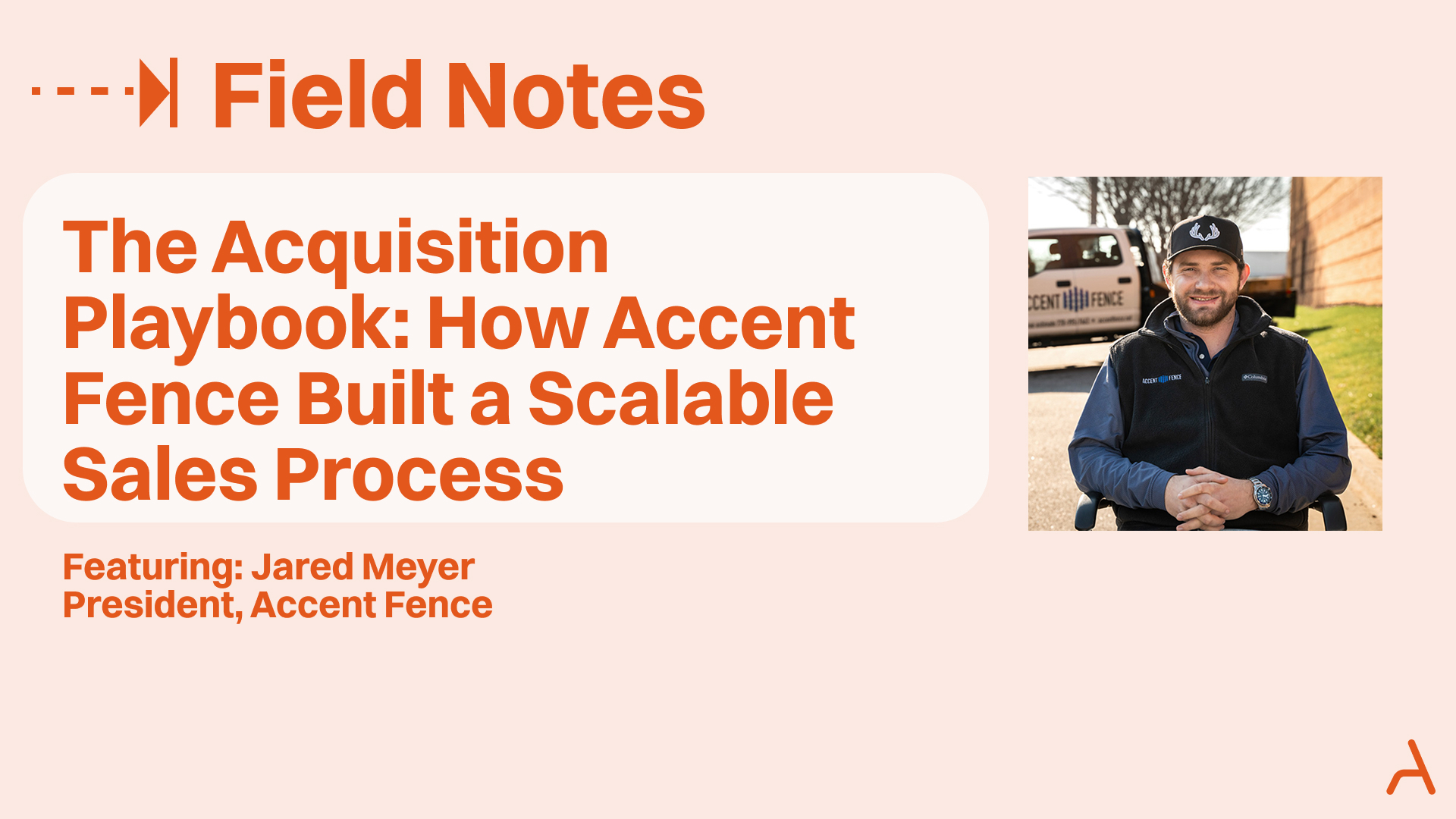
When you open a new location, how long before it closes deals the way your first one does?
Six months. A year. Sometimes never. Accent Fence does it the same day.
Jared Meyer built a multi-location fence contractor out of Atlanta without losing the thing that made his first location work. Not more salespeople. Not more overhead. A system tight enough to hand a brand-new rep on day one and get his best closer's numbers back.
In this episode of Field Notes, Jared breaks down the two numbers behind that growth: a new location fully operational the day it opens, and a 20% jump in average ticket from one specific change in how he presents a quote — an idea he borrowed, of all places, from a pest control invoice.
He also gets into why his reps stopped bringing their own iPads to the door, the built-in checks that make it nearly impossible to skip a step, and the three moves he says any contractor can make this week.
Watch the full conversation. See how "we're too busy to grow" became "we scale on demand."


The Acquisition Playbook
Field Notes — Episode 2
All right. Well hi everyone. Welcome to Field Notes. It's a series from ArcSite where we sit down with real pros doing real work and talk about solutions to their business challenges. I'm Nicole Kelly. Today's episode is called The Acquisition Playbook, and we're talking about how you grow a home services business without losing the thing that made it work in the first place. That's your process because the hard part of scaling isn't finding more work. It's making sure that the next location closes deals the same way that the first location does. We have someone who has figured this out at scale, and I'm really excited to bring out our guests. But before we do that. Here's what we're covering today. First, the Accent Fence model. Our guest has figured out a really great process to figure out how to scale and build their sales operation as they're they're expanding into different locations. Next, where payments and financing fit in. And what that did to their numbers. Then the operational setup behind all of it. So what you actually need in place. And then as you know we like to be really helpful here at ArcSite. So the three things that you can do this week to put these learnings into practice. Are you guys ready. I'm really excited. Let's get into it. But first, when you bring a new location
[01:30]
into your operation, how long before that first rep in the new location closes a job? The same way that you would now be honest if you know it's months. Well, that's exactly why we're here. If the answer is immediately, I would love to know how. and so would Everybody in this room, with the exception of maybe Jared. So DM me and we can get you on another episode of Field Notes. All right. Are you guys ready to get into it? Super excited. So we have here today. Jared. Jared I'm so excited to have you here. For folks who don't know you yet. Give us like, the 30-second version of who you are and what Accent Fence does. So we are a fence contractor. My name is Jared Meyer. I'm with Accent Fence. We're located in Atlanta, Georgia. Pretty much the long story short of it is we wanted to our operations wanted to speed up. We wanted to get bigger. We wanted to grow. We wanted to figure out how to make more sales because we're in that little tight between the business was in the tight between. You know, we're making good money. But if we had to do more to make more money, you know, we're overhead in the cash flow just seemed different. It wasn't in the right spot. So we we implemented ArcSite and this process and it's been wonderful so far so awesome. And just so people have context on what you've built. Accent Fence is a multi location fence operation. That's pretty incredible. But what makes your story so interesting
[03:00]
is that you're not just growing into different locations. You're deploying a standardized process as you stand up these new locations. And that's a really that's what we're going to talk about. But that's a really cool thing. So we're going to we're going to dive into it. And we want to establish like what that Accent Fence model looks like. So this is exciting to me I love this slide. This is pretty incredible. Two data points. Same day deployment of a new location's quoting process same day and a 20% lift in the average ticket that came from one specific change on how you close. I mean this these numbers come from building something that's completely systematic. It's not I mean, you're good at sales, Jared, but it's not just being good at sales. It's building something that's like a system. So before we talk about how awesome it is, take me back to the beginning. Like before you had a standardized process. What did the sales side of the business look like? Like when a rep went out on an estimate, like what happened? The sales side, I mean, go back six years ago, sales side was paper and pen and a bunch of guys running around all over Atlanta trying to, you know, close deals. And they'd have to come back to the office and then go back out. And it was just a long, lengthy process. And during Covid it worked. We did well. But post-COVID and with technology coming into play, and AI and everything else, we wanted to be above the game. We wanted to be ahead of the curve. And this allowed us to, you know, really standardize everything.
[04:30]
There's no mistakes from pricing. There's no issues. If we had stuff in stock, we knew what was in there and it was all it's all handled by the sales manager or someone else in the office to make sure that everything goes through and everyone gets notified. So we have all the systems and processes in place. It's a very repeatable process that has allowed us to scale with using financing and we're excited. Same day as onsite estimates. We most of our, I would say 99% of our quotes that are residential or on site estimates. They offer financing onsite through the proposal. I mean, it's just a great process and it's allowed us to win at a higher rate. That's awesome. And that decision to standardize was there. Was there any kind of like single moment or was it just the accumulation of, hey, this this process just doesn't work as we scale. The paper and pen process didn't work because there's too many mistakes, you know, people going on their phone doing calculations on, you know, how much materials they had or whatnot. It just didn't work. There's always a mistake. There's always pricing. The company has always taken a hit, and I was sick of it. If we have to put food on people's plates, we want to make sure they help put food on my plate and the family's plate. So we want to make sure we put more food back on their plate with, you know, more achievable processes and better, better ability to win. Because when they win, we win. Exactly, exactly. And so, you know, thinking about the fact that you're standing up a new location
[06:00]
and people are quoting and doing the process the same day, what does that actually mean in practice? So when a new location comes into your operation, like walk me through what that first day looks like. So I mean, it's really we just train them at our, our, the original location and then we just move them on from there. I mean, it's the same, same exact process from the warehouse and operations to the quoting. It's all the same. And that allows us to continue to standardize it because we're a subcontractor based model. So if we set the standard upfront and we continue to do the same thing, nothing changes. We're just doing residential and commercial work. And this allows us to be really fast and efficient, which allows us to keep driving, you know, profits and and revenue up. Yeah for sure. So now that we've got the foundation, let's talk about a piece that might be surprising for some of the people on the call here today. So let's talk about where payments fit in. So this slide really breaks down how payments show up in like four different places in your operations. So offer payments before offering the price. The bigger yes the higher close rates and proof to the investors. So do me a favor. Start walking me through a little bit for each one of these places, because I think this might be a little bit different for some of the people that are on the call. So this all came back to my idea. I've always had this in the back of my brain.
[07:30]
Right when I first bought my house five years ago, I had, you know, a pest control company come out and do you know the termite control? And they offered financing for 12 months. And they and they had it all in their proposal, all of it. And I was like, wow, this is awesome. I was like, how do I fit this into my business? Because they're a very, very, very, very large company. So I'm like, how do I do this? How do I get to be that right? Yeah, it's all in one place. It's all in one. One email, all in one text. It's all there. So when they go through and they present you with your product, you can they can be like, hey, it's 12 months, six months, eight months. It shows you that breaks down the pricing. You know, with your guys' partnership through Sunlight, it allows them to go right on top of it. They can see what their pricing is per month. So it's a $5,000 fence. It's 123 bucks a month for however many months or five years. But it allows them to know upfront, or they can pay it off early, or they can just pay it in cash or credit card. You're giving them the options, right? Yeah. In 2026, I found that customers aren't very they don't want to tell you their financial status or how they're doing. So they just want to be able to do it on their own. So we we propose it to them in their proposal, which we send off on site. And then we walk them through how they do everything, walk through how to make the payment, everything else. But it's on them to figure out if they're going to finance, pay cash, pay credit card, pay ACH, or finance it through Sunlight. And it's off of our plate. We don't see that. We just get them to the
[09:00]
to that point. And then they they're on their own and it allows that success at a way higher rate. And since we're doing it on site, the tickets are higher because we have we're able to do we're able to do some upcharging and allow some higher margins because we're that much more efficient. We're we're installing it quicker than everyone else in town. We're doing this a lot. The ability to do this has raised the efficiency by far for everyone. Awesome. And you, you mentioned offering like financing and payments before the price. Tell me a little bit about like what what that did for your sales process. When you put that on the table even before you gave them the price. So we found like a lot of people wanted financing and they didn't because they I mean, it's a large investment. It's not a it's not like a deck or like fence is not a deck. It's not a, you know, a bathroom remodel. It's it's a large non tangible investment. They don't sit on it. They just see it. Right. It's tangible but it's not. They're not going to go feel and touch and lay on their their fence. They're going to hold it anyway. I hope not. You know I don't know what happens nowadays but they they they want to feel like they got something for nothing. And that's just the way to say today's society is. So we found that offering financing and doing that up front has allowed them to be like, oh, okay, this is way more affordable. I can get way more, I can get a better product for a lot less, even though it's the same price
[10:30]
or a little bit more with financing charges. But that's on them, you know? And we found that the success rate has been so much higher. Yeah. And and you bring that up in the sales process like first home visit even before you gave them the price. And you know, I'm kind of interested. You mentioned that you were able to get a 20% lift in your ticket. When did you first notice that like what what changed the moment that you start leading with like a monthly payment instead of the total. Being able to do it on site? You know, if you look at a lot of the very, very large companies that are doing door to door sales, I mean, which is I mean, you got Vivint, you've got all these other you got whatever the other alarm companies are, and pest control companies and the roofing companies and all those guys, they're doing it all on site and that in there, but they're offering all these other things with it. Why didn't why can't we do that? Even though we're doing appointments, we can still do that with our with our product. And it's it's just allowed the success rate to go up because no one else is able to do that. No one else is doing that because it takes such a long time to lift from a for a business. So once you invest in it, take the six months to slow down, to take eight months to speed up. It's been incredible. That's awesome. And, you know, thinking about it from a homeowner perspective as a customer, you know that to me, being able to have all those different options would be great. But I'm thinking in my own personal experience, what is what do your customers say? Like when you present like, here's what, here's what it looks like
[12:00]
monthly versus here's the total. What kind of reactions do you get from your customers? The customers? The customers like it. They actually I would say 60 or 70% of them are looking for that. They just didn't know it. So they're like, oh, it's not a it's something more affordable. I don't have to drop five, ten, 15, 20 grand right now. I can drop 200 bucks, or I can drop $1,000 on a down payment and continue to monthly roll it over over the next 3 to 5 years or one year, however long they decide to do it, whatever, they get approved for it. And it's just been a lot more successful with how they how the interaction with the customer is. Yeah. And I can imagine in this economic environment having that choice and the ability to regulate your cash flow as a homeowner is really super helpful too. And so, you know, thinking about that for contractors in the room who haven't introduced financing yet, like what would you tell them? I would do it. The only stipulation I would say is have enough cash to be built up because you don't get paid until the job is done, right. So it's you got to do it quick. You got to do it efficient. You got to make sure you don't mess up because you don't get paid until the job's done and you do it right. So if you do it right and you show up on time and you have no issue, you shouldn't have any issues. You're getting paid within two days. And that's a pretty quick cash flow turnaround. If you can install a fence within a week, two weeks, you know, so it's just it's been a very, very great process so far. That's awesome. I'm really I'm really excited
[13:30]
to hear that we little plug for ArcSite. We do offer financing and payment options. And I know a lot of our contractors are a little hesitant because maybe they're worried about the cash flow issue, or they're worried that, you know, how is that going to work? So when you introduced the payments and financing piece, just give me a little bit of insight and let everybody in the room know, like what did that process look like? Was it easy? Was it difficult? It was it was a very easy process. It was it was a little bit for us internally to learn, but for the customers. Very easy. I mean, I've seen, I think the, the biggest close, the biggest sale on it for me was everything's in one spot. You sign your proposal in one spot, you pay in one spot. Everything's through ArcSite. There's not. I'm going from one program to another to another tech stack. It's all in one spot And it has allowed us to be more efficient. Again, efficiency is the key to the growth and being able to do it repeatable and not have that many extra steps that you have to track. It's all done. I can track it on my dashboard, how many sales I have that day, how many appointments I went on, what my what my win rate was, what my loss rate was. I can see when they signed it. I can see when they opened the proposal, when they signed it, when they did this, when they did that, It's just the success rate has been tremendous offering it all, all in one spot. That's the biggest thing. Yeah. And I'm sure as a business owner, having that visibility to the, the metrics and the stats
[15:00]
that you really need to be able to see to run your business effectively, having that in one location, that visibility is really critical for you. I can do it from anywhere in the world. Oh that's awesome. So it's all online. So it's it's all cloud based, which I know scares a lot of people. But we've really taken on to that. And you can track you know, I can track all my stats. I can do everything I want to do from the sales perspective through our CRM. We can also track all that. And we just we really we really dug in deep and embraced it. And if you don't embrace it, you're not going to get anywhere. But once you embrace it, you're going to see everything skyrocket, in my opinion. Yeah, it's obviously worked well for you. So, you know, there's a lot of really good information in here. And, you know, we've covered a lot of ground, but theory's only as good as what you put into practice. Right. So I want to share something with y'all. This is a really awesome quote from Jared that I think really is impactful. Getting the system right will enable us to scale operations, increase margin, hire more staff, and expand to new locations. That's a lot to pack in there. So Jared, walk me through this a little bit like expand on this quote a little bit, because I think it's really important for people to understand the benefits from putting in a system and getting it right. So in my eyes, systems and processes will drive businesses to the moon. So when you have the right, the right, it's also about the people.
[16:30]
There's no doubt the people make the system work. But when you have processes and policies and procedures and you can follow a step by step guideline on how to do everything you will, there's no issues of what we do when this happens or what we do when that happens is we do this. There's no questions asked. There's no there's no riddles to solve. It's just there. So we can you can go and start a new location, or you can go and sell a job. When you go through the script, you go through everything you're supposed to do. You know what your pricing is because it's already in there being managed by the sales manager or someone else in the office. It's allowed us to be like, we know we need to do this once the order comes in, when we know we need to order it, if we don't have it in stock and go forth and do great things, expanding new locations is the same thing, we train them, we do the same thing we did here. We move on to the next place and we continue to do that. It's just it's very it's very repeatable. Once you have that, this is the playbook and that's what we're going to do. Exactly. And and that's really the whole thing. Right. Because I mean everyone on this call can see what Accent Fence has built the models, the numbers, the the process. And so I guess maybe the next question that we should dive into is, what does it actually take to run a system like this? So let's talk about the operational prerequisites. So what does it What does it take to make this this process repeatable throughout multiple locations.
[18:00]
And so before you can do what you do what Jared, like before a new location can run the same day. By the way, I just love the fact that you can stand somebody up and like, have them run the same day, like what already has to be in place. Like, what does it mean to be ready to replicate? You have a little bit of training, but instead of being a six month takeoff or a two month takeoff, it's a two week takeoff. You show them the products, you get them familiar with it, You show them what you're doing, you have them do on site visits, but in two weeks you can get a sales rep operational and you can have a branch operational that quick. I mean, it's very, very simple because we're following that procedure. You have to know your pricing. You have to know your numbers. That is the biggest thing. I wouldn't jump into this if you didn't know your numbers. If you don't know how much a pig it costs, you know how much a roll of chain link costs. You might need to figure that out beforehand. But once you get all that stuff into ArcSite, it's very, very easy. It takes a while to get ArcSite up and running, but once you figure it out and get it on the ball, it's so easy. Then having to have Great customer success to help you on that process. And when you when you think about that standardized pricing, you know, and the ability for your sales rep to not have to guess, like what is how does that impact like your ability as an owner from like the profit margin perspective and a cash flow perspective? It just allows us to be more efficient, more. It's in quicker. We make decisions quicker. I know it's like I push and pull in my marketing every month
[19:30]
based off of two months lagging. Right? So I know I'm going to spend more this month or I'm gonna spend less this month, right? And that allows me to stay even throughout the year and continue the growth at a at a decent level. Right? I'm not going to push. I don't want 50% growth one month and then 30% less the next month. I want to continue it the same so and yet ebbs and flows of the business cycle. But when we can have it, we can adjust on the fly. Knowing how much we've sold this past month, how much we got in the pipeline for next month, how many leads we went on, how many, how many proposals are out there, How many have been viewed? it just allows us to be a little bit more effective in using data to make decisions instead of shooting from the hip. Right. And that's what we used to do. And it worked out, but sometimes it doesn't. We've made a lot of mistakes in our career, and the team really likes the ability to look at data. Hey, we sold X amount this past month. We want to sell X amount this month. Here's what we need to do. And we know it from past data. Yeah that's that's also helpful too to like continue to set expectations. And then you know you you mentioned like the proposal and the payment option in the same visit. You know so everything is is all given and presented to the customer in the same that same time period. And that kind of helps reduce the I don't know, let me think about it. And then they delay. So give me a little bit of insight into how that helps your reps feel confident when they go on site. So the reps go on an on-site estimate. We do onsite estimates
[21:00]
for everything after we pre-qualified them in the office before we set the appointment, but when the reps get on site, they measure, they flag it out. They do all the stuff they need to do. They put the brands out there, they all drive logo trucks, They all put logoed flags out. They all have logoed logoed apparel. You know, they all look presentable, right? So when you show up looking presentable and you have you walk the job, you measure out the job, you put it into ArcSite, you give them the 3 or 4 options that they want. It's in 30 minutes. You go measure the job. Within five minutes the proposal is done. You send it to them. We actually our process is we don't even go to the door with our iPads anymore. They actually go to the door and have the customer pull it up on their phone or their computer or their iPad. So it's on them to look at the proposal and they feel more comfortable. Hey, we're not pushing anything down your throat, but we just want you to see what we did and that they're like, oh, that's awesome. And it just allowed the process to be even that much more quick. Yeah, that is awesome. And that that kind of gives the customer, the homeowner like more ownership too, Which they feel a lot more comfortable. I felt they felt a lot more comfortable, if that makes sense. So they're on their phone. They're not on my iPad. They're on their phone. And it's. Right. Like you're giving them ownership of it. Yeah, yeah. And you know, thinking about this process you spent you spent some time developing and building this what what breaks this process. Like what have you tried that just didn't work? I mean, I've tried everything. A lot of stuff doesn't work.
[22:30]
It's really just keeping it simple. You know, the homeowner doesn't want headache. They don't want to go sign a contract on one thing and then get an email from another thing and sign it on that, and then pay through another process. They want to do it all in one spot. When you go online and you go buy something from, you know, let's say you go on Amazon, you click on what you want to buy, you add to your cart, you buy it. You know, it's very simple in the smooth process. And that's what today's day and age has in the in the economy and the, you know, culture has gone to. So why didn't we do that to begin with with with our fence sales. So now it's what we're doing. It's prove the growth. Yeah. And and we look professional doing it. Exactly, exactly. And you use ArcSite for your quoting for the standardization. Walk me through because you mentioned it took a little while to get up and running on ArcSite, but now you're up and running. So like walk me through what it looks like for a new rep. Like what do they have to do on their first estimate? On the first, it's the same as any other estimate. They measure the job they put in, all the information they need to. We have checks and balances in ArcSite throughout the way we built it. So they have they can't stop go. They can't collect $200 until they do that, collect that information, then they go to the next and then they go to the next. So it might take an extra five minutes. But then the internally the operations team has more more information and has all the information to do the job correctly. Exactly. And then for the financing piece, because I think that that's really important,
[24:00]
how do you train your reps to present it naturally? Because, you know, there's the version that will feel like a used car salesman, and then there's the version where you're trying to, like show that you're helping the customer. Like, how do you get to that second one? If we we really read the customer, you know, depending on what they want. You know, if it's a some certain through Sunlight, there's only certain levels that you can finance. So it has to be over a certain dollar amount. but once it's over that dollar amount and we know it before we even get to the door we push it. Hey just want you to look at this. It shows the monthly payment on the bottom of the proposal. Let's look at this first. Make sure that's what you want. We kind of get that gauge prior to. And then we we try to push it softly. We're not we don't we don't hard close anything. But we we've seen the uptick of, hey, all you got to do is click this link in, your proposal takes you there, you're going to pre-qualify two minutes. We'll get an email, make sure you're approved and you're good to go. And then all you just got to click is click and sign that. And we're good. And we'll get them on the calendar and ready to be installed. That's awesome. That's awesome. And I know that it's obviously worked really well for you. And it helps increase 20% in your ticket. So awesome. So this is also really good. And you had mentioned this before. Your sales process is only as good as your what your least experienced rep can execute. I think that that's really a testament to like how you can create a process that your least experienced rep can replicate.
[25:30]
I just I love this quote. And, you know, just walk me through a little bit like how you came to this. So I want everyone on the same playing. Field, if that makes sense. If my top sales guy can do it, my least experienced sales guy can do it. Now. They might know a little bit more knowledge, but if everything is in there for them to do on, I would say 90% of the quotes that they go on. Now, custom stuff is different that we have to quote out by vendors, but when they go, when they go on site, if they're doing a six foot privacy fence or a chain link fence or an aluminum fence, it's all there for them. They pick and choose. They know what needs to be there. They can't stop, go, can't collect $200 because of the process we have in ArcSite. And when they can do that effectively, it might take them an extra minute or two to build a proposal, but they're still on site, they're still able to close, and they're still able to do their job without asking 100 questions, because it asks them the questions for them and helps them figure out the answers as well. And has that helped in your hiring process as you've expanded? So we actually test them prior to we pretend that they're we're a homeowner and they're a sales rep. We give them the iPad, we're like, hey, try to figure this out. Draw the draw the fence out. You know, here's what I want you to do. We'll walk them through it. We'll train them a little bit. But I think with our using ArcSite, it's a very quick up, get up and running take off. I mean you can learn how to draw it in five minutes. And even if you don't know the products, it's still very easy to go back in
[27:00]
and draw a fence. You know, we can set them up for success from day one and then moving on. It's just so much easier. Yeah, I can imagine. And that's that's also the secret to your, your secret sauce to be able to get a new location up and running the exact same day. And so you've got, you've given us some really, really great information. And, you know, people who are listening to this are like, okay, that sounds great, but how do I make it actionable? There are three things that you can do this week to put it into practice. that kind of steal in Jared's playbook. The first is to map your current quote close to quote time. So how many hours from when that first visit to sign job? And Jared, you said if it's more than 24, you're losing deals while customers are still warm. Yeah. If they call on Monday and I'm not there on Tuesday, giving them a quote. You know, I feel like I lost a deal now. That's just my opinion. But it's working for us. We we try to run as many quotes a day as possible. It helps with the sales guys. And that's what they're they're they're there to sell. You know if they don't want to sell then that's on them. But we're there to make sure the customer gets a quote. we're there to install fence. That's our jobs. So I want to be on site within 24 hours or 48 hours at most. But when I can give them a quote on site instead of going to their house, giving them an estimate, not even getting an estimate to them, coming back to the office, running numbers and then sending it to them via an email that I chicken scratch
[28:30]
on a piece of napkin paper, like it doesn't look professional. So when we did, when we started doing that, so much easier, right? And the sales guys don't have to remember anything because all the information is in the proposal or in their, in their in the job packet. Right? Then once they're on the proposal, the customer sees it, they sign in, they can pay right then and there. It prompts them to do everything. And then it it automatically goes into our CRM that we use it use and pushes it all information off. So we don't have any paper on the front end of documents. It's already there. It's all implemented in a process. So it's very quick closing and then it notifies the front office to call the customer, do a welcome letter, push everything off and tell them what the next part of the process is. Yeah. So there's like some automation in there too. So you don't have to worry about some things falling through the cracks. Yeah, yeah. And then the next one that you had mentioned to help make this actionable add one payment option to your next estimate and then document the process like you're handing it off. So is there is there one of these three for anybody on the call that you're like, you should probably do this first., I would automatically add a credit card or ACH payment to your proposal today. I think it is. I mean, I've I've talked to a lot of contractors that are doing it and a lot of good friends. I call them friends. They're not colleagues, they're friends, that are doing this. And they're seeing success when everyone's still doing the old schools kind of thing.
[30:00]
And that ability to close, an ability to have it all one spot and you get notified is just it's crazy. It's crazy data to put in and it's great information to have, and it allows your success rate again to go up. Yeah. And and I'll do a little plug for Nate here at ArcSite. He's our rep that handles getting you set up with the payment and financing options. But tell me a little bit about your experience with like how you you worked with ArcSite to get that going. So I've been working with ArcSite and Nate and Patrick and Patrick Gorman and Patrick Caldwell for five years now. And I mean, from where you guys were to where you guys are now and where you guys are going, it's incredible. Nate's awesome. He's gotten me and him have worked hand in hand to get this process down pat. And it's shown, you guys continue to grow and grow and grow. Every month it's bigger and bigger and bigger because of this process, because we're still fine tuning it, because we're still working on being better and better every day. And it's it's working. I can't I can't explain my gratitude even more. Oh, well, we love hearing that. And we love seeing your success because we feel successful when our customers are successful. And so that's awesome. Thank you. So for those of you that are listening to this and you're like, I want to keep going. Like, how do I do that? Well, if you're not acquiring locations or you haven't standardized your existing team process, you know, you can
[31:30]
you can maybe check out we're going to send you it's a scalable sales process checklist in the next week or so. Take a look at that. See how you can implement that. You can always contact us here at ArcSite for a demo and understand like how does how can we build that repeatable process for your team. And if you want to get a little bit more in depth, Jared has a great customer success story on our website. Really great conversation. This is where I pulled some of the ideas from and asked Jared, like, hey, can you come back and talk to us? Because I think it's really important to hear how that repeatable sales playbook has worked. And so if you're watching this call and you're interested in learning more, take these next steps. And then, as usual, I want to give so many thanks to you who are listening and watching this. But really, thank you so much, Jared. You have really kind of illuminated a lot of actionable ways to be able to grow your business, make it systematic and make it sustainable. And any closing thoughts? Just try it. It's all about implementing the policies and procedures. If you can. Systemize. Everything, I mean, anyone can do it. If you break it down to to that every step. I mean there's never not an answer there. So it's a really achievable process. It just takes time.
[33:00]
Once you implement it, it's it's great success. That's awesome. Well, thank you so much for joining us today. If you have any questions, feel free to drop them in the chat. We probably don't have time right now to get to any of those, but we will definitely reach out with any answers, so drop them in the chat. We're really excited that you guys were here to join us, and I'm really excited that Jared was here. Jared, again, thank you so much and join us next month for another episode of Field Notes. Looking forward to seeing you then.