Watch instantly on-demand. Click the video to unlock the session.
The Parking Lot Playbook: Get Your Inspection Report Out the Same Day
Nicole Kelly
•
October 28, 2026
•
60 min
Access the webinar
Thank you! Your submission has been received!
Oops! Something went wrong while submitting the form.
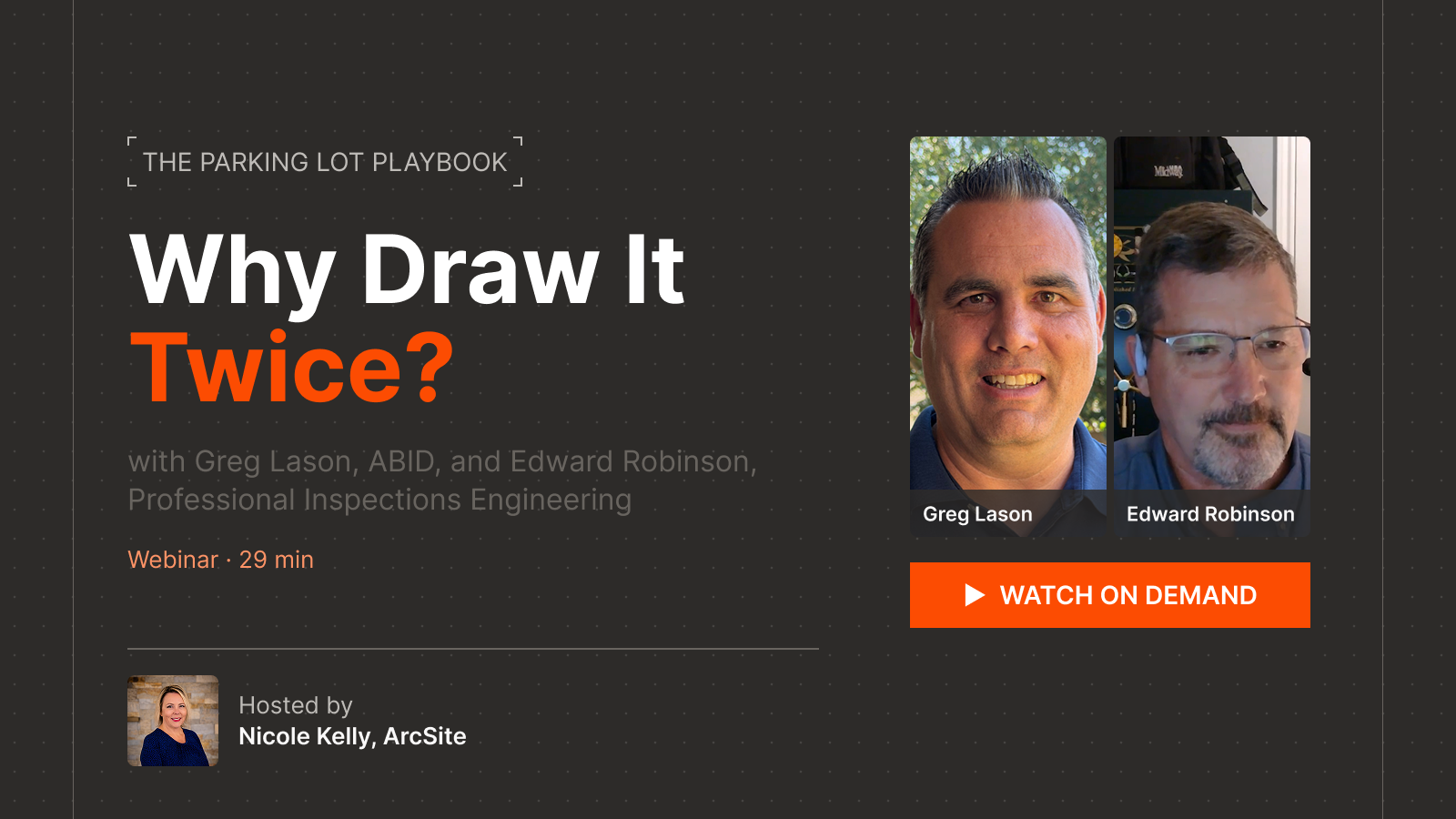
Your inspection takes a morning. For most inspectors and engineers, the report goes out three to five days later, after the redrawing and retyping back at the office.
Nicole Kelly sits down with Greg Lason (President, ABID and Higher Ground Engineering), Edward Robinson (Professional Inspections Engineering), and Alexann Watson (ArcSite) to talk about finishing the drawing before you leave the site. Greg cut his documentation time from 5 to 8 hours down to two. Ed went from losing money on elevation surveys to making money on them. ABID members also get 10% off ArcSite for the life of their subscription.
Watch the replay, then send your next report the same day you inspect.
Share


Parking Lot Playbook: ABID Webinar
Guests: Greg Lason, President, ABID (Association of Building Inspection and Design Engineers) and Higher Ground Engineering; Edward Robinson, Head, Professional Inspections Engineering; Alexann Watson, Partner Account Manager, ArcSite
Host: Nicole Kelly, Events and Partnerships Manager, ArcSite
Timestamps every 90 seconds
Nicole Kelly: [00:00] Welcome, everyone. Glad you're here. This is the Parking Lot Playbook, the webinar series from ArcSite, built for contractors on the go to learn how to more effectively use the tools and associations that may already be part of your workday. You can watch this from the parking lot of your favorite lunch or breakfast spot on your phone. Learn how to level up quickly and hit the ground running. Some quick housekeeping. We're recording this session, so if you have to jump to a job, you'll get the replay in your inbox. You can drop your questions in the Q&A panel on the right-hand side as we go. We'll get to as many as we can at the end. And if we don't get to them, we'll definitely reach out to answer your question directly. Ready? Let's get into it. Let me ask you a question. How long after the site visit does your report usually go out? Same day? 1 or 2 days? 3 to 5 days? A week or more? No judgment here. If it's 3 to 5 days or even a week or more, that's most of you. And that's not because the inspection takes that long. It's everything after If it's the same day, Love that. Stick around, because we're going to show you how to get there with a lot less redrawing. So think about it. A typical residential foundation evaluation the old way: Hand sketch. Dictated notes, readings on a paper grid. Photos dumped into a folder somewhere, the floor plan redrawn in CAD, or the document in Word that night. The report's out days later. [01:30] Now imagine a new way. Floor plan drawn or scanned on site, readings plotted on the drawing, photos pinned to where they were taken. The drawing exported straight into the report. So the difference is in how the work gets captured. But fast documentation only matters if it holds up and nobody thinks harder about what a solid inspection report looks like than the people here with me today. I want to introduce Greg Lason with ABID and Alexann Watson from ArcSite, and Edward Robinson from Professional Inspections Engineering. The three of you, please give an introduction to you, your company and what you do.
Greg Lason: Yeah. So I'm Greg Lason, I'm president of Higher Ground Engineering, also president of Association of Building Inspection Design Professionals, or ABID. I use ArcSite. I just started recently in the last six months or so, but I have found that I use it a lot in the field to get floor plans drawn, so that I can dump that directly into my design software. I do a lot of, redesign of existing structures. So it saves me a ton of time to go out and field-draw using my laser. I found that I can do that quicker than trying to do the scan, because a lot of the buildings [03:00] are tight spaces that I'm working in. So I'm going out drawing it on my iPad, and then using my, my laser to get my exact wall dimensions. Then I can place all the electrical fixtures, the door openings, the window openings, get elevation markers if I need to, all that in the field so that it talks directly into whether I'm using AutoCAD for the drawing or a lot of my stuff is in Revit. So I can take that and use that as a flat plane and then draw my 3D right over top of it. So it saves me hours and hours and hours and hours of of drawing time. And I'm able to send that directly to my drafters and they can draw straight over it. So I found that documentation has been, you know, what used to take me maybe 5 to 8 hours is now taking me two, so it saves me lots of time in the field. But that's how I've been using it, and I know others have been using it, you know, a little bit differently than me.
Nicole Kelly: And, and let's let's move over to you. Tell me a little bit about yourself and what you do.
Edward Robinson: I'm Edward Robinson. I own Professional Inspections Engineering. We are a mostly a residential inspection company. We do some light commercial. We do less design work than Greg does. We do use it for that sometimes if we do need to use a floor layout. But primary method that I use it is in doing foundation evaluations. [04:30] That's that's where I, that's where I brought the product into our workflow. And we use it to do a scale drawing of the house so that we can keep our elevations on it. And we heavily use the new, the new topographical tool that you've added to it to help our clients see what's going on with the foundation. Once we've taken those elevations and to assist us in and taking cut lines through the foundation to show deflection criteria. The, the as far as workflow goes, we used to do this by hand. So we did the same thing. Greg did, we use pen and paper. We would take notes on site, come back to the office, have to draw it in another piece of software. And that took that took maybe a three, four hour exercise and pushes it into about an hour, hour and a half now. That doesn't include some of the analysis time, but just getting the representation on paper or on, you know, captured. It's been a game changer for us. It's changed the amount of information we can put out. So we do value added now, and it provides a much better product for our clients to understand what's going on.
Nicole Kelly: That sounds great. And if you've seen any of our Parking Lot Playbooks before, you recognize Alexann. Alexann, give me a quick 30-second intro to you and what you do here at ArcSite.
Alexann Watson: Yeah. My name is Alexann Watson. I'm the partner account manager here at ArcSite. We have a wonderful partnership with ABID. ABID is exactly who we designed ArcSite for, which is engineers and inspectors who, you know, need [06:00] accurate field data without the hassle. At the end of the day, their membership is a really wonderful resource to network and connect for information on projects you may not have done before. So pairing that resource with, you know, ArcSite and the wonderful tool that it is, it's made a really wonderful partnership for us.
Nicole Kelly: Great. And Greg, I'd like to switch over to you just for a moment. So ABID, which underwent kind of a name change, right? As some of you may still know it as NABIE right now. So it brings together engineers, architects, inspectors, forensic consultants who kind of work at that intersection of like inspection, investigation and design. So give us a quick intro into ABID and why NABIE became ABID.
Greg Lason: Yeah, it's exactly that. We found that, when NABIE was originally founded, it was more, a bunch of professional engineers that were doing home inspection work. That's how it was founded. And over the years, most all of the firms do way more than home inspection work, and many of them don't do any home inspection work like I've never done a home inspection in my career. I'm not sure about Ed if he's done any or not, but you know, we don't just we don't do that anymore. So most all of our, member firms are doing either [07:30] larger scale building evaluation or forensic investigations or, like, design work. Once we do the building inspection, we're designing the actual repair and then overseeing those repairs. And so that really wasn't reflected in the name of the organization very well. And there was a lot of confusion among like, you know, corporate partners about what we did and who we were and stuff like that. So we decided as a, as a board to undertake the kind of the transformation at the beginning of this year. And with that, we've been able to attract more professionals that kind of do what we do. Example, I was at a wind damage project yesterday out here in Phoenix, and I met another engineering company that's nationwide that does. They were there to write the, scope of work for the repair for the insurance company. Well, they're engineers, they do what we do. So I actually invited them to our our, our conference that's coming up in February. Because, you know, that's the type of firm that we want involved in the organization. So a lot of what the rebrand was was just to kind of recenter what we're already doing and to be able to remarket in a better way. The firms that we have and who are trying to attract in.
Nicole Kelly: [09:00] That makes sense. And, you know, thinking about the the standards of practice and the education that ABID provides to their members to help them stay consistent. Tell me a little bit more about, like that piece. And particularly you probably have a lot of education coming up in your February conference.
Greg Lason: Yeah. Historically, we've had a conference each year, and I started in the organization because that's where I went to get my my professional development hours for my license. So I needed 30. Every year I would get at least 15 to 19 credits. So as long as I went every year, I was fine. You know, as far as my continuing ed. So I didn't have to go to other webinars or other conferences or whatever throughout the year. So it was a good time savings for me. While I was there, I started meeting some of the other engineers and developed really good friendships. And like Ed and I, we talk on a regular basis about just different project work. Hey, have you seen this? Have you seen that? What about this is our code thing for that. So we're developing this really professional network of peers that we can tap into. It's like, hey, you know, for example, I was doing a project for a client in Illinois. That with my professional engineering license, I couldn't stamp the set of drawings because it had to do with a stair structure. [10:30] I needed to have a structural engineer. Well, one of our firms, it has structural engineers on staff. So I referred my client to them. They're finishing up the project. So it allowed me to kind of get in, do the initial evaluation, write the report from my client, and then I had another partner firm take on the rest of it and finish it up. So we're trying to develop this kind of nationwide network of people, so that when we come to the conference and we get our continuing education credits, you know, we have a wide variety of different things. We're having a guy talk about welding analysis, which is something a lot of us look at but probably don't know enough about. Two, we're having a presentation on, a non it's a, it's a funny part of the code, but it's actually a straw house that's being built and they're designing it and, and codifying it as they go. So they're going to be talking about that process of getting those inspections done per code and how they're designing it. So there's a wide variety of things. And there's going to be some forensic analysis that's being done. We have a member that speaks up pretty much every conference that he's one of the leading forensic engineers in the country. And he's always telling us about different cases that he's done that have have been settled so that he can talk about them and stuff. But, [12:00] so there's a wide variety. We also have the president elect from National Society Professional Engineers that will be giving a state of the state. They are there every year as well as they do it. Ethics module. So we'll have an ethics CE that's required for a lot of states. But the cool thing about this year, which is something has not been done, is our last day of our conference is the first day of Engineers Week for 2027. So we're going to be kicking off Engineers Week at our conference with NSPE. We're starting to plan a ceremony for that, which is kind of a cool kind of kickoff type thing that just happened to coincide with the dates we picked. It wasn't something we purposely did. It just happened to be that way. So we're going to try and take advantage of it.
Edward Robinson: You know, you did that on purpose.
Greg Lason: No.
Edward Robinson: We also have really good fellowship at these conferences. So you get to rub elbows with a lot of engineers. What Greg was talking about. I've been able to make contacts where I could refer clients. We either within my area of work or across the United States to make sure they get taken care of. And we meet each other there. We share ideas and concepts. A lot of follow- up gets done on those. You know, there's there's good social hours. I think there's a there's a golf tournament this year that we're doing. So we try to lean into that part of it quite a bit because as the industry changes, [13:30] I know I've had to change my practice. We used to do a whole lot of home inspections, but we do a lot less of that now. We're doing a lot more forensic and legal work now. And it's drifting into some more design work, you know, kicking and screaming. So. Yeah.
Nicole Kelly: Well, thinking about, like, everyone that would be part of ABID, right? Like, the fundamentals are there. You have to to capture data on the site. You have to capture it consistently, quickly. And like when you think about what it looks like when you do it on site, Alexann, like, tell us a little bit about, you know, somebody who's in the professional engineering inspection space. Like, how would they use ArcSite to be able to do their job better?
Alexann Watson: Yeah, absolutely. So the the beauty of ArcSite for, you know, members of the inspectors, the engineers, is ArcSite lets you sketch the floor plan, plot your readings, and you can pin photos to where you took them and leave the sky. Excuse me, site with a scaled drawing that's, you know, ready for, you know, that report or whatever documentation you're going to provide? There's no redrawing back at the office. There's no, you know, running out of room on paper. You're able to get it done quickly and efficiently and most importantly, accurately as well.
Nicole Kelly: Well, yeah. And like, even if you're using an iPad, you can even use the LiDAR scanning capabilities on that iPad to, like, make that drawing really, really specific. And, with really, accurate measurements, you can also sketch it with auto dimensions. [15:00] But Alexann, also, you can plot the floor elevation readings directly under the drawing, too.
Alexann Watson: Right. You sure can. We have a really awesome topographical feature that'll show your client where exactly the changes and elevations are. You can map, you know, foundation cracks, settlement. Like I said, elevation changes. And Ed was making a wonderful point earlier. It helps people to understand what they're looking at. Right. Because most homeowners aren't foundation professionals. And so when you're able to show people, hey, there's actually a significant change in your elevation here with your foundation that's going to help them understand exactly what's going on. And like I always say, the better your customer understands, the more trust that they have in you because you're wanting to educate them fully on the project. Greg has a really wonderful story, and, Greg, feel free to go ahead and tell this about you got a request from someone when you were sick at home on your couch, and you were able to give them an answer to their question about, I think in addition to the house, while you were sick on the couch, do you want to you want to tell that story really quickly?
Nicole Kelly: Were those billable hours?
Greg Lason: Well, it was it was for a buddy of mine. So I did him a solid. But essentially one of the cool things that you can do in ArcSite is you can start a drawing with an aerial, a site aerial, just by typing in the address. So you type in the address and you get the, the aerial. And then you can draw right over top of it. And it is literally the scale. So what I do a lot of times when we have a client that wants to know, hey, [16:30] can we add on to this the back of this house, or do we have room to put a casita on our property? I'll go to the, the, aerial and I'll draw the perimeter, and then I'll cross-check that with our Maricopa County Assessor's website. And almost always it's it's it's right on. So if it's 147.2 when I draw my line, I'll draw it 147.22. Draw the box. And I can offset that in for our different setback requirements and show them that this is this is how much space you can actually get or not have, you know, so we can we can verify it very quickly whether that project is going to fly or not fly from a code perspective. And the other thing that that I've been able to do is there's been a couple commercial, tenant remodeling projects that I've been involved with. What I'm on site and I draw and it's a small area, so it's a small office or a small bathroom or something, but I'm able to redesign it with them right there on site, to show them. Okay, you know, if you do this office and move it here, this is how much space you're going to have or you're not going to have. Is this what you want to have and show them right in the space? You know, this is where that wall is going to go. And this is how much square footage you're able to get, because I can I can ping it right on the drawing. So it's very it allows you to do a lot of things very quickly to give the client real time data. [18:00] You know, and when we're talking about topography, you know, for that map and cracks in a foundation, you can show them very easy with the color map, you know, where your low spots are, where your high spots are. So it allows them to see it right there you before you even go back, analyze the report and send it to them. They have an idea of what you're going to be sending them and what the what the results really are.
Nicole Kelly: Yeah. And as Alexann said, that really helps build trust. And, Ed, I want to I want to touch on something. I heard you bought an iPad the same day you saw ArcSite demoed. Like, I, I'm curious what sold you?
Edward Robinson: Well, because I could see that it was going to cut down this, having to go back to the office and and and redraw what I had already drawn. I mean, that was huge. And that that's before we had the mapping capability where you could put the elevations on the drawing. We had to use your, your what do they call that? I can't remember the name of your tool, but but the text tool, you know, so I was just it just kind of blew me away at how quickly and accurately you could do these floor plans, you know? So on the way home, I'm a non user, so I stopped at a Verizon store and picked up a an LTE capable iPad. It also that's one of the things I like about the the using the iPad, everything I do gets pushed to the cloud continuously and I carry you know one is none, two is one. So I carry two iPads with me. And if if I drop one or it runs out of batteries, I go pick the other one up and I can download my my ArcSite off the cloud and keep working. So if I get a [19:30] call in the middle of the day and I'm at a doctor's office or something because, you know, everybody's patient, I can pull up the drawing and edit it if I need to and send it back to the office. So I really like the functionality of that.
Nicole Kelly: That's awesome. And and I want to touch on something to that really impacted your business. Like when you think about like the margin and like the costs, the price points, the, the surveys at a price point used to lose you money sometimes. And how has using ArcSite helped with your margins? And like the price point that that your company can offer to clients?
Edward Robinson: Yes, it used to be that we lost money in doing elevations because we couldn't really charge for all the time it took to redo the drawings and set up the elevations. Especially the the tool ArcSite has has made it. So we're making money with it now. I mean, we're not we're we're just a little more than breaking even on what we used to make on them, compared to our competitors. So we can it and it comes out with a much more professional looking report. It's, it's very slick looking. So I, I, I can't believe a lot more of my, my peers are not using it honestly. So at least locally, I mean, I don't rub elbows with everybody, but I and I am seeing several of the foundation companies are using your product here in Houston. I know at least one other engineering firm that's using it because I run across their reports from time to time. So it's getting more popular.
Nicole Kelly: Yeah, for sure. And I think that time savings, [21:00] but also the ability to look at how that impacts your bottom line, whether it's the time spent where you could be doing another inspection.
Edward Robinson: I don't have to hire somebody to do the work.
Nicole Kelly: Yeah, right. Exactly. So I guess the takeaway here is like, why draw the the site twice? Why input the data twice? You know, you just capture it once on site. You leave when the drawing is done. And you be able to, to get more time back in your day whether you want to. And. Your or. Or something. Something. Greg.
Edward Robinson: Yeah. Something Greg pushed into that that we also find is that I was doing a legal inspection where I had to draw a patio and there was an outdoor kitchen and, and, you know, as I was doing the drawing, I was able to catch other defects because the space out on the, you know, you just realized that, hey, this isn't going to fit, you know, the thing they wanted to do, the thing they were trying to accomplish, well, it's not going to fit. And it was a little easier to see as you were drawing it. I don't it just kind of works out that way sometimes. So having the drawing finished before you leave the site and having all your notes on it, you don't lose anything in translation. And a lot of times you're able to see I we find room sometimes when we're doing drawings with ArcSite that, you know, there's a space there. You didn't realize there was a cavity there, you know. So.
Greg Lason: And in fact, the scanning tool is really good for that because it it'll find sometimes when you're drawing something, you're starting an entry for you, for example, and maybe the study pushes out past it and you're like, well, how do I get [22:30] that measurement? You know, and the scanning tools are a lot better at it than I am. So
Edward Robinson: True. True.
Nicole Kelly: So if you're interested in learning more about ArcSite, you can go to our website and fill out the demo request form. We'd be happy to walk you through a personalized demo to show you how you get more time back in your day, while getting the reports into the hands of your clients faster. And great. Where should people go to learn more about joining ABID to attend the conference?
Greg Lason: Yeah, so you can go directly to our website, which is abid.pro, or abidpro.org, and there is a link that will pop up on your screen. You can't miss it to join for the conference as well as sponsorship opportunities. And then there's a resources page that has our link to our ArcSite partner page that you can go to to get more information about signing up for ArcSite.
Nicole Kelly: Right. And Alexann, is there is there anything that people should know about? Is there members of ABID and want to have ArcSite?
Alexann Watson: Absolutely. Yeah. All members of ABID actually get 10% off for the lifetime of their ArcSite subscription. So it's not just for the first year, it's for the entire time that you're using it, you're going to get 10% off. And that applies to both monthly and annual plans.
Greg Lason: Something I wanted to interject with, too, is that we've had a wonderful relationship with ArcSite as a as an organization, and even as an individual user, I have found that if I have something that, you know, I want to do, that you guys think you can make money with, you're more than willing to [24:00] listen to me and you, you solve my problems in real time. So I've really enjoyed the relationship. We did a. We have two.
Nicole Kelly: Well, we are getting close on time. I want to make sure that we have time for Q&A. If you haven't dropped your question into the panel on the right hand side of your screen, do it now. I'm going to take a look. And the first question is, Does ArcSite work offline, like in a crawl space or a basement with no signal?
Alexann Watson: Yes yes yes it does. Yes.
Nicole Kelly: And I think actually Ed and Greg know this from personal experience too, right?
Greg Lason: Yes, but Starlink is your friend, so.
Nicole Kelly: Let's take a look. Can I export to AutoCAD or drop this into my report? I'm assuming this means the drawing.
Greg Lason: Yes. And that's the thing I like about it is it's a 1 to 1 conversion straight into AutoCAD. You can do both the DWG and a DXF file. You can also export into PDF if you want to to send it through an email or whatever. So I transported back and forth all the time. And it it is perfect.
Edward Robinson: And I dropped I dropped mine into Word documents in a format. So yeah, I, I use all those formats too. But it also will drop into PNG and you can put it in anything you want.
Greg Lason: Yep.
Nicole Kelly: [25:30] Awesome. And let's see there's one more. Do I need to use any specific measuring tools. And I'm thinking, Alexann, this is a great time for us to say that we integrate with Moasure and Smart Level. Correct?
Alexann Watson: Yeah, that's absolutely correct. I, I was I was just about to clarify that. Yeah, we do integrate with Moasure and Smart Level. It is incredibly easy to use the integration. It's I am terrible with technology. I always call myself the world's worst millennial. And I had a very easy time downloading the apps, connecting them and just measuring right into ArcSite with both of them.
Greg Lason: Yeah, and then I use a Bosch laser that's Wi-Fi connected to it. So that's how I, I do all my drawing is through my laser. I use it.
Nicole Kelly: Like a Moasure?
Edward Robinson: Yeah, I do have a Moasure. I just haven't used it with ArcSite yet other than screwing around in my house. But it works.
Alexann Watson: We, We for more information on that, you can actually go to our integrations page and go to measurement tools, and it'll show you all the measurement tools that we integrate with, which go from Leica to Bosch to Moasure to Smart Level and what things as well.
Nicole Kelly: And I heard Greg uses the LiDAR in the iPad itself. So yeah, super. And one last question before we run out of time, is my data secure? I do expert witness work and I'll answer this question. Yes, ArcSite is SOC 2 compliant. [27:00] So definitely a definitely security built into ArcSite there. And then one final question. What does ABID offer for continuing education? PDHs?
Greg Lason: Yes. So all of our sessions at the conference will have PDHs available. I haven't got the final count yet, but we should be close to 15 hours I think, this year plus or minus a few. But, we, we try to get somewhere between 10 and 15 each, each conference of PDHs. And we're trying to do some we're trying to do some webinar PDHs like this. We haven't quite gotten that off the ground yet. That is something we're working hard to do. Become a member. Help us with it.
Edward Robinson: Yep.
Greg Lason: The other thing I will mention about the website, we are doing a field trip to the training center at Simpson Strong-Tie here in Chandler, Arizona. So that's where they make a lot of their decorative, fixtures or mechanical connectors. So we're gonna be seeing that in motion. We're doing it on a Friday so that the plant's actually working, as well as doing a training presentation in their training center.
Nicole Kelly: Wow. That sounds that sounds like a really great conference. Everybody should be attending.
Edward Robinson: They'll probably break stuff for us there. That's a great that's a great presentation. I've been to the one [28:30] in McKinney, Texas before. Yep.
Nicole Kelly: Well, Greg, Alexann, and thank you so much for being here and everyone else on the call. Thank you so much for spending part of your day with us. The recording will be coming to your inbox. And if you've got a question we didn't get to. Feel free to email us. Thanks again everybody and see you at the next Parking Lot Playbook from ArcSite.
Share
Share


Ask AI about ArcSite: