7 Mortar Calculation Mistakes That Blow Up Masonry Estimates


Mortar estimates go wrong in small ways - maybe one joint runs too big. Or one window never comes off the wall area. Another estimator still uses the bag count his first boss taught him twenty years ago.
Then the crew runs out of materials on day three. Somebody drives to the supply yard, the mason waits, and your margin starts evaporating.
We hear versions of this from hardscape and concrete contractors all the time. The math isn't hard, it's just that it's done on paper, back at the office, hours after the site visit and without the drawing handy to reference. The owner of a patio cover, deck, and hardscape company told us:
"I'm still taking the drawing, and then I'm having to still do pricing on paper."
-Owner, patio cover, deck, and hardscape company
Out of all the conversations we've had with our customers, there are seven mistakes that cause most mortar and hardscapes companies to lose their margin. But it doesn't have to be that way. Each one has a fix you can put in place before your next bid, so that you can focus on working on your business and not in your business.
Mortar, concrete, hardscape: which is which?
Let's start with the basics. All these things are similar to one another, but have distinct qualities. Mortar and concrete start with the same ingredient, Portland cement, and do different jobs.
Concrete mixes cement, water, sand, and gravel into a structural material. You pour it into forms for slabs, footings, and driveways, and you order it by the cubic yard.
Mortar mixes cement, lime, sand, and water, with no gravel. It bonds brick, block, and stone together. Your mason trowels it into joints instead of pouring it, and you buy it by the bag.
Grout is the third material, and people mix it up with mortar all the time on their estimates. The Concrete Masonry & Hardscapes Association (CMHA) defines grout as a cementitious mix that fills the cores or cavities in masonry (TEK 09-04A). Fine grout uses sand as its only aggregate. Coarse grout adds pea gravel. Grout goes in wetter than mortar or concrete because the block soaks up water. Mortar stays in the joints. Grout fills the cells.
Hardscape is the overall category, and it covers every non-living part of an outdoor project. Some hardscape work uses mortar, but a lot of it doesn't.
The bottom three rows are where concrete and hardscape work meet, and where estimates get messy. You pour the footing or slab, lay block on top, grout the cells, and finish with veneer, all in one job. Your concrete numbers live in one calculator and your mortar numbers in another. Grout often lands in neither, and it goes completely unaccounted for.
What a mortar miss costs you
Mortar is one of the cheapest lines on a masonry bid. Running out of it is one of the most expensive.
Come up short, and your mason stands around while someone makes a supply run. The schedule slides a day, overtime picks up, and either you're eating those costs or billing them back to a very unhappy homeowner.
Order too much and the extra bags sit in the trailer, soaking up humidity until they're no good. That's product you paid for and threw away. That's why it's so important to get it right the first time.
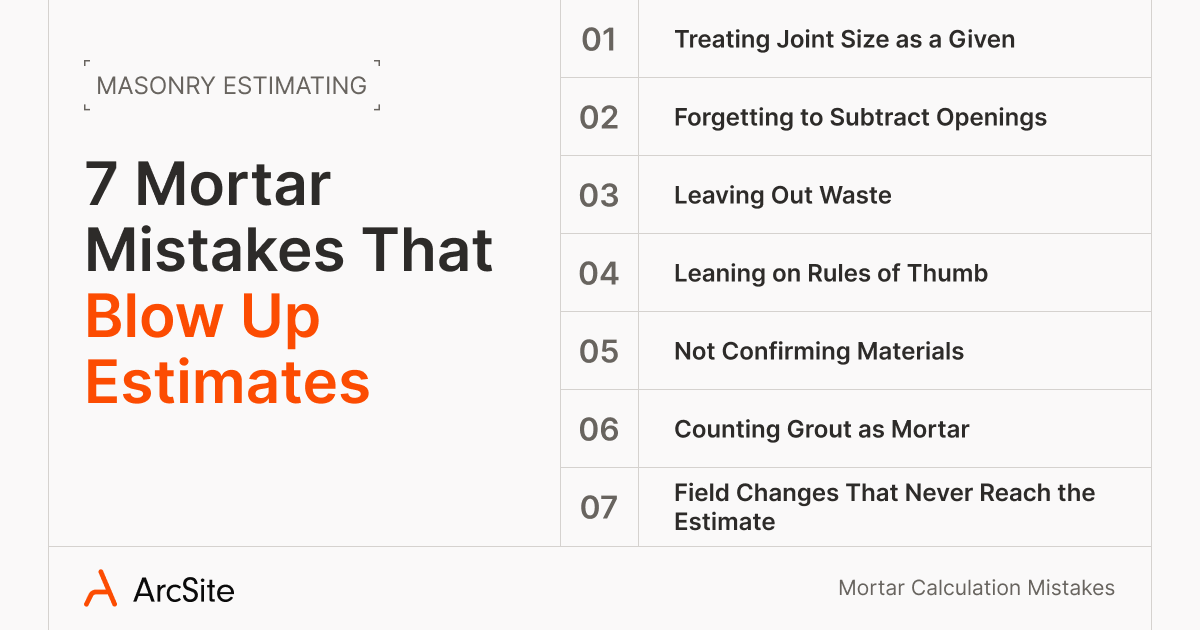
Mistake 1: Treating joint size as a given
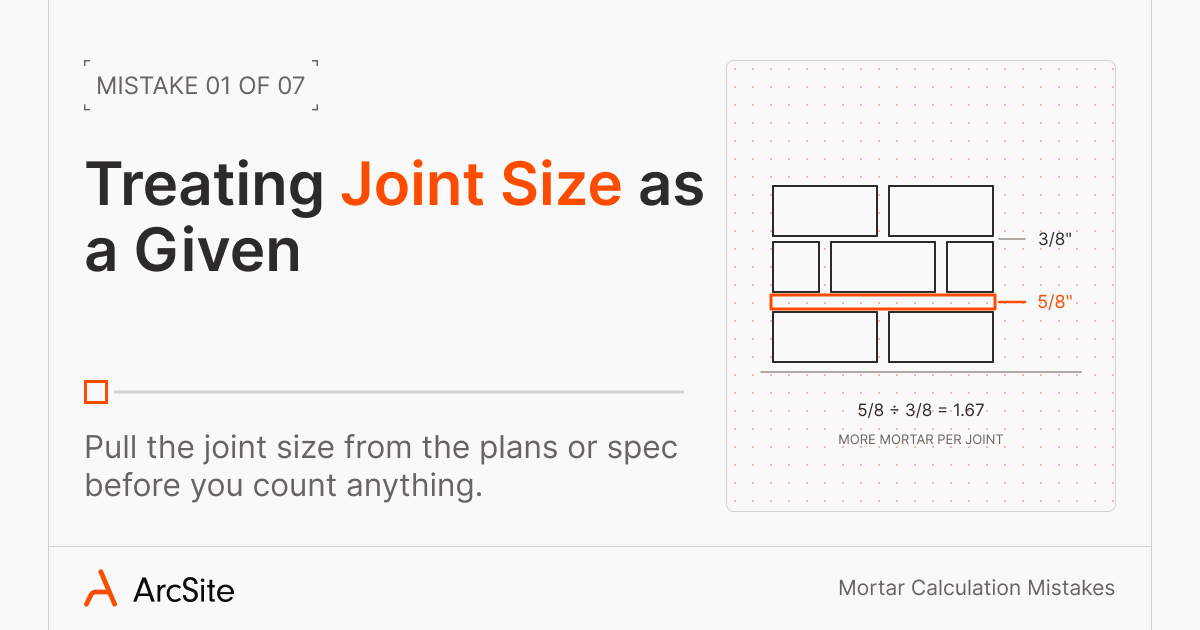
Joint thickness is one of the biggest drivers of mortar volume on the bid. Concrete block is built around a 3/8" joint: CMHA notes that a unit's actual dimensions run 3/8" less than its nominal 8x16 size, and the joint makes up the difference (TEK 05-12). A joint that opens up to 5/8" holds more mortar per joint.
Joints open up for a variety of reasons: natural stone isn't uniform, or footing runs out of level. A newer mason lays it heavier than your lead does. If your estimate assumed 3/8" everywhere, you'll find out mid-job.
How to fix it
- Pull the joint size from the plans or spec before you count anything
- Plan wider joints for natural stone and tumbled block than for modular brick
- Make joint width a question your estimator answers on site, instead of a number buried in a spreadsheet formula
Mistake 2: Forgetting to subtract openings (and overlaps)
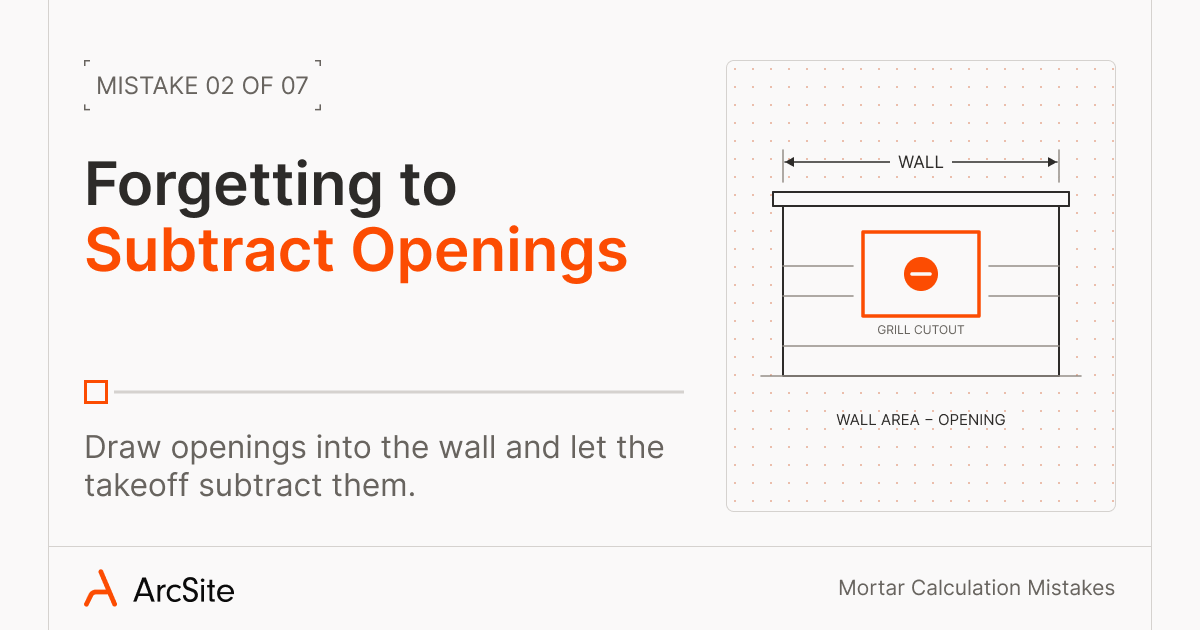
You measure the full wall, price the full wall, and forget the grill cutout in the outdoor kitchen. Or the gate opening in the seat wall. Or the firebox in the fireplace face. Each one is mortar you'll never use.
Openings change the block count in other ways, too. CMHA's estimating guide has you subtract door and window areas, then count corner, pilaster, and bond beam units on their own (TEK 04-02A).
Overlaps cause the same problem in reverse. When you draw one material on top of another instead of carving it out, your takeoff counts both.
How to fix it
- Measure openings on site and draw them into the wall
- Give each material its own area so nothing stacks on top of something else
- Let the takeoff subtract openings for you, not your memory at 9 p.m.
Mistake 3: Leaving out waste
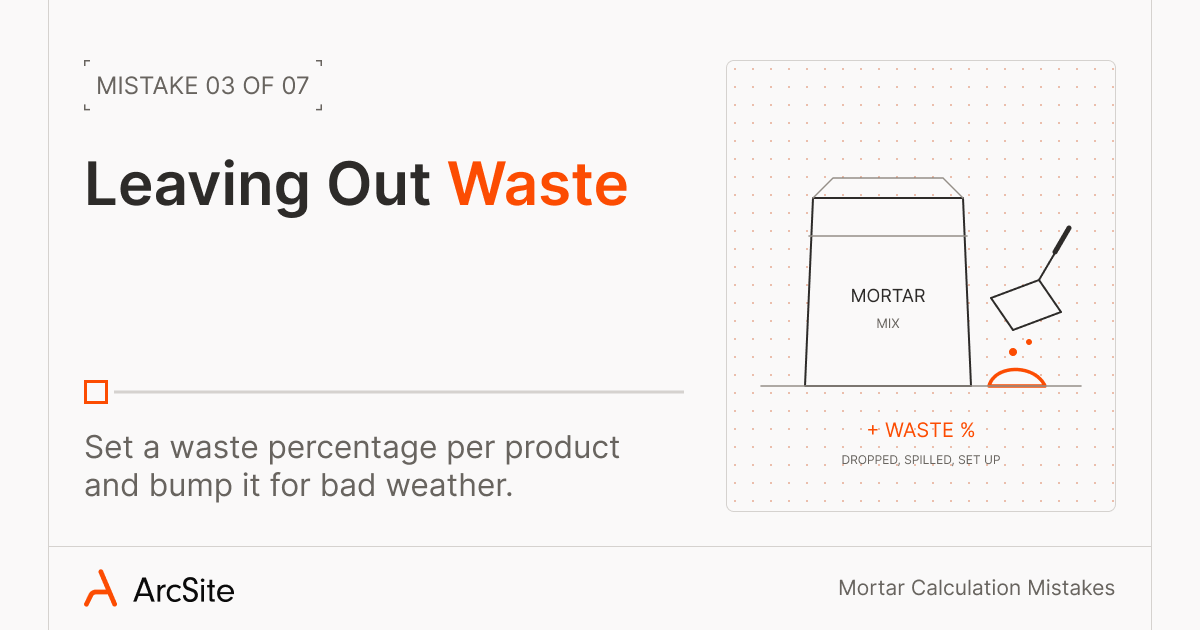
No crew uses every ounce. Mortar gets dropped off the board, mixed too early, or left to set up in the wheelbarrow on a hot afternoon. A textbook number with zero waste guarantees a short.
For the block itself, CMHA's estimating tables build in about 5% for waste and breakage and assume 3% waste on grout. CMHA also notes that small jobs tend to waste a larger share of grout (TEK 04-02A). Pick your own number for mortar, write it down, and use it on every bid.
How to fix it
- Set a waste percentage per product, since brick, block, and stone each waste differentl
- Bump it for hot, windy, or freezing days
- Check it against what your crews used on your last few jobs and adjust
Mistake 4: Leaning on "3 bags per 100 blocks"
You've heard some version of it: so many bags per hundred block. The trouble starts with the bag. CMHA's estimating guide says, "One 70 lb (31.8 kg) bag of masonry cement will generally lay approximately 30 hollow units if face shell bedding is used" (TEK 04-02A). The same guide's table puts an 80 lb bag of preblended mortar at 16 units. Same block, 30 units per bag versus 16. Use one bags-per-100 number for both, and your order is off already.
The Pros who get it right count from the wall itself. A contractor walking our team through his block takeoff described how his estimator does it:
"[He] wants to know the length of the wall and he's going to divide that by 16 inches because the block is 16 inches wide, then he knows the height and he divides that by eight inches because the block is eight inches tall. He's calculating the number of blocks that way not just by wall area."
- Contractor, block wall takeoffs
Then he added the step most estimates skip: "If I was really sophisticated, I'd have mortar." In other words, mortar belongs in the same calculation as the block, tied to the same length and height.
His math matches the industry number. CMHA counts each standard 8x16 block as 8/9 of a square foot of wall, or 119 units per 100 square feet once you add 5% for waste (TEK 04-02A).
How to fix it
- Count units from wall length and height, not a flat ratio
- Tie mortar to the unit count, so one moves when the other does
- Check whether you're buying masonry cement or premix before you trust any bags-per-100 number
Mistake 5: Not confirming materials before you finalize
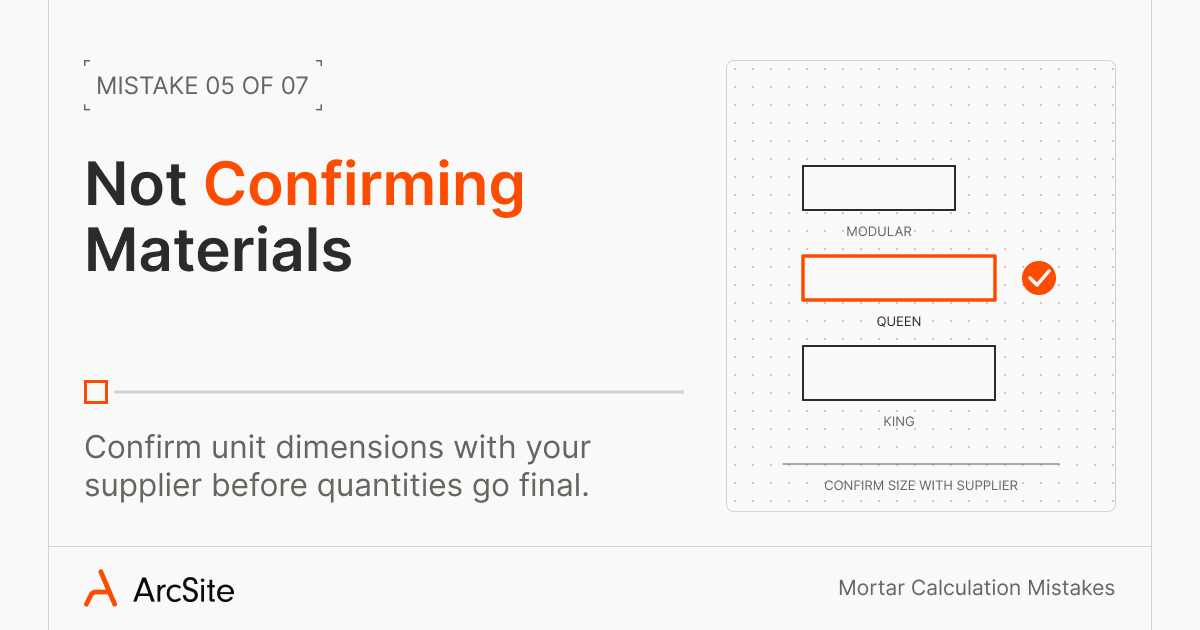
Brick and block sizes aren't universal. Modular, queen, and king brick lay up differently. An 8" block and a 12" block take different mortar per unit. Natural stone varies piece to piece.
Supplier mix makes it harder. One hardscape company we spoke with buys concrete pavers from one supplier, natural stone and travertine from a second, and porcelain from a third. Three suppliers means three sets of specs to check.
How to fix it
- Confirm unit dimensions with your supplier before quantities go final
- Load each size as its own product with its own price
- Put the supplier and SKU on the material list so the crew orders the right thing
Mistake 6: Counting Grout as Mortar
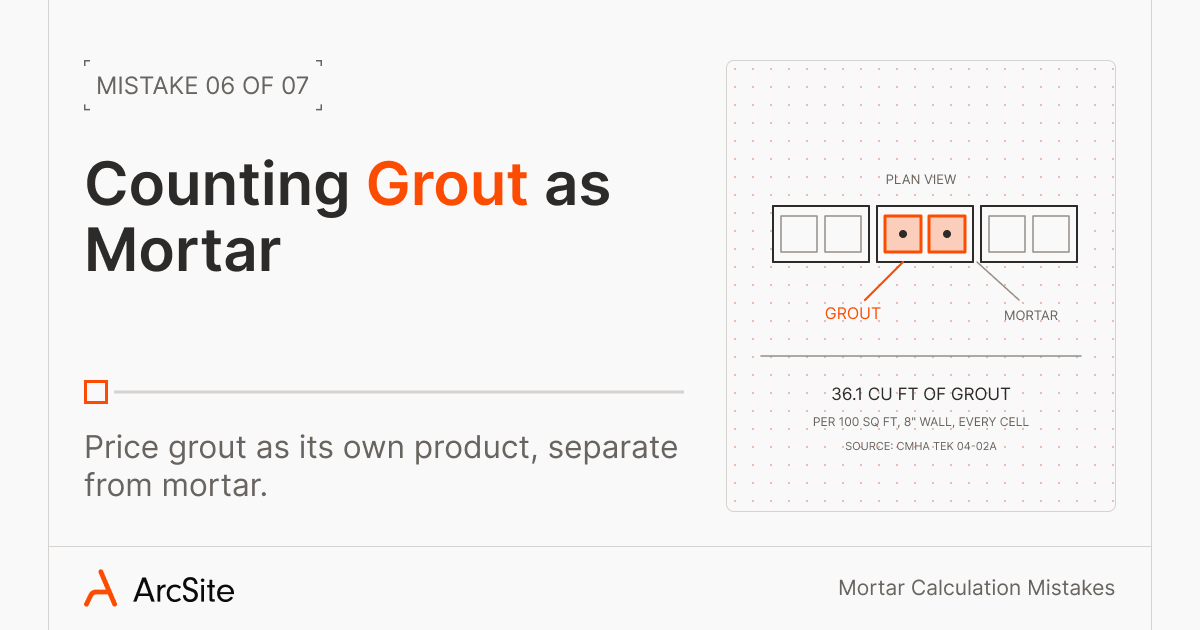
Block retaining walls, outdoor kitchen cores, and any wall with rebar need grout in the cells. Grout bonds the rebar to the block so the two work as one system, and solid grouting adds weight that helps a retaining wall resist overturning (TEK 09-04A). It's a different material from mortar, and it needs its own line on the order.
The volumes add up fast. CMHA's estimating tables put an 8-inch wall grouted at every cell at 36.1 cubic feet of grout per 100 square feet, or 1.34 cubic yards (TEK 04-02A). That's more than a cubic yard of grout for every 100 square feet of wall, and none of it shows up in a mortar count.
This is where concrete and hardscape crews cross paths. If your concrete crew pours the footing and your hardscape crew lays the block, somebody still has to own the grout line on the estimate.
How to fix it
- Price grout as its own product, separate from mortar
- Mark on the drawing which cells get grout: all of them, every other one, or bond beams only
- Check the spec for fine or coarse grout, since coarse grout adds pea gravel
Mistake 7: Field changes that never reach the estimate
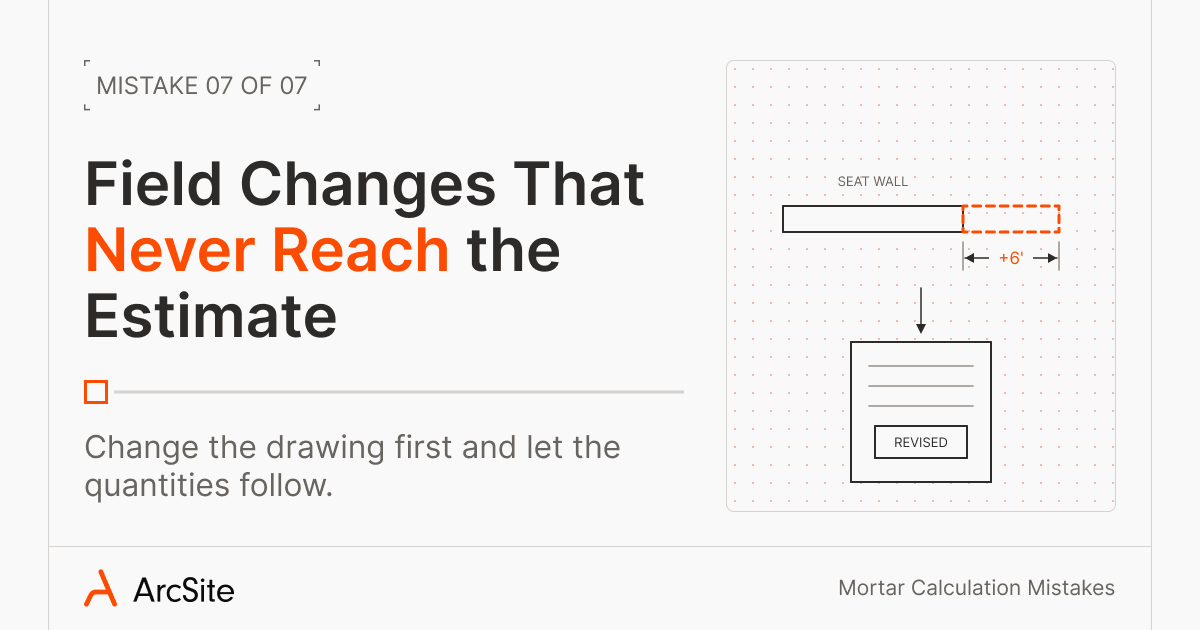
The homeowner walks out on day one and wants the seat wall six feet longer. Your foreman says yes, writes it on a notepad, and the office never hears about it. The mortar order, the invoice, and the margin all stay wrong.
Pros bring this up on almost every call.
"But as of right now, we're using a piece of paper for a change order."
- Concrete contractor
How to fix it
- Change the drawing first and let the quantities follow
- Send a revised estimate for signature before the crew builds the change
- Keep the original version so you can show the customer what changed
How ArcSite keeps the drawing and the numbers together
Every mistake above has the same root. The measurements live in one place, the math lives in another, and somebody has to carry numbers between them by hand. A contractor comparing tools put the ask in one line:
"I need my drawing to tell me this square footage."
- Hardscape contractor
ArcSite is field software that keeps the job going: drawings, material lists, proposals, and payments. For hardscape and concrete work, the job runs like this.
Draw it on site. Start from a blank grid, or pull up a satellite view of the address. ArcSite scales the map for you, so you can trace a driveway or patio and get its square footage before you leave the truck. Pros also scan with LiDAR or bring in measurements from Moasure.
Fill it with your products. You load your own products and your own pricing: block, brick, stone, pavers, mortar, grout, base gravel, caps. Draw a wall, give it a height, and ArcSite calculates what it takes to build it. Draw a patio, fill it with pavers, and you have the square footage, minus anything you carved out.
Answer the questions that change the math. Each product can carry its own questions. Which size? How thick? Gas, electric, or wood-burning fire pit? On concrete jobs, how many inches of void fill or lift? Your estimator answers on site, while the details are fresh.
Get two documents from one drawing. The material list (some Pros call it a takeoff or a crew sheet) shows quantities with no pricing, in the units you order by: pounds, bags, square feet, or cubic yards. The proposal shows the homeowner the drawing, the scope, and the price, ready to sign.
Keep the office in the loop. ArcSite saves each drawing and document to the cloud, so the office sees what the field sees as soon as you hit save. When the scope changes, you edit the drawing, the quantities update, and you send a revised estimate to sign. Change orders make this process even more seamless when the scope changes midway through the job.
See it in action: ArcSite for Hardscapes: Overview + Demo and ArcSite for Concrete: Overview + Demo.
Your mortar estimate checklist
Run through this before any masonry bid goes out:
- Confirm unit type and dimensions with your supplier
- Pull the joint size from the plans or spec
- Measure every wall on site: length, height, and openings
- Draw openings and overlaps out of the takeoff
- Count units from length and height, then tie mortar to that count
- Check whether you're pricing masonry cement and sand or premixed bags
- Price grout separately for any reinforced or grouted cells
- Add a waste percentage for the material and the weather
- Remind the crew: mix mortar with as much water as it takes to stay workable, retemper to replace water lost to evaporation, and toss any batch older than 2½ hours (Brick Industry Association, Portland Cement Association, Mason Contractors Association of America)
- Update the drawing and the estimate when the scope changes, and get a signature
Get it right on site
Mortar won't win you a job. Running out of it can cost you the next one. The Pros who get it right do the math where the measurements happen, while the homeowner is still standing there.
From the first line to the last dollar, ArcSite puts time back in your day. See how hardscape and concrete Pros use it, and quote your next wall before you're back in the truck.
Sources
- Concrete Masonry & Hardscapes Association, TEK 05-12: Modular Layout of Concrete Masonry
- Concrete Masonry & Hardscapes Association, TEK 04-02A: Estimating Concrete Masonry Materials
- Concrete Masonry & Hardscapes Association, TEK 09-04A: Grout for Concrete Masonry
- Brick Industry Association, Technical Note 8: Mortars for Brickwork
- Portland Cement Association, Retempering
- Mason Contractors Association of America, Retempering Mortar
Categories
FAQs
Related posts